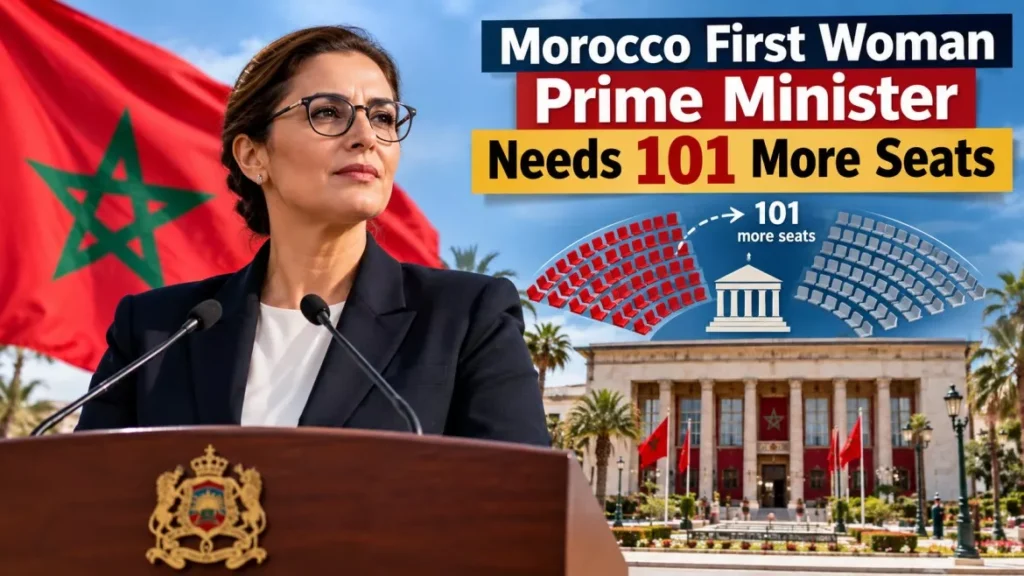

King Mohammed VI appointed a new head of government for Morocco on 29 September 2026, six days after the country’s parliamentary election. The Authenticity and Modernity Party won 97 of the 395 seats in the House of Representatives. Morocco first woman prime minister Fatima Ezzahra El Mansouri needs 101 more seats to be confirmed.
What the 23 September Election Delivered
No party came close to governing alone, and the outgoing senior partner was the biggest loser. The Authenticity and Modernity Party, known by its French initials PAM, finished first without reaching a third of the chamber.
| Party | Seats | Note |
|---|---|---|
| Authenticity and Modernity Party (PAM) | 97 | Finished first; El Mansouri’s party |
| National Rally of Independents (RNI) | 66 | Down from 102; led the outgoing government |
| Istiqlal Party (PI) | 65 | Was in the outgoing coalition |
| Justice and Development Party (PJD) | 54 | Up from 13 |
| Popular Movement | 29 | |
| Socialist Union of Popular Forces (USFP) | 26 |
Turnout was the other headline figure. About 38% of roughly 15.8 million registered voters cast a ballot, down from 50.86% in the 2021 election, according to the count reported by Atalayar and other outlets covering the provisional results.
The 101-Seat Gap She Has to Close
Investiture requires 198 votes in the 395-seat chamber, so PAM’s 97 seats leave El Mansouri 101 short. She cannot govern on her party’s result alone, and the arithmetic dictates at least two partners.
Two of the three parties that could supply those numbers were in the government she is replacing. A combination of PAM, the RNI and Istiqlal would reach 228 seats, which analysts at Atalayar describe as the most likely outcome, though no coalition agreement has been announced. That would invert the outgoing arrangement, with the RNI dropping from lead party to junior partner.
The Justice and Development Party, the Islamist party that quadrupled its seats to 54, has said it will not take part in a coalition. The left-wing parties are also positioned in opposition. Nothing about the composition of the government is settled.
What “Head of Government” Means in Morocco
The office El Mansouri has been given is not the same as a prime ministership in a parliamentary republic, and the difference matters for what she can actually do. Morocco’s 2011 constitution calls the post Head of Government, and the appointment was made under Article 47.
That article requires the King to appoint the Head of Government from the party that finished first in the election. It also provides that the King appoints the ministers on the Head of Government’s proposal, and that he may end a minister’s functions on his own initiative after consulting the Head of Government.
In practice the monarch retains executive authority alongside the government, and the sovereign’s prerogatives over defence, religion and foreign policy are not exercised through the Head of Government. The statement announcing the appointment came from the Ministry of the Royal Household and expressly invoked Article 47.
El Mansouri is also widely described in coverage as Morocco’s first woman prime minister, which is the familiar English rendering rather than the constitutional title. Her name appears in English variously as Fatima Ezzahra El Mansouri and Fatima-Zahra Mansouri.
What Happens Next, and When
As of 1 October 2026, Morocco has a designated head of government and no cabinet. The immediate sequence is procedural rather than electoral:
- Coalition negotiations: El Mansouri leads talks with other parties to assemble a majority.
- Cabinet submission: she proposes a list of ministers, which the King appoints under Article 47.
- Parliament convenes: the chamber is due to open on 9 October 2026 with an address by the King, according to Atalayar’s account of the timetable.
- Investiture vote: the government presents its programme and must win the confidence of the House of Representatives.
No public deadline for forming a government has been reported. Until the investiture vote passes, the outgoing administration continues in a caretaker capacity.
Who Fatima Ezzahra El Mansouri Is
She is a 50-year-old lawyer who has held elected and ministerial office for most of two decades. Born in Marrakesh in 1976, she studied law and holds qualifications from the University of Montpellier and New York University, according to Al Jazeera’s account of her background.
She became mayor of Marrakesh in 2009, the first woman to run a major Moroccan city, and served as Minister of National Spatial Planning, Urban Development, Housing and Urban Policy from October 2021 in the government she is now replacing. She led PAM’s election campaign.
“For the first time in our country’s history, a woman is taking on the responsibility of leading the government,” she said after the appointment. Al Jazeera reported that she becomes the third woman to lead a government in the Arab world.
What Is Agreed and What Is Contested
The result itself is not in dispute. The seat totals, El Mansouri’s appointment and the date of the election are common to every account, and no party has challenged the overall outcome.
Two things are contested or unresolved. Atalayar reported allegations of campaign irregularities, including AI-generated fake videos and claims of ballot tampering; those are allegations rather than established findings, and no official determination on them has been reported. The interpretation of the turnout figure is also disputed, with the government’s critics reading 38% as a verdict on the political system and its supporters treating it as continuity from a long-term decline.
The political backdrop is not contested. Protests organised under the Gen Z 212 banner ran from 27 September to 18 October 2025, demanding better public health care and education and criticising spending on international sporting events. Youth unemployment has been reported at about 36%. Aziz Akhannouch, the outgoing head of government, had pledged not to seek a third term and stepped down as RNI leader, with Mohamed Chaouki elected to replace him on 7 February 2026.
The coalition problem is a familiar one this year. Sweden faced a comparable wait after its own vote, as our report on the Swedish election results set out.
Frequently Asked Questions
Who Is Morocco’s First Woman Prime Minister?
Fatima Ezzahra El Mansouri, a 50-year-old lawyer, former mayor of Marrakesh and housing minister in the outgoing government. King Mohammed VI appointed her on 29 September 2026.
Does She Have a Majority in Parliament?
No. Her Authenticity and Modernity Party won 97 of 395 seats in the 23 September 2026 election. Investiture requires 198 votes, so she needs at least 101 more from coalition partners.
Who Appoints Morocco’s Government?
Under Article 47 of Morocco’s 2011 constitution, the King appoints the Head of Government from the party that came first in the election, and appoints ministers on that person’s proposal. The King retains executive authority alongside the government.
What Was the Turnout in Morocco’s 2026 Election?
About 38% of roughly 15.8 million registered voters, down from 50.86% in 2021, on the provisional figures reported at the time of the count.
When Will Morocco Have a New Government?
No date has been set. Parliament is due to convene on 9 October 2026, after which the government must present its programme and win an investiture vote. The outgoing administration continues until then.