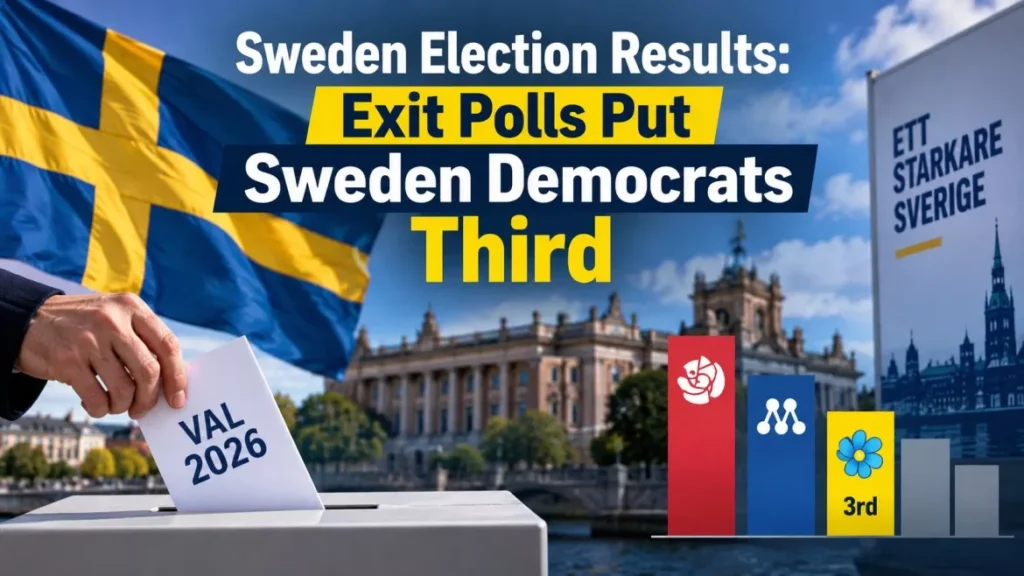

Sweden election results are not settled: both election-night exit polls put the centre-left bloc ahead on 51.3% when voting closed on Sunday 13 September 2026. Both put the Sweden Democrats on 17.2%, down 3.3 points and into third place. The official count is not final until the weekend of 19 September.
What the Two Exit Polls Found
Two exit polls were published when polling stations closed at 20:00 local time. SVT, the Swedish public broadcaster, runs Valu, based on interviews with 13,709 voters outside polling stations. TV4 published a separate poll by Novus. They agreed closely.
| Bloc | SVT Valu | TV4/Novus |
|---|---|---|
| Centre-left (S, V, C, MP) | 51.3% | 51.3% |
| Centre-right (M, SD, KD, L) | 46.8% | 47.0% |
SVT’s party-level figures, with the change against the 2022 general election, were as follows.
| Party | SVT exit poll | Change on 2022 |
|---|---|---|
| Social Democrats (S) | 28.4% | −1.9 |
| Moderate Party (M) | 18.1% | −1.0 |
| Sweden Democrats (SD) | 17.2% | −3.3 |
| Left Party (V) | 8.0% | +1.3 |
| Centre Party (C) | 7.5% | +0.8 |
| Green Party (MP) | 7.4% | +2.4 |
| Liberals (L) | 5.4% | +0.8 |
SVT projected 183 seats for the centre-left bloc against 166 for the centre-right. The Riksdag has 349 seats and 175 are needed for a majority. An exit poll is a survey of voters, not a count of ballots, and its published figures carry a margin of error that its authors do not treat as a result.
Why the Running Count Looks Tighter Than the Exit Poll
The preliminary count and the exit polls do not currently agree, and the gap is large enough to matter.
With 13.9% of Sweden’s 6,626 electoral districts reported at 21:46 CEST on 13 September, the Social Democrats stood at 27.12%, the Moderates at 19.19% and the Sweden Democrats at 18.47%. On those figures the four centre-right parties were on roughly 49.5% and the four centre-left parties on roughly 48.9%, a gap of about half a point rather than the four and a half points the exit polls showed.
Early districts are not a random sample. Small rural districts report first because they have fewer ballots to count, and Swedish cities, where the left polls more strongly, report later. Neither figure should be read as the outcome while the count is at this stage.
When Sweden Election Results Become Official
The count runs on a fixed schedule set by Valmyndigheten, the Swedish Election Authority.
- Sunday 13 September, from about 21:00: preliminary results published from voting locations and updated as districts report.
- Monday 14 September: the county administrative boards begin the final, official count. Every ballot is counted a second time.
- Wednesday 16 September: the count known in Swedish as onsdagsräkningen, when late advance votes and ballots cast abroad are processed into the totals.
- Weekend of 19–20 September: the authority states that final results of the 2026 elections to the Riksdag are “expected to be finalised during the weekend after election day”.
The late and overseas ballots are not a rounding error this year. A record 3.6 million people voted early, more than 45% of the roughly 8.05 million registered voters, so a larger than usual share of the total sits outside the election-night count. Readers wanting the numbers rather than a summary can follow the authority’s own results pages on val.se.
The Sweden Democrats’ First Setback Since 2010
If the exit poll figure holds, it is the first time the Sweden Democrats have lost ground at a general election since entering the Riksdag in 2010. The party took 20.5% in 2022, when it finished second and became the largest party on the right.
At 17.2% it would fall behind the Moderate Party and into third place overall. That matters beyond the arithmetic: since 2022 the party has supported a Moderate-led minority government from outside the cabinet under the Tidö agreement, and its leader Jimmie Åkesson had pressed for ministerial posts in the next term. A third-place finish weakens that claim, whichever bloc forms a government.
This is a projection from exit polling, not a counted result. The running count had the party higher, at 18.47%, on the districts reported so far.
What Happens Before Sweden Has a Government
An election result does not by itself produce a Swedish government. The Riksdag elects a prime minister on a rule known as negative parliamentarism.
The Speaker of the Riksdag, the talman, holds talks with party leaders and then nominates a candidate for prime minister. The chamber votes, and the nominee is confirmed unless an absolute majority — 175 of the 349 members — votes against. Abstention therefore counts as tolerance rather than opposition, which is how minority governments are formed in Sweden. The Speaker may put forward up to four nominations; if all four fail, an extraordinary election follows.
Neither bloc has claimed a majority on counted votes, and no party leader has conceded. Nothing about the composition of the next government is decided by the exit polls.
What Is Agreed, What Is Claimed and What Is Unverified
- Agreed: Sweden voted on 13 September 2026 for all 349 Riksdag seats; polls closed at 20:00 local time; the count is under way; 3.6 million people voted early.
- Published by named pollsters: the 51.3% centre-left figure and the 17.2% Sweden Democrat figure come from SVT’s Valu and TV4’s Novus poll, not from counted ballots.
- Provisional: the district-level count of 13.9% at 21:46 CEST, which is not a representative sample of the country.
- Not established: the final vote shares, the seat distribution, which bloc will govern, and who will be prime minister.
- Not claimed by anyone: at the time of writing no party leader had declared victory or conceded on the basis of counted votes.
Sweden Election Results FAQ
Who Won the Swedish Election?
No winner has been declared. Exit polls from SVT and TV4 put the centre-left bloc ahead on 51.3%, but the count was at 13.9% of districts as of 21:46 CEST on 13 September 2026 and showed a much narrower gap.
When Will the Final Result Be Announced?
The Swedish Election Authority says final results are expected during the weekend after election day, meaning 19 to 20 September 2026. Late and overseas ballots are processed on Wednesday 16 September.
How Did the Sweden Democrats Do?
Exit polls put them on 17.2%, down 3.3 points from 20.5% in 2022 and third behind the Moderates. That would be their first decline at a general election since entering parliament in 2010. The partial count had them higher, at 18.47%.
How Many Seats Are Needed for a Majority?
175 of the 349 seats in the Riksdag. Under negative parliamentarism a prime ministerial nominee is confirmed unless 175 members vote against, so a government can take office without holding a majority.
Could the Sweden Democrats Still Enter Government?
It depends on the final count and on talks led by the Speaker of the Riksdag, neither of which has concluded. The party supported the outgoing government from outside the cabinet after 2022 and had sought ministerial posts this time.