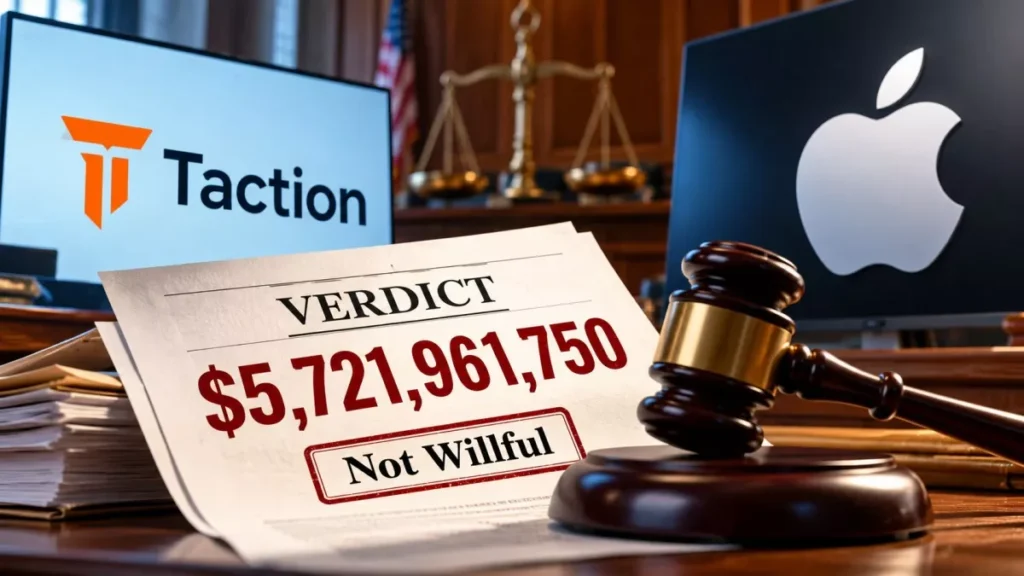

A federal jury in San Diego set the Apple patent verdict at $5,721,961,750 on Friday 25 September 2026. Jurors found Apple’s Taptic Engine infringes two haptics patents owned by Taction Technology. It is the largest patent award in United States history; the jury found no willfulness, and Apple said it will appeal.
What the Apple Patent Verdict Decided
The jury found that Apple’s Taptic Engine infringes claims of two patents owned by Taction Technology, a San Diego company that makes haptic transducers for headphones and gaming headsets. The Taptic Engine is the small vibration unit inside iPhone and Apple Watch models that produces the taps, clicks and buzzes a user feels.
The case is Taction Technology, Inc. v. Apple Inc., No. 3:21-cv-00812, in the United States District Court for the Southern District of California, before Judge Todd W. Robinson. Trial began on 14 September 2026. After two days of deliberation, seven jurors returned the verdict at 1:15 p.m. Pacific time on Friday 25 September, Bloomberg Law reported, putting damages at $5,721,961,750.
| Item | Jury finding |
|---|---|
| US Patent No. 10,659,885 | Infringed |
| US Patent No. 10,820,117 | Infringed |
| Willful infringement | Not willful |
| Damages | $5,721,961,750 |
Both patents cover tactile transducers that produce bass-frequency vibrations meant to be perceived by touch. A transducer, in this context, is the component that converts an electrical signal into physical movement.
Why the Willfulness Answer Matters
The single word “not” in front of “willful” removes Apple’s largest remaining exposure. Under United States patent law, a court may increase a damages award by up to three times the amount found by the jury where infringement is willful. Because the jury declined to find willfulness, that multiplier is off the table.
Had the jury gone the other way, the same verdict could in principle have supported a figure above $17 billion. The finding also weakens any argument for the enhanced remedies that usually accompany deliberate copying.
How a Dismissed Case Reached a Jury Five Years Later
This verdict came from a case Apple had already won once. The sequence matters, because it explains why a 2021 complaint was only tried in 2026.
- 2021: Taction sued Apple in the Southern District of California, alleging the Taptic Engine used its patented transducer design without a licence.
- 2023: Judge Robinson granted Apple summary judgment of non-infringement, ending the case before any jury heard it.
- August 2025: The United States Court of Appeals for the Federal Circuit, the appeals court that hears all patent appeals from federal district courts, reversed. In an opinion by Chief Judge Kimberly Moore, the panel held the district court had abused its discretion in striking parts of Taction’s expert testimony and had erred in interpreting the patent claims.
- 14 September 2026: Trial opened in San Diego on remand.
- 25 September 2026: The jury returned its verdict.
Taction’s lead trial counsel, Lance Yang, said after the verdict: “We’re happy the jury found for Taction and vindicated its patent rights. Taction waited five and a half years for this case to get to trial, so it was a long time coming.”
What Has to Happen Before Apple Pays Anything
A jury verdict is not a cheque. As of Sunday 27 September 2026, the award exists as a verdict in a United States district court, no final judgment has been reported, and Apple has said it will appeal.
Apple said in a statement: “While we thank the jury for their consideration, we strongly disagree with today’s verdict and the damages awarded, which are entirely unsupported by the facts.” The company added that its “Taptic Engine is fundamentally different from Taction’s technology”, and that “Apple does not use Taction’s technology, and we will appeal.”
Two stages stand between the verdict and any payment. First, Judge Robinson rules on post-trial motions, which in United States patent cases typically include a request for judgment as a matter of law, a request for a new trial, and a request for remittitur — an order reducing a damages figure a court considers excessive. Only after judgment is entered does the losing side appeal, and patent appeals go to the Federal Circuit.
The Record Patent Awards That Did Not Survive
Every previous record-setting United States patent award was cut down after trial, which is the main reason to treat $5.72 billion as a starting figure rather than a final one.
| Case | Jury award | What happened next |
|---|---|---|
| Idenix v. Gilead Sciences, Delaware, December 2016 | $2.54 billion | Judge Leonard Stark granted Gilead’s post-trial motions in February 2018 and held the patent invalid, wiping out the award |
| VLSI Technology v. Intel, Western District of Texas, March 2021 | $2.18 billion ($1.5 billion plus $675 million) | The Federal Circuit vacated the award on 4 December 2023 and sent the case back for a new trial on damages |
| Taction Technology v. Apple, Southern District of California, September 2026 | $5,721,961,750 | Post-trial motions pending; Apple has said it will appeal |
The comparison is not a prediction. It is the record of what has happened to awards of this size, and it is the part of this story most coverage leaves out. Readers following other large technology patent disputes may recall that the xAI antitrust case against Apple ended by voluntary dismissal rather than by any ruling on the merits.
Who Paid for Taction’s Case
Taction is a small company. Court discovery in the case showed it financed the litigation through Gronostaj Investments LLC and Kenosha Investments LP, entities identified in separate litigation as indirect subsidiaries of Burford Capital Ltd, the listed litigation funder, according to Bloomberg Law.
Litigation funding means a third party pays a claimant’s legal costs in exchange for a share of any recovery. The arrangement is lawful in the United States and increasingly common in patent cases, where trials are long and expert costs are high. No figures for the funders’ share of any eventual recovery have been made public.
Taction’s own products are consumer audio components: its Transporter transducer powers the Corsair HS60 Haptic headset, and the company was founded by Silmon J. Biggs, its chief technology officer. Taction alleged that Apple reverse-engineered the design from two of its Kannon gaming headsets — an allegation Apple denies and which the jury was not asked to decide as a separate question. Patent disputes brought by smaller firms against far larger ones are a recurring pattern in the sector, as in the earlier AI chip patent claims against Nvidia and Microsoft.
Frequently Asked Questions
How Much Is the Apple Patent Verdict?
The jury set damages at $5,721,961,750, usually reported as more than $5.7 billion. That is the figure on the verdict returned in San Diego on 25 September 2026.
Which Apple Products Were Involved?
The claims concerned the Taptic Engine, the vibration hardware used in iPhone and Apple Watch models. The verdict does not order any product to be withdrawn from sale.
Has Apple Paid the Money?
No. As of 27 September 2026 the award is a jury verdict, not a final judgment, and Apple has said it will appeal. Post-trial motions before the district court come first.
What Does “Not Willful” Mean Here?
It means the jury did not find Apple infringed deliberately. Under United States patent law a court can increase damages up to threefold for willful infringement, so this finding closes off that increase.
Which Court Heard the Case?
The United States District Court for the Southern District of California, in San Diego, in case No. 3:21-cv-00812, before Judge Todd W. Robinson. Any appeal would go to the Federal Circuit in Washington, DC.