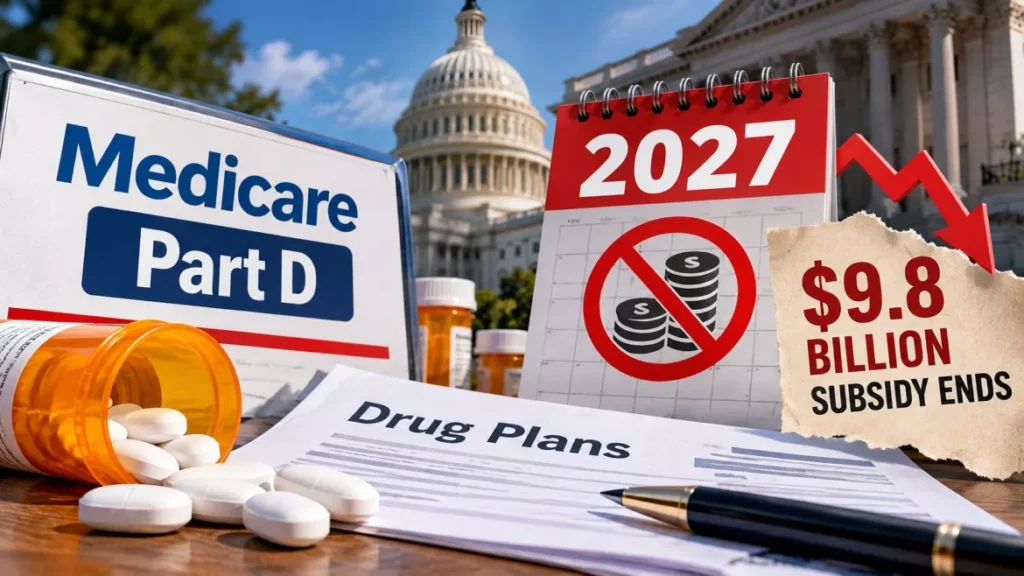

Medicare Part D 2027 will run without the premium subsidy that has propped up stand-alone drug plans in the United States for two years. The Centers for Medicare and Medicaid Services confirmed on 28 July 2026 that the demonstration ends on 31 December. It paid out $9.8 billion across 2025 and 2026.
What Ends on 31 December 2026
The Part D Premium Stabilization Demonstration closes at the end of contract year 2026, a year earlier than its original run. It was a voluntary programme for stand-alone prescription drug plans, known as PDPs, introduced for 2025 to absorb the premium swings that followed the Inflation Reduction Act’s redesign of the Part D drug benefit.
CMS — the federal agency that administers Medicare — gave its reasoning in the bid information fact sheet published on 28 July 2026. Its bid analysis “indicates that Part D plan sponsors had sufficient experience under the redesigned Part D benefit to support their assumptions in developing the prescription drug plan bids,” so it will “discontinue the demonstration at the end of CY 2026 to return the program to operating under traditional market conditions in CY 2027.”
How Much Support Is Being Withdrawn
The programme did two things each year: it cut the base premium figure plans worked from, and it capped how much any plan could raise its premium. Both supports disappear for 2027.
| Feature | 2025 | 2026 | 2027 |
|---|---|---|---|
| Reduction applied to the base beneficiary premium | $15 a month | $10 a month | None |
| Cap on a plan’s monthly premium increase | $35 | $50 | None |
| Average subsidy per enrollee | $26 a month | $16 a month | None |
Those parameters and the $9.8 billion two-year total come from the analysis published by KFF, the health policy research organisation, following the CMS announcement. KFF’s assessment is that some stand-alone plan enrollees could face a larger premium increase for drug coverage in 2027 than in recent years. No figure has been attached to that, because plan-level premiums are set by each insurer.
Who Loses the Subsidy, and Who Never Had It
Only stand-alone prescription drug plans took part. People who get drug coverage bundled into a Medicare Advantage plan were never in the demonstration, so nothing is being withdrawn from them.
- Affected: Enrollees in stand-alone Part D prescription drug plans, taken by people who stay in Original Medicare and buy drug coverage separately.
- Not affected by this change: Enrollees in Medicare Advantage plans that include prescription drug coverage, usually called MA-PD plans.
The two markets already price very differently. KFF put the average stand-alone plan premium at about $36 a month against about $8 for a Medicare Advantage drug plan — more than four times higher. Averages of this kind are not what any individual pays; premiums vary by plan and by region. Stand-alone plan enrolment rose from 22.8 million in 2024 to 24.9 million in 2026 while the demonstration was running.
The 2027 Figures, Set Against 2026
Four headline numbers change, and two of them are the ones beneficiaries meet at the pharmacy counter. All figures are in United States dollars and apply to the 2027 calendar year.
| Measure | 2026 | 2027 | Change |
|---|---|---|---|
| Maximum standard Part D deductible | $615 | $700 | Up $85 |
| Annual out-of-pocket cap on covered drugs | $2,100 | $2,400 | Up $300 |
| National base beneficiary premium | $38.99 | $41.33 | Up about 6% |
| National average monthly bid amount | $239.27 | $296.05 | Up about 24% |
The deductible and out-of-pocket cap were finalised in the CY 2027 Rate Announcement, which CMS published on 6 April 2026. The bid amount and base premium came in the 28 July fact sheet. Once a beneficiary’s spending on covered drugs reaches the out-of-pocket cap, cost sharing on those drugs falls to nothing for the rest of the calendar year.
Why the Bid Rose 24% but the Base Premium Only 6%
The two figures measure different things, and a law limits one of them. That is why a 24% rise in insurer cost projections does not translate into a 24% rise in anyone’s bill.
The national average monthly bid amount is an enrolment-weighted average of what Part D plans bid to provide the basic drug benefit, and CMS uses it to calculate the government’s subsidy to plans. The base beneficiary premium is a statutory figure used as the starting point for working out a plan’s basic premium. Under the Inflation Reduction Act’s premium stabilisation provision, the annual increase in the base beneficiary premium cannot exceed 6% a year between 2024 and 2029 — which is why it moved from $38.99 to $41.33 while the bid moved by roughly a quarter.
Neither number is a bill. The gap between rising plan costs and a capped premium figure is absorbed through the government subsidy and through the choices insurers make in their own plan designs — premiums above the basic level, deductibles, formularies, pharmacy networks, and whether to offer a plan in a given region at all. CMS has not published an allocation of where the difference lands.
What Beneficiaries Receive, and When
The document that carries a person’s own 2027 numbers is the Annual Notice of Change, and plans must send it by 30 September 2026. The dates below apply to the United States Medicare programme.
- By 30 September 2026: Every Medicare Advantage and Part D plan must send each enrollee an Annual Notice of Change, setting out the 2027 premium, deductible, cost sharing, formulary and network against the current year.
- Mid-to-late September 2026: CMS said in the 28 July fact sheet that it would release the 2027 Medicare Advantage and Part D landscape, along with final average premiums, once plan offerings were finalised.
- 15 October to 7 December 2026: Medicare Open Enrollment, the window in which enrollees can change plan for 2027.
- 1 January 2027: Any change made during Open Enrollment takes effect, as do the new deductible and out-of-pocket cap.
The official channels are Medicare.gov’s plan finder and the plan’s own Annual Notice of Change. A beneficiary who has not received the notice by 30 September can request it from the plan. People on Medicare who also receive Social Security may find the picture altered by the 2027 cost-of-living adjustment; this site covered the projected 3.4% Social Security COLA for 2027 separately.
What Is Not Yet Public
Plan-level premiums for 2027 are the missing piece. Until the landscape files and each plan’s Annual Notice of Change are in hand, there is no way to say what any particular stand-alone plan will charge, how many plans will be offered, or which regions will lose plans. CMS has not published a projection of how much stand-alone premiums will rise on average once the subsidy stops, and it has not said whether it will monitor 2027 premiums with a view to any further intervention.
Frequently Asked Questions
What Is Changing for Medicare Part D 2027?
In the United States, the standard maximum deductible rises to $700 from $615 and the annual out-of-pocket cap on covered drugs rises to $2,400 from $2,100. The Part D Premium Stabilization Demonstration, which supported stand-alone drug plan premiums, ends on 31 December 2026.
Does the Subsidy Ending Affect Medicare Advantage Members?
No. The demonstration covered stand-alone prescription drug plans only. People whose drug coverage is bundled into a Medicare Advantage plan were not in the programme.
Is the $41.33 Base Beneficiary Premium What Someone Will Pay?
No. It is a statutory figure used to calculate a plan’s basic premium, not a bill. Actual premiums are set by each plan and vary by plan and region.
When Will 2027 Plan Premiums Be Known?
Plan-specific figures reach enrollees in the Annual Notice of Change, which plans must send by 30 September 2026. CMS said it would publish the 2027 landscape and final average premiums in mid-to-late September 2026.
When Can Medicare Enrollees Change Plans for 2027?
Medicare Open Enrollment runs from 15 October to 7 December 2026, and any change takes effect on 1 January 2027.