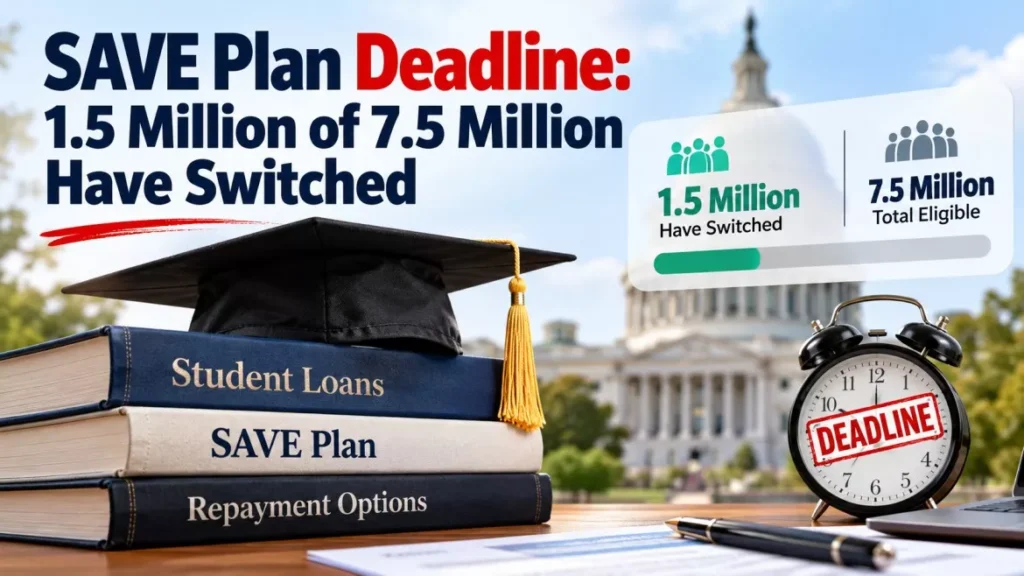

The first SAVE plan deadline falls on 29 September 2026 in the United States. It binds only borrowers whose loan servicer sent a 90-day notice around 1 July, not all 7.5 million people who were enrolled in the defunct repayment plan. The Education Department said 1.5 million had picked a new plan by 14 September.
Who the 29 September SAVE Plan Deadline Applies To
The 29 September date is the earliest individual deadline, not a national cut-off. The United States Department of Education, the federal agency that runs the Direct Loan programme, told servicers to begin issuing notices on 1 July 2026, each giving the borrower 90 days to move to another repayment plan. Ninety days from 1 July lands at the end of September.
In its 27 March 2026 announcement, the Department said servicers “will notify borrowers of their specific 90-day deadline” and that borrowers who do not move within that window are enrolled automatically into either the Standard Repayment Plan or the new Tiered Standard Plan. The clock therefore starts when a notice arrives, and borrowers in later waves have later dates.
How long the waves run is not settled. The Department has not published a schedule. Student Loan Planner, citing the servicer Nelnet, reports notices going out between July 2026 and March 2027, which would push the last deadlines into mid-2027. Other trackers describe waves ending in December 2026. Both figures come from servicer guidance rather than from the Department.
How Many Borrowers Have Left SAVE So Far
As of 14 September 2026, 1.5 million of the 7.5 million borrowers who had been enrolled in SAVE had selected a new repayment plan, a Department figure reported by Business Insider. That leaves roughly six million who had not chosen, two weeks before the first wave’s deadline.
SAVE — Saving on a Valuable Education — was the income-driven plan introduced under the Biden administration. It ended through a settlement between the Department and the state of Missouri that a court approved in March 2026. Under that settlement the Department stopped enrolling new borrowers, denied pending applications, and began moving everyone in the plan into other options. The Department describes SAVE as unlawful and cites estimates that it would have cost taxpayers more than $342 billion over ten years; those are the Department’s characterisations, and the settlement did not produce a court finding on the cost.
Two Separate Deadlines Fall in the Same Week
Two unrelated dates land a day apart, and they do different things. One is about which repayment plan a borrower is on. The other is about the interest rate charged on the loan.
| Date | What it covers | Who it applies to |
|---|---|---|
| 29 September 2026 | Deadline to select a repayment plan | Only SAVE borrowers whose servicer notice was dated around 1 July 2026 |
| 30 September 2026 | Deadline to enrol in automatic payments to qualify for a 1 percent interest rate reduction | Borrowers with Federal Direct Loans originated after 1 July 2012, including former SAVE borrowers once they are on a legal plan |
The Department announced the interest rate reduction on 18 June 2026. Servicers already cut 0.25 percent for borrowers on automatic payments; the temporary measure adds 0.75 percent on top, for a total of 1 percent, and it runs through 30 June 2028. Borrowers already enrolled need do nothing. Borrowers whose loans are in default have to consolidate and enter a repayment plan first. The reduction stops if a borrower leaves automatic payments.
“Borrowers should not wait to take advantage of this temporary interest rate reduction to stay on track for key student loan benefits,” Under Secretary of Education Nicholas Kent said in that announcement. The Department also said that more than 80 percent of borrowers in active repayment used automatic payments before the COVID-19 pandemic, against 40 percent now.
Where Borrowers Land if They Choose Nothing
Borrowers who pass their own 90-day deadline without acting are placed on a balance-based plan rather than an income-based one. That is the change that moves the monthly figure.
- Standard Repayment Plan: Fixed payments over ten years, calculated from the loan balance.
- Tiered Standard Plan: A new plan available from 1 July 2026, with fixed terms of 10, 15, 20 or 25 years set by the borrower’s total outstanding balance, so larger balances get longer terms and lower monthly payments.
Which of the two applies depends on the loan, and the servicer notice states it. Because payments under both are set by balance rather than income, borrowers whose SAVE payment was zero do not move to a small payment — they move to a balance-based one. Money Under 30 illustrated the size of that step with a calculation: a borrower owing $35,000 at 6.5 percent interest would pay roughly $397 a month on the ten-year standard plan. That is an illustration of the arithmetic, not a typical bill; the amount depends on balance, interest rate and loan type.
Being moved to a different plan is an administrative change. It is not recorded as a missed payment in itself, though payments that then go unpaid are treated normally.
The Plans That Replaced SAVE
Four income-driven options are open, one of them new. The Repayment Assistance Plan and the Tiered Standard Plan were created by the Working Families Tax Cuts Act and became available on 1 July 2026.
- Repayment Assistance Plan (RAP): Payments set by income and number of dependents. The Department says borrowers who make full, on-time payments are shielded from interest building up and reduce principal each month.
- Income-Based Repayment (IBR): An existing income-driven plan, in both its older and newer forms depending on when the borrower first borrowed.
- Pay As You Earn (PAYE): An existing income-driven plan.
- Income-Contingent Repayment (ICR): An existing income-driven plan.
Eligibility for each depends on loan type and borrowing dates, so not every plan is open to every borrower. Time spent on an income-driven plan while making qualifying payments can count towards Public Service Loan Forgiveness, which discharges certain loans after 120 payments; the fixed Standard and Tiered Standard plans generally do not build credit towards it in the same way. Federal debt cancellation has been contested repeatedly — the Department under the previous administration discharged $1.2 billion for borrowers defrauded by for-profit colleges under a different authority — and none of those earlier programmes affects the SAVE transition.
How Borrowers Find Their Own Deadline
The deadline is in the servicer’s notice, not on a public calendar. The official channels are the borrower’s loan servicer account and the Department’s own site.
- The servicer notice: It states the specific 90-day deadline. Servicer contact details and the current servicer are listed in the borrower’s StudentAid.gov account.
- StudentAid.gov: Applications for income-driven plans are filed there, and the Department says consent to pull federal tax information from the Internal Revenue Service speeds processing and removes the need to upload income documents.
- The Loan Simulator: The Department’s own tool on StudentAid.gov estimates payments under each plan before a borrower applies.
- StudentAid.gov/courtactions: The Department’s page for the settlement that ended SAVE.
Borrowers who want to move before a notice arrives can contact their servicer to enrol at any time, according to the Department’s March announcement.
What Is Still Unresolved
The Department has not said what happens to borrowers whose notices are delayed or never arrive, and it has not published the wave schedule that would let borrowers confirm when their own notice is due. It has also not published a running count of how many borrowers have switched since 14 September. Servicer processing times for plan applications filed close to a deadline have not been disclosed.
Frequently Asked Questions
What Is the SAVE Plan Deadline?
There is no single one. In the United States, 29 September 2026 is the earliest individual deadline, and it applies to borrowers whose servicer sent a 90-day notice around 1 July 2026. Each borrower’s date is stated in their own notice.
Does the 29 September Date Apply to Every Former SAVE Borrower?
No. Notices are being sent in waves, so borrowers who received one later have a later 90-day deadline. Reported servicer schedules run into 2027, though the Department has not published one.
What Happens to Borrowers Who Miss Their Own Deadline?
Their servicer enrols them automatically in either the Standard Repayment Plan or the Tiered Standard Plan, both of which set payments from the loan balance rather than income.
Is the Automatic Payment Deadline the Same Deadline?
No. Enrolling in automatic payments by 30 September 2026 qualifies a borrower for a 1 percent interest rate reduction through 30 June 2028. It is separate from choosing a repayment plan, and it applies to Federal Direct Loans originated after 1 July 2012.
Which Plans Replaced SAVE?
The Repayment Assistance Plan and the Tiered Standard Plan opened on 1 July 2026, alongside the existing Income-Based Repayment, Pay As You Earn and Income-Contingent Repayment plans. Eligibility varies by loan type and borrowing date.