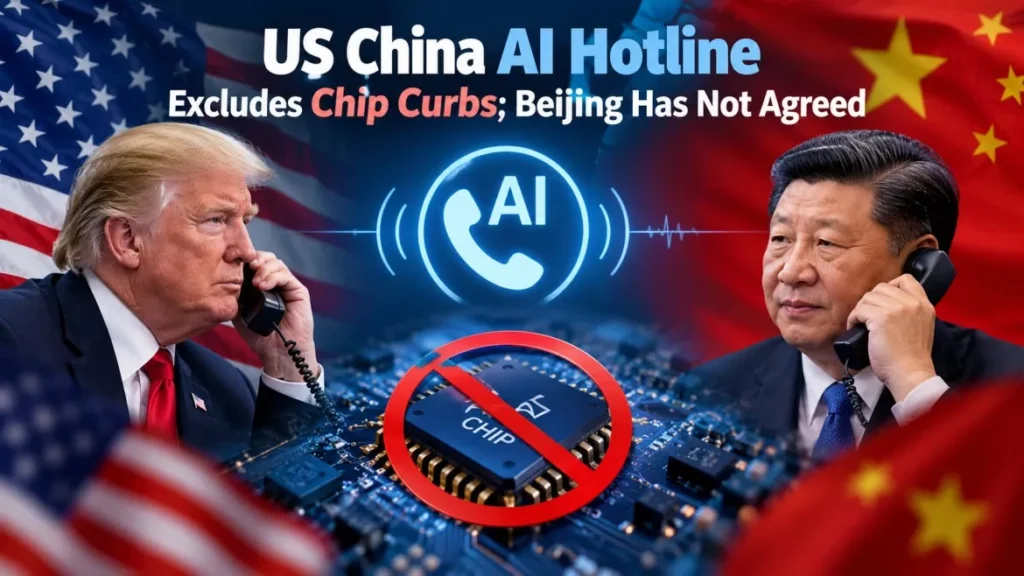

The United States has proposed a US China AI hotline, a channel for warning each other about serious artificial-intelligence incidents, and Beijing has not publicly agreed to it. Treasury Secretary Scott Bessent put the plan to Vice Premier He Lifeng in New York on Sunday 20 September 2026. Export controls on advanced chips were excluded.
What the United States Actually Proposed
The proposal is a channel for the two governments to tell each other about artificial-intelligence incidents serious enough to reach the level of national security. Reporters covering the New York meeting have described it as an AI “hotline”, although neither government has used that word in a formal document.
Bessent, who heads the United States Department of the Treasury, framed it as a transparency measure between the two largest AI powers. He said the aim was “moving from opaque to more transparency between the number one and the number two AI powers in the world”.
Washington’s own AI governance is itself unsettled: the Trump AI Force announced on 19 September 2026 exists so far as a social-media statement rather than an executive order. What counts as an incident has not been defined in public. Neither side has said which agencies would run the channel, how quickly a notification would have to be sent, or whether it would cover incidents involving private companies as well as government systems.
What Beijing Said, and What It Did Not Say
China acknowledged the talks but announced no agreement. The state news agency Xinhua said the two sides held “frank, in-depth and constructive” exchanges on economic, trade and artificial-intelligence matters, wording that records a discussion rather than a commitment.
As of 22 September 2026, no Chinese ministry has published an endorsement of the notification mechanism, and no joint text has been released by either government. The proposal is therefore a United States proposal awaiting a Chinese answer, not a bilateral arrangement.
Al Jazeera reported that the New York session ran about eight hours at the headquarters of JPMorgan Chase, and that Chinese officials left without speaking to reporters. That detail comes from a single outlet and has not been confirmed by either government.
What the Mechanism Leaves Out
The proposed channel does not touch the measures the two countries argue about most. Export controls on advanced semiconductors were kept outside it, so the restrictions Washington places on chip sales to China would not be affected by anything the mechanism does.
Nor does it reach the build-out on either side. China’s cloud providers continue to announce domestic compute projects, including a 100,000-processor cluster disclosed on 9 September 2026, and nothing in the proposal governs what those systems are used for. Three further gaps are worth naming, because the announcements do not close them:
- Threshold: no published definition of an AI incident that “rises to a national security level”.
- Operators: no named agency on either side to send or receive a notification.
- Military channel: security researchers in both countries have argued for a separate military-to-military line so that automated activity is not mistaken for a deliberate attack. Neither government has endorsed that idea.
The Calendar That Now Governs It
Two dates decide what happens next, and they are close together. The first is the state visit; the second is the expiry of the tariff truce that has held since the two presidents met in Busan, South Korea, in 2025.
| Date (2026) | What Is Scheduled |
|---|---|
| 23 September | Xi Jinping and Peng Liyuan arrive at Joint Base Andrews, Maryland |
| 24 September | State Arrival Ceremony at the White House; State Dinner in the East Room |
| 25 September | Tea in the Red Room and a visit to the National Archives; the visit ends |
| 10 November | The United States-China tariff truce expires |
The schedule for the three days comes from the White House statement published on 21 September 2026, which also lists 479 military personnel at the arrival ceremony. The White House has not published a separate agenda for the leaders’ talks.
What Was Not Settled in New York
The tariff truce was discussed and not extended. United States Trade Representative Jamieson Greer joined Bessent, and China’s chief trade negotiator Li Chenggang joined He Lifeng, but no extension was announced when the session ended.
Tariff deadlines have been moving elsewhere too, as with Canada’s counter-tariffs on United States goods, which took effect on 8 September 2026. Rare-earth magnets were raised and produced nothing new. American manufacturers and chip firms have complained that Chinese shipments arrive too slowly and in quantities below what they ordered; reporting on the meeting described no new progress on that point.
Bessent told reporters the talks were “very successful”, and Greer said they laid groundwork for the summit. Those are characterisations by the American side. The published Chinese account does not use comparable language.
The level of United States duties on Chinese goods is not settled in the public record either. Published estimates differ because they measure different things — headline rates, trade-weighted averages, and the layers of duty that survived a February 2026 Supreme Court ruling on emergency tariff powers. This article does not adopt a single figure.
Frequently Asked Questions
Has China Agreed to the US China AI Hotline?
No. As of 22 September 2026, China has acknowledged the discussion through Xinhua but has announced no agreement to the notification mechanism, and no joint document has been published.
What Would the Mechanism Cover?
It would cover artificial-intelligence incidents serious enough to raise national security concerns. The public descriptions do not define that threshold, and export controls on advanced chips were excluded from the proposal.
When Do Trump and Xi Meet?
Xi Jinping’s state visit to the United States runs from 23 to 25 September 2026, with the State Arrival Ceremony and State Dinner at the White House on 24 September, according to the White House.
When Does the Tariff Truce Expire?
The United States-China tariff truce expires on 10 November 2026. No extension was announced after the New York talks on 20 September 2026.
Who Took Part in the New York Talks?
Treasury Secretary Scott Bessent and Trade Representative Jamieson Greer represented the United States. Vice Premier He Lifeng and chief trade negotiator Li Chenggang represented China.