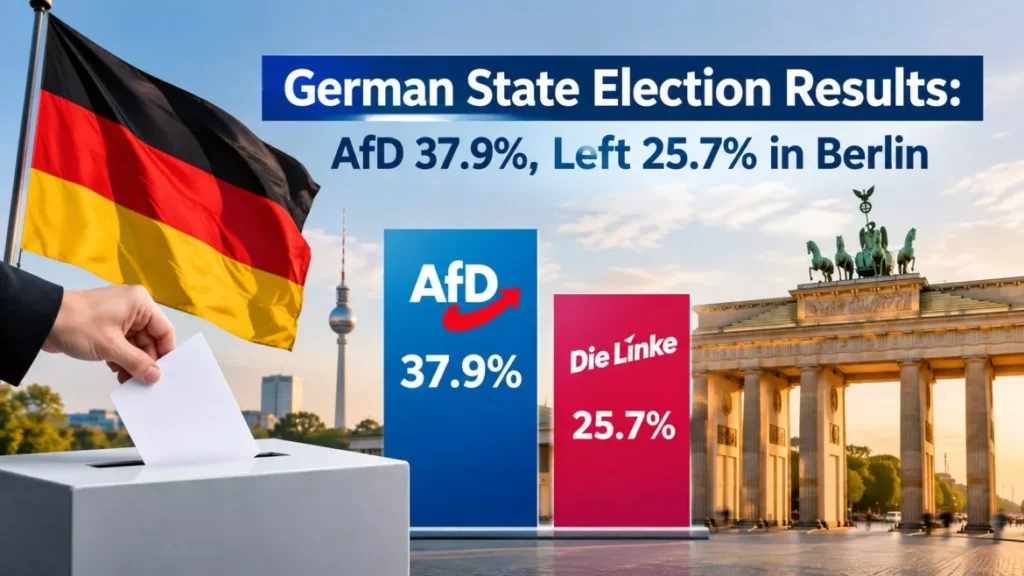

German state election results on Sunday 20 September 2026 put the Alternative for Germany first in Mecklenburg-Vorpommern and Die Linke first in Berlin. Projections gave the AfD 37.9% against the Social Democrats’ 35.7%, while Berlin’s official count showed Die Linke on 25.7%. Neither party has a governing majority.
Where the Counts Stood Late on Election Night
The two states were at different stages of counting on Sunday evening, and the numbers being quoted came from different kinds of source. That distinction matters, because the figures still move.
In Berlin, the state returning officer published a running official count. As of 20 September 2026 at 21:36 local time (CEST), with 3,713 of 4,114 electoral districts counted, the Berlin returning officer’s published tally put Die Linke on 25.7% of second votes. In Mecklenburg-Vorpommern, the widely quoted figures were a projection (a Hochrechnung, a statistical estimate built from sampled districts) issued by the Forschungsgruppe Wahlen polling institute at 21:05 CEST and broadcast by ZDF, not a completed count.
| Party | Mecklenburg-Vorpommern (projection, 21:05 CEST) | 2021 result | Berlin (official count, 21:36 CEST) | 2023 result |
|---|---|---|---|---|
| AfD | 37.9% | 16.7% | 16.1% | 9.1% |
| SPD | 35.7% | 39.6% | 12.1% | 18.4% |
| Die Linke | 6.5% | 9.9% | 25.7% | 12.2% |
| Greens | 5.6% | 6.3% | 14.3% | 18.4% |
| CDU | 5.0% | 13.3% | 18.8% | 28.2% |
| BSW | 4.9% | did not stand | 4.7% | did not stand |
Turnout rose in both states. Berlin’s official figure stood at 72.5%, or 1,646,489 of 2,272,122 registered voters, against 63.0% in 2023. Mecklenburg-Vorpommern’s turnout was put at 78% to 79% by election-night reporting, against 70.8% in 2021.
Why the 5% Threshold Decides Who Sits in Schwerin
The seat arithmetic in Mecklenburg-Vorpommern was still open on Sunday night because three parties were sitting within a point of the 5% threshold. Germany’s state parliaments allocate seats only to parties that clear 5% of the vote; votes cast for parties below that line win no seats at all, and the seats are shared out among the parties that did clear it.
On the 21:05 projection, the CDU stood at exactly 5.0%, the Greens at 5.4% to 5.6% and the BSW at 4.9%. Small movements as the real ballots are counted therefore change not just those parties’ fortunes but the size of every other party’s bloc, including the AfD’s.
- 71 seats: the size of the Landtag of Mecklenburg-Vorpommern.
- 36 seats: the number needed for an absolute majority.
- 5% of valid second votes: the threshold a party must clear to be allocated any seats.
- 30 September 2026: the latest date by which the state electoral commission must determine the final official result.
Because the allocation depends on which parties clear the line, no final seat count could be stated on election night, and none of the figures above should be read as a settled distribution of seats.
Winning the Most Votes Is Not the Same as Forming a Government
Coming first in a German state election does not by itself put a party into office. The Minister-President is elected by the state parliament, not directly by voters, so a party needs either a majority of seats or partners willing to vote for its candidate.
Every party represented in the Landtag other than the AfD has to date refused to enter a coalition with it, a position German parties describe as the “firewall”. Manuela Schwesig, the Social Democrat who has been Minister-President of Mecklenburg-Vorpommern since 2017, said on Sunday that “the AfD will not be able to form a government” and that “the majority has chosen democratic parties”. That is her assessment, made before the count was complete, rather than a settled outcome.
Leif-Erik Holm, the AfD’s lead candidate in the state, said his party was “ahead and naturally want to govern if possible”. Whether any partner emerges, and whether the outgoing SPD–Die Linke coalition can be rebuilt or replaced, is unresolved.
Berlin Put Die Linke First for the First Time
Die Linke finished first in a Berlin state election for the first time, on the count published on Sunday evening. The party stood at 25.7% of second votes, a gain of 13.5 percentage points on its 2023 result of 12.2%.
The CDU, which led Berlin with 28.2% in 2023, was on 18.8%, down 9.4 points. The SPD was on 12.1%, down 6.3 points and its weakest Berlin showing since 1990. The BSW stood at 4.7%, below the 5% threshold on that reading.
Elif Eralp, Die Linke’s lead candidate, said she wanted “to become the governing mayor of Berlin so that the people in our city can once again have a better life”. As in Schwerin, the office is filled by a vote in the state parliament, and Die Linke at 25.7% would need coalition partners to reach a majority. No coalition had been agreed when the count paused.
What Friedrich Merz Said, and What It Means Federally
Chancellor Friedrich Merz, who leads the CDU, called the Mecklenburg-Vorpommern result a “disaster” for his party, which recorded its worst postwar showing in that state. He said that “what needs to be done now requires backbone, steadfastness, and patience”, and that “the reforms must go ahead”.
Tino Chrupalla, an AfD co-leader, called on Merz to resign, describing the chancellor’s response as “more than feeble”. Merz gave no indication of standing down.
Neither state election changes the federal government’s parliamentary arithmetic directly: Germany’s next federal election is not scheduled until 2029, and Merz’s CDU/CSU–SPD coalition took office in May 2025. The results follow the Saxony-Anhalt state election of 6 September 2026, at which the AfD took 43.8% and the CDU 17.2%. Merz’s approval rating stood at roughly 14% in polling reported around the vote, after about 16 months in office, amid stalled economic and welfare reforms and a eurozone interest-rate cycle that has moved against borrowers, with the European Central Bank raising its key rates in September 2026.
What Happens Next
- Counting completes: remaining electoral districts in both states are counted and the provisional official results are published.
- Final results certified: Mecklenburg-Vorpommern’s state electoral commission must determine the final official result by 30 September 2026.
- Seats allocated: only once the final percentages are fixed is it known which parties cleared 5% and how the 71 seats in Schwerin divide.
- Parliaments convene and elect leaders: each new state parliament meets and votes on a Minister-President in Schwerin and a governing mayor in Berlin.
Coalition talks in both states had not begun when the counts were published on Sunday evening.
German State Election Results: Your Questions Answered
These answers reflect the counts and projections published on the evening of 20 September 2026 and apply to the German states of Mecklenburg-Vorpommern and Berlin.
Did the AfD Win the German State Election Results?
The AfD took the largest share of the vote in Mecklenburg-Vorpommern, at 37.9% on the 21:05 CEST projection. In Berlin it was third, at 16.1% on the official count published at 21:36 CEST. Coming first does not by itself give a party power in either state.
Are These Figures Final?
No. Berlin’s figures were an official but incomplete count, with 3,713 of 4,114 electoral districts counted at 21:36 CEST on 20 September 2026. Mecklenburg-Vorpommern’s were a polling institute’s projection, not a count. The final official result in Mecklenburg-Vorpommern is due by 30 September 2026.
Who Will Govern Mecklenburg-Vorpommern?
That was undecided on election night. The Minister-President is elected by the 71-seat Landtag, where 36 votes form a majority, and every other party has so far refused to govern with the AfD. No coalition had been agreed when the counts were published.
Why Does the 5% Threshold Matter So Much This Time?
In Mecklenburg-Vorpommern the CDU was on exactly 5.0%, the Greens on about 5.5% and the BSW on 4.9% in the 21:05 projection. Parties below 5% receive no seats, so small shifts in the completed count change how all 71 seats are shared out.
Do These Results Change the German Federal Government?
Not directly. State elections do not alter the Bundestag, and Germany’s next federal election is scheduled for 2029. Chancellor Friedrich Merz, whose CDU/CSU–SPD coalition took office in May 2025, said he intends to continue.