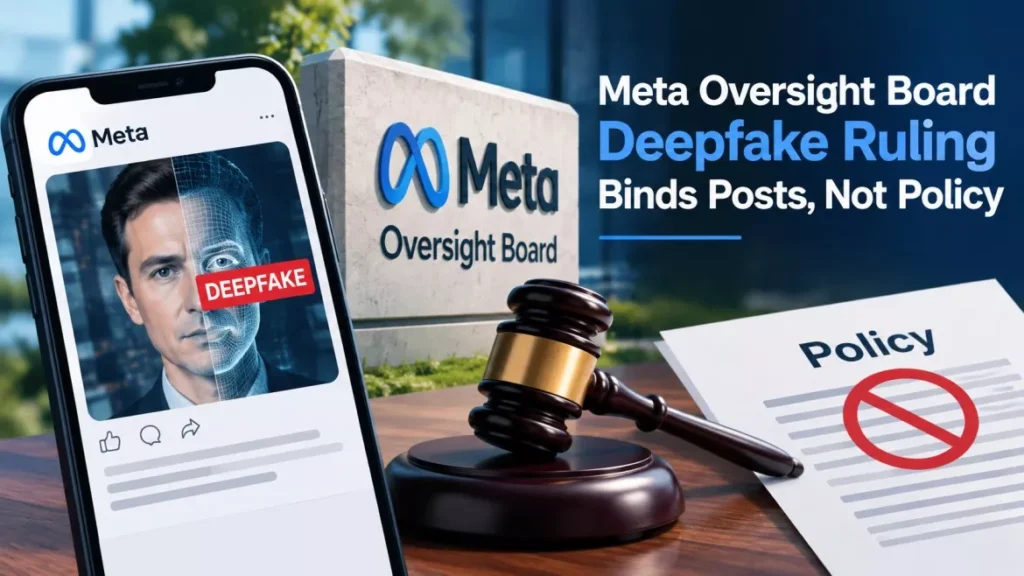

The Meta Oversight Board deepfake ruling, published on 17 September 2026, orders Facebook to remove two AI-generated videos and calls Meta’s rules on such content consistently and fundamentally inadequate. Those two takedowns are binding on Meta. The nine policy recommendations attached to them are not, and Meta has 60 days to respond.
The Two Cases
Both cases reached the Board because Meta’s own systems had decided the content could stay. The Oversight Board is an independent body funded by Meta that reviews contested moderation decisions, and it took these two together to examine how the company handles synthetic media.
The Scottish Councillor Video
A video posted to Facebook in November 2025 showed a Labour councillor in Scotland appearing to say words she had never said, attributing serious sexual criminality to refugees as a group. The synthetic origin was visible in the mismatch between the audio and the facial movements.
The Board’s published decision records that the video sat in an album alongside protest photographs and drew more than 5,000 views, over 50 comments and more than 20 reactions. Two people reported it, including the councillor herself. Meta’s systems did not route it to a human reviewer, the appeals failed, and no AI label was applied. Meta’s position, as summarised in the decision, was that no trusted partner had flagged the content and engagement was too low to trigger review.
The Board’s majority found the video breached the Hateful Conduct policy because it alleged serious criminality against refugees as an entire group, and ordered it removed. A minority disagreed, arguing the video attacked the councillor’s stated views rather than refugees themselves. The majority also concluded the video warranted a High Risk AI label that Meta had not applied.
The Campaigner Video
The second case concerned a young Muslim woman in Europe who had taken part in a campaign on menstrual health education for girls and women from ethnic minority backgrounds. AI-manipulated video and images mocking her circulated widely, drawing what The Next Web and Engadget both describe as views in the tens of millions across platforms.
Meta’s automated systems closed the initial reports and the subsequent appeals without human review. The company removed harassing comments and then the post itself only after the Board took the case. The Board found the content violated the Bullying and Harassment policy.
What the Board Said Is Wrong
The Board’s central criticism is structural rather than case-specific: Meta’s policies are, in the Board’s words, “consistently and fundamentally inadequate to address the rapid rise of AI-generated content”. The phrase has been reported identically by Engadget and The Next Web.
Three specific failures run through both cases. Meta’s High Risk AI labelling is tied largely to crisis periods and elections, so ordinary harassment falls outside it. Reports from the person depicted carried no special weight in routing content to a human. And where a label was theoretically available, it was a passive marker rather than anything that slowed a viewer down.
Binding Order Versus Advice: What Meta Must Actually Do
This is the distinction that most coverage leaves implicit, and it decides how much of this ruling reaches users. The Oversight Board’s decisions on individual pieces of content bind Meta; its policy recommendations do not.
| Element of the ruling | Status for Meta |
|---|---|
| Remove the Scottish councillor video | Binding — Meta has complied |
| Remove the campaigner content | Binding — Meta has complied |
| The nine policy recommendations | Advisory — Meta must respond, not adopt |
| Deadline to respond to the recommendations | 60 days from 17 September 2026, running to about 16 November 2026 |
In practice this means Meta can answer every one of the nine recommendations with a refusal and remain fully compliant with the ruling. The only enforceable outcome so far is that two pieces of content are gone.
The Nine Recommendations
Six recommendations came from the councillor case and three from the campaigner case. The Board’s published decision sets them out in full; the substance is as follows.
- Lower the labelling threshold: Stop confining High Risk AI labels largely to crises and election periods.
- Add friction, not just labels: Place an interstitial warning screen in front of high-risk manipulated media so a viewer has to click through.
- Demote and demonetise: Reduce distribution of content carrying the High Risk label and remove its ability to earn.
- Penalise repeat sharers: Apply escalating account-level penalties to people who repeatedly post such material.
- Broaden the interference rules: Extend voting and census interference provisions beyond the United States context.
- Publish the numbers: Release annual transparency data on how often labels are applied.
- Make labels searchable: Expose label data in the Meta Content Library so researchers can study it.
- Prioritise reported AI content: Route content likely to be AI-generated to human review when it is reported.
- Cover private individuals: Widen the definition of unwanted manipulated imagery so it protects people who are not public figures.
What Changes for Users Right Now
As of 19 September 2026, nothing has changed in how Facebook or Instagram handle AI-generated content beyond the removal of the two specific posts. No new label, warning screen or reporting route has been announced, and Meta has not published a formal response to the recommendations. The Guardian reported approaching Meta for comment without receiving one at the time of publication.
Two things remain genuinely unknown. Meta has not indicated which, if any, of the nine recommendations it intends to adopt, and the company has given no timetable for changes separate from the 60-day response window. Platform rules on synthetic media have moved elsewhere in the meantime, including YouTube’s disclosure requirement for AI-generated content, and the gap between disclosure rules and harassment enforcement is the space this ruling is aimed at. The pattern the Board describes, in which manipulated imagery is used to drive named women out of public argument, is the same one seen in the AI-generated images of Taylor Swift that circulated in 2024.
Frequently Asked Questions
What Did the Meta Oversight Board Decide About Deepfakes?
It ordered Meta to remove two AI-generated videos from Facebook, one under the Hateful Conduct policy and one under Bullying and Harassment, and issued nine recommendations for changing how the company handles synthetic media.
Is the Ruling Binding on Meta?
Partly. The instruction to remove the two specific posts is binding and has been carried out. The nine policy recommendations are advisory; Meta must publish a response within 60 days but is not required to implement any of them.
When Must Meta Respond?
Within 60 days of the 17 September 2026 decision, which runs to around 16 November 2026. Meta has not said what its response will contain.
What Is the Oversight Board?
An independent review body funded by Meta that rules on contested content decisions on Facebook, Instagram and Threads. Its content rulings bind the company; its broader policy advice does not.
Does This Ruling Apply Outside the United Kingdom and Europe?
The two removals concern specific posts, but the recommendations are written as global policy changes, including one asking Meta to extend rules currently framed around the United States. Whether any of them is applied anywhere depends on Meta’s response.