
Houthi forces took Mokha port on Yemen’s Red Sea coast on Thursday 10 September 2026, after overnight fighting with pro-government units. The port lies within about 80 kilometres of the Bab el-Mandeb strait. The United Nations envoy told the Security Council that day that Yemen had entered a more dangerous phase of war.
What Is Confirmed and What Is Only Claimed
Accounts of a fast-moving offensive differ, so it is worth separating what several independent sources report from what rests on one. The table below sets out where each claim currently stands.
| Claim | Standing | Attributed to |
|---|---|---|
| Houthi forces hold Mokha port | Reported by multiple independent outlets and referred to at the Security Council | Al Jazeera, NPR, Associated Press, The National |
| More than 11,400 households displaced since 3 September 2026 | Stated on the record to the Security Council | Hans Grundberg, UN Special Envoy for Yemen, 10 September 2026 |
| The island of Mayun, also called Perim, was taken | Reported by a news agency; not independently confirmed | Associated Press, via ABC News |
| Zuqar island was also taken | Single-source; attributed to an unnamed military source | A Yemeni military source, cited in wire reports |
| 73 civilians wounded in an 8 September attack on Saudi Arabia | Stated at the Security Council | Saudi Arabia’s ambassador al-Wasil |
The Houthi movement, the armed group that controls much of northern Yemen and is backed by Iran, did not issue a statement carried in the reporting reviewed here. The internationally recognised Yemeni government’s position was put at the United Nations by its ambassador rather than in a separate communiqué.
Why Mokha Port Matters to Bab el-Mandeb
Mokha’s significance is its position, not its size. It is a small commercial port, and what makes it consequential is how close it sits to one of the world’s narrowest shipping chokepoints.
- Distance to the strait: reported as about 75 kilometres by the maritime trade press and about 80 kilometres, or 50 miles, by the Associated Press. The two measurements differ by the reference point used.
- Width of Bab el-Mandeb: 18 miles at its narrowest, which confines tanker traffic to two channels two miles wide, according to the United States Energy Information Administration.
- What passes through: the strait links the Red Sea to the Gulf of Aden and the Indian Ocean. In 2018, the last full year in that agency’s analysis, about 6.2 million barrels a day of crude and refined products moved through it.
- Share of trade: roughly 12% of the world’s goods normally ship through the route, the Associated Press reported.
The port itself is not in working order. Mokha was hit by more than 25 missile strikes in August 2026, causing damage put at about 16 million United States dollars and halting commercial activity, according to the maritime outlet WorldCargo News.
What Changed for Red Sea Shipping
Less than the alarm suggests, at least so far. Traffic through Bab el-Mandeb is already down about 60% from the levels before Houthi attacks on shipping began in late 2023, so much of the diversion the seizure threatens has already happened.
Maersk, MSC and, most recently, COSCO Shipping had begun rebuilding Red Sea services after more than two years routing around the Cape of Good Hope. Richard Meade, editor-in-chief of Lloyd’s List, told the Associated Press the capture “doesn’t change the immediate risk profile” for vessels, while adding that it “puts the Houthis in a strong position”.
The energy numbers moved more visibly. Red Sea oil loadings fell from 3.8 million to 2.2 million barrels a day during August 2026, according to figures cited by the Associated Press. Routing around Africa rather than through Suez lengthens a voyage from roughly 24 days to about 54.
This matters more than it would have a year ago because the alternative route is also under strain, as the disruption to traffic through the Strait of Hormuz has shown.
What the United Nations and Member States Said
The Security Council met on 10 September 2026. Hans Grundberg, the UN Special Envoy for Yemen, said the country faced “a new and more dangerous phase of war” and warned that the consequences would not remain within Yemen’s borders. He called on the Houthis to halt attacks and threats against commercial vessels.
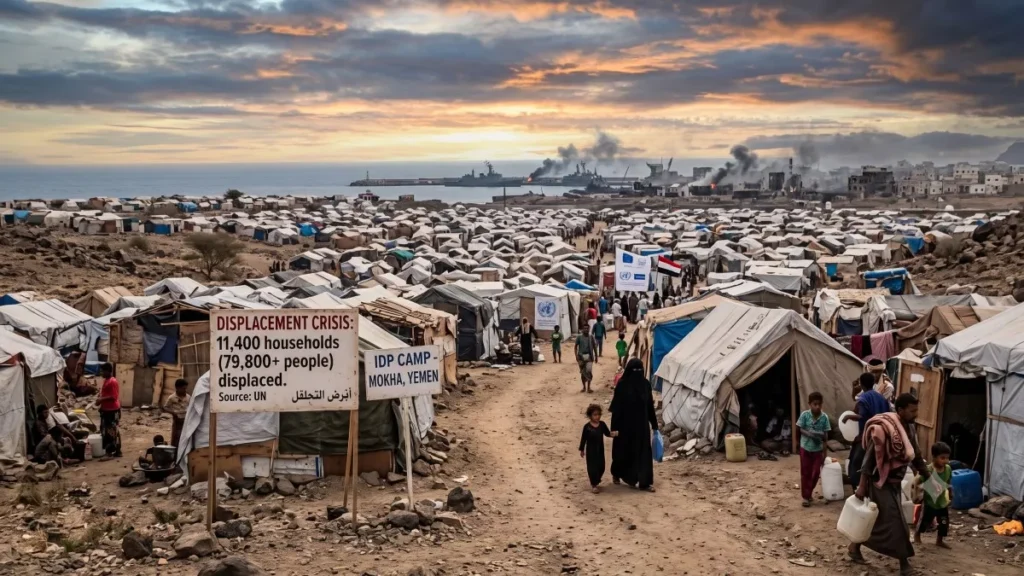
Grundberg said fighting had spread across the provinces of Taiz, Hodeidah, Marib, al-Jawf and al-Bayda, and displaced more than 11,400 households since 3 September 2026. Yemen’s ambassador to the United Nations, Al-Saadi, gave a different count of 6,145 families, about 44,000 people. The two figures use different units and different cut-offs, and neither has been reconciled publicly.
The UN Office for the Coordination of Humanitarian Affairs put 18.3 million people in Yemen in acute food insecurity, with more than 2.2 million children under five malnourished and more than 500,000 of those severely so. Speaking for the Gulf Cooperation Council, Bahrain’s ambassador Alrowaiei said the seizure worsened civilian suffering and threatened navigation through Bab el-Mandeb.
What Happens Next
As of 12 September 2026, Mokha is reported to be under Houthi control, the four-year truce that had held in Yemen is described by the UN envoy as collapsing, and no ceasefire process has been announced.
Several things remain undetermined. Whether carriers that resumed Red Sea sailings will reverse that decision has not been announced by any of them. Whether the islands near the strait are held, and by whom, is not independently established. Nor has the Security Council adopted any measure in response to the session of 10 September.
Mokha Port and Bab el-Mandeb: Questions Readers Are Asking
Where Is Mokha Port?
On Yemen’s Red Sea coast, roughly 75 to 80 kilometres north of the Bab el-Mandeb strait. It is a small commercial port and gives its name to the coffee trade that once passed through it.
Has Red Sea Shipping Stopped?
No announcement of a halt has been made by the carriers that had resumed transits. Traffic through the strait was already about 60% below its pre-2023 level before the seizure.
Who Controls Mokha Now?
Houthi forces, according to multiple independent news organisations reporting on 10 and 11 September 2026. The internationally recognised Yemeni government has not published a detailed account of the loss.
How Many People Have Been Displaced?
The UN Special Envoy told the Security Council on 10 September 2026 that more than 11,400 households had been displaced since 3 September. Yemen’s UN ambassador gave a lower figure of 6,145 families, about 44,000 people.