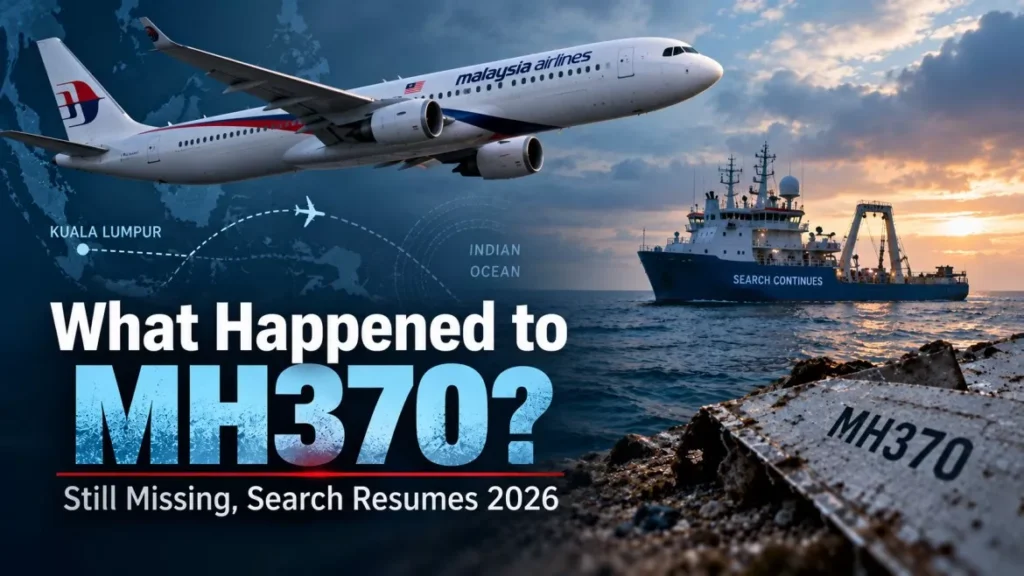

MH370 has never been found. The Malaysia Airlines Boeing 777 vanished on 8 March 2014 with 239 people aboard, and the most recent seabed search covered 7,571 square kilometres of the southern Indian Ocean without locating it. Malaysia extended the hunt to 30 June 2027.
Has MH370 Been Found?
No. As of 9 September 2026, no part of the main wreckage of MH370 has been located, and no flight recorder has been recovered.
That answer has not changed in twelve years, despite three separate deep-sea search operations. It is worth stating plainly because searches for this story routinely surface headlines claiming the aircraft has been discovered or that coordinates have been revealed. Malaysia’s Air Accident Investigation Bureau told the families on 8 March 2026 that the latest operation “has not yielded any findings that confirm the location of the aircraft wreckage”.
What Is Actually Confirmed About the Flight’s Final Hours
A surprising amount is known with precision, right up to the point where the evidence stops.
Flight MH370 left Kuala Lumpur for Beijing just after 12.40am local time on 8 March 2014. At 1.19am, approaching the handover between Malaysian and Vietnamese airspace, the cockpit made its last radio call: “Good night Malaysian three seven zero.” A minute later the transponder stopped broadcasting and the aircraft disappeared from civilian air traffic screens.
It did not stop flying. Military radar and automated satellite log-ons showed the 777 turn back across peninsular Malaysia and then track south, with a final partial satellite handshake recorded at 8.19am. Those hourly handshakes are what produced the “seventh arc” — a line across the southern Indian Ocean along which the aircraft is believed to have run out of fuel. Every search since has been an attempt to guess where along that arc it came down.
The Debris Is the Only Physical Evidence
One object anchors the entire case. A wing flaperon washed up at Saint-André on the French island of Réunion on 29 July 2015, and French investigators confirmed it as MH370’s by matching serial numbers found inside the component to parts used in building that specific Boeing 777.
Further pieces later came ashore in Madagascar, Mauritius, Mozambique, South Africa and Tanzania — consistent with a crash in the southern Indian Ocean and years of drift, but useless for pinpointing a location. Debris tells investigators the aircraft ended in the water. It does not tell them where.
What the Official Investigation Concluded
The Malaysian safety investigation team released its report on 30 July 2018 and did not identify a cause. Its conclusion was that the team “is unable to determine the real cause for the disappearance of MH370”.
The reason is the missing wreckage. Without the flight data recorder and cockpit voice recorder, investigators had no way to establish whether the aircraft was deliberately diverted, suffered a catastrophic failure, or something else. Everything published since about motive or mechanism is inference drawn from radar tracks, satellite data and drift modelling — not from evidence recovered at the crash site, because there is no known crash site.
Why Twelve Years of Searching Has Failed
The arc is long, the ocean is deep, and the aircraft’s position along that line was never narrowed to anything smaller than thousands of square kilometres. Deep-sea recovery works when the loss position is known within a few miles, as it was in the search for the Titan submersible. For MH370, the starting estimate was a strip of seabed larger than many countries.
| Search | Period | Seabed covered | Result |
|---|---|---|---|
| Australian-led multinational search | 2014 to January 2017 | More than 120,000 sq km | Suspended, nothing found |
| Ocean Infinity, first attempt | January to May 2018 | More than 112,000 sq km | Ended, nothing found |
| Ocean Infinity, renewed contract | March 2025 to January 2026 | 7,571 sq km over 28 operational days | No confirmed wreckage |
Ocean Infinity’s chief executive Oliver Plunkett said on 8 March 2026 that the company had mapped more than 140,000 square kilometres of seafloor across all its MH370 operations since 2018, spending more than 150 days at sea. “Despite all that effort, we haven’t been able to find it,” he said, adding that the result still carries information: “it isn’t where we looked. That matters — it brings clarity, and it will help those continuing to study the evidence refine their thinking.”
When Does the Search Resume?
Not before November 2026. Malaysia’s cabinet approved a twelve-month extension of its agreement with Ocean Infinity in late June 2026, and transport minister Anthony Loke announced it on 29 June, covering 1 July 2026 to 30 June 2027.
The extension is designed to let Ocean Infinity finish the remaining 7,428.54 square kilometres of the priority area defined under the March 2025 agreement. The terms are unchanged: Malaysia pays nothing unless the aircraft is located, in which case a success fee of $70 million is due.
Work is scheduled for the November 2026 to April 2027 window, when southern Indian Ocean conditions are calm enough for safe operations and when Ocean Infinity’s vessels are free of other commercial contracts. Voice 370, the group representing the families, has pressed Malaysia to keep the contract alive and to seek similar arrangements with other deep-sea operators.
Twelve years is a long wait, though not an unprecedented one — disappearances have been resolved decades later, as in the case of the Martin family. What makes MH370 different is that the answer depends on finding a specific patch of seabed, and the area still to be searched is now measured in thousands of square kilometres rather than hundreds of thousands.
Frequently Asked Questions
How Many People Were on MH370?
239 in total — 227 passengers and 12 crew. Most of those on board were Chinese nationals, and the flight was routed from Kuala Lumpur to Beijing.
Has Any Wreckage From MH370 Been Recovered?
Yes, but only drifting debris, never the main structure. A confirmed flaperon came ashore on Réunion in July 2015, and further pieces were later recovered along the coasts of Madagascar, Mauritius, Mozambique, South Africa and Tanzania.
Who Is Paying for the MH370 Search?
Nobody, unless the aircraft is found. Ocean Infinity operates on a “no find, no fee” basis, and Malaysia owes a $70 million success fee only if the wreckage is located.
Where Is the Search Area?
A stretch of the southern Indian Ocean along the seventh arc, roughly west of Australia, derived from the final satellite handshakes. Under the current contract, 7,428.54 square kilometres of that priority zone remain to be surveyed.
Do Investigators Know Why MH370 Disappeared?
No. The Malaysian safety report published in July 2018 stated that the investigation team could not determine the cause, and that position stands because the flight recorders have never been recovered.