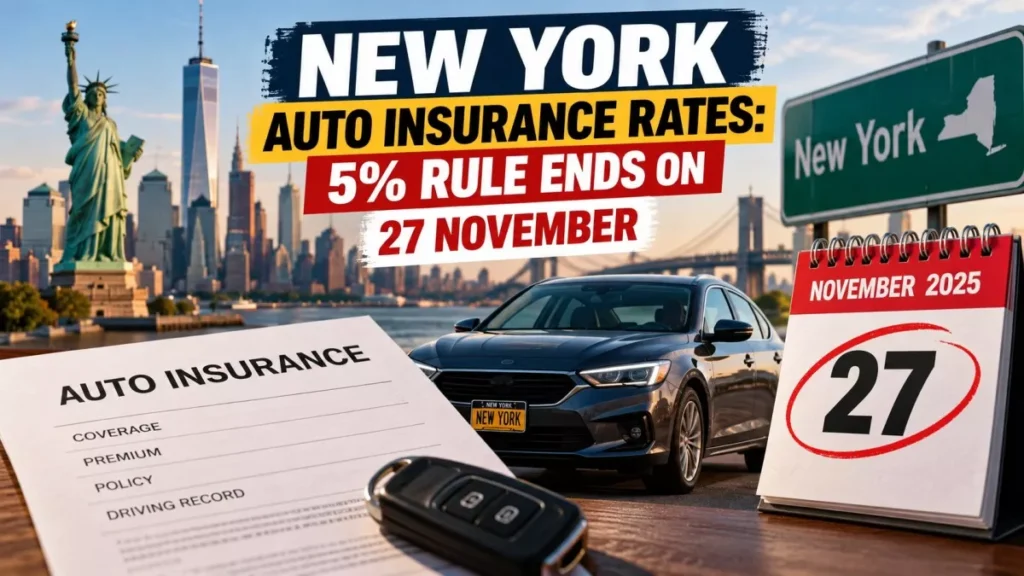

New York auto insurance rates will need state approval before any increase, under a regulation the Department of Financial Services proposed on 9 September 2026. The rule ends a window that let insurers raise private passenger rates within 5% without clearance. It begins on 27 November 2026.
What the Proposal Changes About New York Auto Insurance Rates
The change is to who signs off on an increase, and when. New York auto insurance rates are currently governed by a “flex rating” system that lets insurers move rates within a set band before the regulator sees the filing. The proposal removes that band for upward moves.
| Rule | Flex rating today | Under the proposal |
|---|---|---|
| Prior approval for an increase | Not required inside the band | Required for every upward change |
| Increases allowed without approval | Up to two overall average increases | None |
| Size allowed without approval | Cumulative effect within 5% | Not applicable |
| Explanation to policyholders | Not specified | Insurers must explain rate changes, including decreases |
The Department of Financial Services, the New York State agency that supervises insurers and banks, would review each filing before it reaches customers. Kaitlin Asrow, the department’s acting superintendent, said the regulation ensures any increase in private passenger auto rates is subject to comprehensive and independent review, in a statement reported by Insurance Journal on 10 September 2026.
How Flex Rating Works Today
Flex rating is a middle ground between free pricing and full prior approval. Under New York’s current version, an insurer may put through no more than two overall average private passenger auto rate increases without the department’s advance sign-off, provided the increases add up to no more than 5%.
Anything beyond that already needs approval. The proposal does not create the department’s review power, then, so much as remove the exception to it.
Two Dates New York Drivers Should Note
The proposal carries two separate deadlines, and they are three weeks apart.
- Wednesday 9 September 2026: Governor Kathy Hochul announced the proposed regulation, and a 60-day public comment period opened with publication in the State Register.
- Monday 9 November 2026: the public comment period closes, according to Insurance Journal. Comments are submitted to the Department of Financial Services.
- Friday 27 November 2026: prior approval applies to upward private passenger auto rate changes.
The statutory requirement itself comes from the state’s enacted Fiscal Year 2027 budget. The regulation now out for comment is the instrument that implements it, which is why the underlying date holds while the text is still open to consultation.
Who Is Covered, and What the Rule Does Not Do
The proposal applies to private passenger automobile insurance in New York State. That is personal car cover. Commercial auto policies, and every other line of insurance, sit outside this particular filing, and drivers in other United States states are unaffected — each state regulates insurance rates through its own department, as the separate wildfire cover deadline in Washington State this month shows.
It is also worth being precise about what prior approval is. It is a review step, not a price cap. The department can approve an increase, and the regulation sets no ceiling on premiums, no target reduction and no guaranteed saving for any policyholder. What changes is that an insurer cannot implement an upward move first and be reviewed later.
Individual premiums will continue to depend on the driver, the vehicle, the address, the claims history and the insurer. Published estimates of the average New York premium differ widely between commercial comparison sites because they measure different coverage levels, and no single figure describes what a particular household pays.
The Wider Package the Regulation Implements
The rate-approval requirement is one of five auto insurance measures in the Fiscal Year 2027 budget. On 1 July 2026 the department issued guidance to insurers telling them to build the expected savings from those measures into pending and future rate filings.
- Fraud definition: widened so prosecutors can pursue anyone organising or facilitating a staged accident, not only the driver.
- Damages cap: recoveries are capped for drivers engaged in unlawful conduct at the time of a crash.
- Serious injury threshold: tightened to require objective demonstration of a serious injury for pain and suffering damages.
- Comparative fault: damages limited for drivers found primarily at fault in causing the crash.
- Rate approval: express prior approval from the department before any upward rate change.
Insurance Journal also reported that the package bars insurers from setting rates on the basis of homeownership, occupation, education level or postcode, and requires excess profits to be returned to policyholders. Those provisions were not itemised in the department’s July guidance.
As of 12 September 2026, the regulation remains a proposal open to public comment in New York State, and the department has not published a final text.
New York Auto Insurance Rates: Questions Readers Are Asking
Does This Mean New York Auto Insurance Rates Will Fall?
No. The regulation requires state review before an increase takes effect. It does not cap premiums or require a reduction, and the Department of Financial Services can approve increases it considers justified.
What Is Flex Rating?
Flex rating lets an insurer change rates within a defined band without the regulator’s advance approval. In New York the band has allowed up to two overall average private passenger auto increases adding up to no more than 5%.
When Does the Comment Period Close?
A 60-day comment period opened when the proposal was published in the State Register following the 9 September 2026 announcement, and closes on 9 November 2026 according to Insurance Journal. Comments go to the Department of Financial Services.
Which Drivers Does This Affect?
Holders of private passenger automobile policies in New York State. Commercial auto policies are outside this proposal, and drivers in other states are regulated by their own state insurance departments.