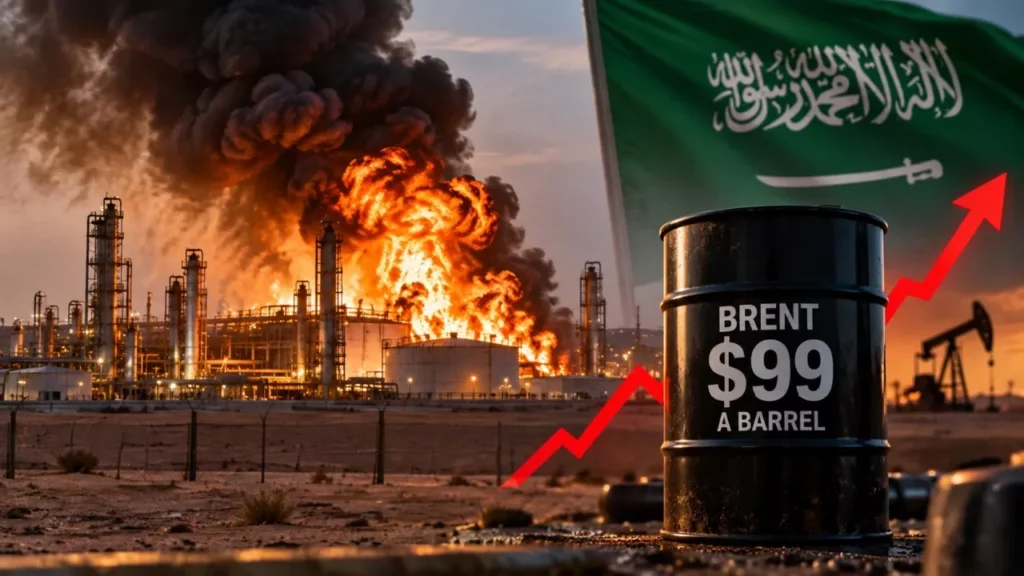

A Saudi Arabia oil attack on 8 September 2026 halted operations at several energy facilities in the kingdom’s south and injured 73 civilians, the state-run Saudi Press Agency said. Yemen’s Houthi movement claimed the strikes. Brent crude touched $99 a barrel the same day, its highest level since the Iran-United States war began.
What Saudi Arabia Confirmed on 8 September
Saudi authorities confirmed three things: attacks on southern cities, fires at energy installations, and 73 civilian injuries with no reported deaths.
The Saudi energy ministry said fires broke out at several sites and that firefighting and emergency teams were working to contain the blazes and assess damage. Operations at some facilities were paused. The Saudi Press Agency, which attributed the attacks to the “terrorist” Houthis, did not name the facilities involved and did not publish a figure for lost output.
That omission matters. Without a named site or a barrels-per-day number from Riyadh, the physical supply loss on 8 September remains undisclosed, and every production estimate in circulation is inference rather than confirmation.
What the Houthis Claimed, and What Nobody Has Verified
The Houthi military spokesman, Yahya Saree, said the group targeted Saudi energy infrastructure operated by Saudi Aramco using drones and ballistic missiles, and named an air base at Khamis Mushait alongside oil facilities at Abha, Najran and Jazan.
| Claim | Who says it | Status as of 8 September 2026 |
|---|---|---|
| 73 civilians injured, no deaths | Saudi Press Agency and the Saudi-led coalition | Stated by Saudi authorities; widely reported |
| Fires and paused operations at energy sites | Saudi energy ministry | Confirmed by Saudi Arabia; sites not named |
| Specific targets hit at Khamis Mushait, Abha, Najran and Jazan | Houthi spokesman Yahya Saree | Houthi claim; not confirmed by Saudi Arabia |
| The attacks answered about 121 Saudi air strikes on Yemen in three days | Yahya Saree | Houthi claim; Saudi Arabia has not published a strike count |
| Volume of Saudi output or refining lost | No party | Not disclosed by anyone |
Al Jazeera, reporting from the region, stated plainly that it could not independently verify the battlefield claims made by either the Houthis or the internationally recognised Yemeni government. That caution applies to the target list above.
One widely cited figure comes from a trade publication rather than from Riyadh: World Oil reported that the Jazan refinery, which it puts at 400,000 barrels per day of capacity, has been targeted repeatedly. Saudi Arabia has not confirmed damage to Jazan on this occasion.
How Far Oil Prices Actually Moved
Brent crude, the international benchmark, touched $99 a barrel on 8 September 2026 and was trading around $98.30, up more than 1 per cent, when NBC News published its reading that day. CNBC reported November Brent futures at $99.16, up 2.23 per cent, at a different point in the session. Both readings are from 8 September; intraday movement explains the gap.
- Brent crude: touched $99 a barrel on 8 September 2026, per NBC News.
- West Texas Intermediate: around $93.50 a barrel, up more than 2 per cent on 8 September 2026.
- Wholesale gasoline: up more than 3 per cent on 8 September 2026.
- US retail petrol: a national average of $4.15 a gallon on 8 September 2026, unchanged from the previous day. This is a United States figure only, and a national average is not what any individual driver pays.
Set against the year, the day’s move is small. NBC News reported that Brent is up about 62 per cent since the start of 2026 and about 36 per cent since the Iran-United States war began on 28 February 2026, while US pump prices are up about 40 per cent over the same stretch.
Why an Attack in Yemen’s Neighbourhood Moves a Global Price
The attack landed on a market that has already lost its main artery. Traffic through the Strait of Hormuz, the channel between Iran and Oman that normally carries more than a fifth of the world’s energy supply, has collapsed to a handful of vessels a day: four ships on Saturday 5 September and six on Sunday 6 September, according to NBC News.
With Hormuz barely functioning, Saudi Arabia’s Red Sea coast facilities matter more than usual, because they sit outside the strait. An attack there removes one of the few remaining routes, which is why a single day’s damage report can move a global benchmark. The concentration of production in this region is a long-standing feature of the oil market rather than a new one; the difference in 2026 is how few ways out of it are still open.
Escalation at sea has continued in parallel. The United States struck three Iranian oil tankers on Saturday 5 September, disabling two and sinking one, and Iran struck three US-affiliated vessels in response, according to reporting compiled by Democracy Now. Mohsen Rezaei, a senior Iranian official, said Iran would declare a maritime exclusion zone: “From now on, inshallah, in the coming days and weeks, we’re going to announce a restricted, prohibited zone.”
What Banks Are Modelling, and What That Is Not
Several banks published scenarios around the attack. These are conditional models, not forecasts of what will happen, and each depends on assumptions the banks state openly.
- Goldman Sachs, on Monday 7 September 2026, said Brent might exceed $120 a barrel if Gulf flows stay low, naming more intense shipping attacks in Hormuz and the Red Sea as the most likely route to that outcome. It separately raised its December 2026 forecasts by $5, to $85 for Brent and $80 for WTI.
- HSBC, on Tuesday 8 September 2026, put Brent near $120 if diplomacy fails and Hormuz flows stay near current levels, with a base case of roughly $95 through year-end.
- Bank of America‘s Francisco Blanch put Brent in a $95 to $120 range if disruptions continue, and said a broader conflict could reach $150.
The spread between those numbers is the honest summary: nobody currently knows how much supply is offline or for how long.
The Cost Inside Yemen
The exchange of fire is not one-directional, and the heavier casualty toll is in Yemen. The World Health Organization reported that at least 728 people have been killed or wounded in Yemen since 23 August 2026, with the majority of casualties in Taiz and along the western coast.
Saree said the 8 September attacks answered about 121 Saudi air strikes on Yemen over the preceding three days, and pointed to a strike on a prison in the northern province of al-Jawf. At least seven people, including a child, were killed and seven more wounded in that strike, according to reporting on 8 September. Saudi Arabia has not published its own strike count or a casualty figure for al-Jawf.
What Each Side Has Said It Will Do Next
The Saudi-led coalition said it “will take all necessary operational measures to deter such attacks”. Saudi Arabia’s foreign minister, Prince Faisal bin Farhan al Saud, said the kingdom “will never hesitate to defend itself and its interests” and added that “the road to diplomacy is not closed”.
On the Yemeni government side, Rashad al-Alimi, who heads the Presidential Leadership Council, said “our armed forces will continue to carry out their constitutional duty until state institutions are restored”. The Houthis have not set out a public condition for stopping.
No ceasefire talks between Saudi Arabia and the Houthis had been announced as of 8 September 2026, and no party had published a timetable for restarting the halted facilities.
Frequently Asked Questions
What Happened in the Saudi Arabia Oil Attack?
On 8 September 2026, attacks on Saudi Arabia’s southern region caused fires at several energy installations and halted operations at some of them. The Saudi Press Agency said 73 civilians were injured, with no reported deaths.
Who Carried Out the Attack?
Yemen’s Houthi movement claimed responsibility through its military spokesman, Yahya Saree, who said drones and ballistic missiles were used against Saudi Aramco-operated infrastructure. Saudi state media attributed the attacks to the Houthis.
How Much Did Oil Prices Rise?
Brent crude touched $99 a barrel on 8 September 2026 and West Texas Intermediate traded around $93.50, up more than 2 per cent. Oil prices move continuously, so these are readings from that day rather than standing levels.
How Much Saudi Production Was Lost?
No figure has been published. Saudi Arabia confirmed that operations were paused at some facilities but did not name them or quantify the lost output as of 8 September 2026.
Why Is the Strait of Hormuz Relevant?
The Strait of Hormuz normally carries more than 20 per cent of the world’s energy supply. NBC News reported traffic of four ships on 5 September and six on 6 September 2026, so the market has little spare routing capacity when other facilities are hit.
How Many People Have Been Killed in Yemen?
The World Health Organization reported at least 728 people killed or wounded in Yemen since 23 August 2026, mostly in Taiz and along the western coast. Figures for individual strikes are contested and often come from one side only.