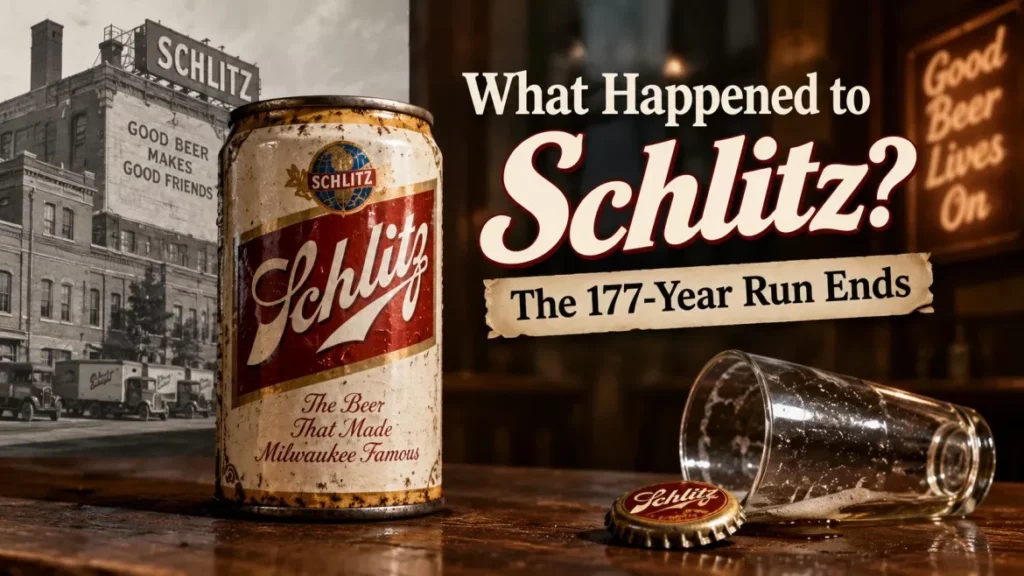

Pabst Brewing Company stopped producing Schlitz in 2026, ending a 177-year run. The final batch was brewed on 23 May 2026 by Wisconsin Brewing Company in Verona, Wisconsin, using a 1948 recipe. Pabst called the move a hiatus, blaming rising costs to store and ship the brand.
Why Pabst Stopped Brewing Schlitz
Pabst attributed the decision to distribution economics rather than to the beer itself. In its statement the company said it had “seen continued increases in our costs to store and ship certain products and have had to make the tough choice to place Schlitz Premium on hiatus.”
That phrasing matters. Schlitz was not withdrawn because of a recall, a lawsuit or a change in ownership. It was withdrawn because the volume no longer justified the warehouse space and freight required to move it around the country.
Schlitz was not the only casualty. Blatz and Old Milwaukee, two other heritage labels in the Pabst portfolio, also became harder to find over the same period. All three occupy the same commercial position: recognisable names with small, regionally concentrated followings and thin margins.
The pattern is familiar for legacy products that outlive their own market. Minute Maid frozen juice concentrate met the same fate in 2026 after an 80-year run, discontinued not because it failed but because the category around it shrank.
Is Schlitz Gone Forever or Only on Hiatus?
Pabst has not described the decision as permanent. The company’s own word was “hiatus,” which leaves the trademark intact and the door open.
Most headlines reported the news as the end of Schlitz, and in practical terms that is what it looks like. But there is a meaningful difference between a brand being retired and a brand being paused. Pabst continues to own the Schlitz name and its associated marks, and it has previously revived the label after long dormancy, reintroducing a retro formula intended to recall the pre-1970s original.
What can be said with confidence as of September 2026: no brewery is currently producing Schlitz for national distribution, and Pabst has announced no date for its return. Anyone waiting for a relaunch is waiting on a decision that has not been made publicly.
The Last Batch Was Brewed From a 1948 Recipe
Schlitz did get a deliberate send-off. Wisconsin Brewing Company, in Verona, Wisconsin, obtained permission from Pabst to brew one final batch, and brewmaster Kirby Nelson brewed it on 23 May 2026.
Nelson did not use the modern formula. He built a composite recipe drawn primarily from 1948 brewing logs from the original Milwaukee brewhouse, the period when Schlitz was the best-selling beer in the world. The grain bill used six-row malted barley with 25 per cent yellow corn grits, hopped with German Hallertau Mittelfrüh and Washington Cluster.
Nelson gave a taproom talk on the day of the brew, and preorders opened the same day through the brewery’s website. The finished beer was released publicly on 27 June 2026 at an event at the brewery.
The batch was limited and sold through that channel rather than through national distribution, which is why it did not reach shelves outside the immediate area.
Can You Still Buy Schlitz?
Only whatever remains in the supply chain. Because production has stopped rather than being recalled, cans and bottles already sitting in warehouses, liquor stores and bars remained legal to sell and continued to be sold after the final brew.
That stock is finite and unevenly distributed. Remaining inventory has tended to concentrate in the Midwest, where the brand held its strongest following, and in independent liquor stores rather than large chains that rotate slow-moving lines out quickly.
Beer does not keep indefinitely. A standard American lager is at its best within a few months of packaging, so late-found cans are likely to taste flat or papery rather than the way the brand is remembered.
How Schlitz Became the Best-Selling Beer in the World
The brewery opened in Milwaukee in 1849 under August Krug. Joseph Schlitz took control in 1858 after marrying Krug’s widow, and the company eventually carried his name.
Growth was rapid. By 1902 Schlitz was producing a million barrels a year and had passed Pabst to become the largest brewery in the United States. Its slogan, “the beer that made Milwaukee famous,” was a statement about the city’s industrial identity as much as a marketing line.
Prohibition should have ended it. The national ban on alcohol ran from 1920 to 1933 and wiped out a large share of American brewing, leaving many established companies unable to restart when it was lifted. Schlitz came through intact and moved quickly afterwards, becoming the world’s top-selling brewery in 1934, the year after repeal.
The peak lasted through the middle of the century. Schlitz traded the number one position with Anheuser-Busch repeatedly during the 1950s, and 1948 stands out as the year it was the best-selling beer in the world. That is why the brewers chose 1948 as the basis for the final batch nearly eighty years later.
One widely repeated origin story deserves a caveat. Schlitz is often credited with shipping thousands of barrels of beer to Chicago after the Great Chicago Fire of 1871, supposedly cementing the brand’s reputation. Brewing historians describe this account as a later marketing invention rather than documented history, and it should be treated with scepticism wherever it appears.
The Schlitz Mistake: The Recipe Change That Broke the Beer
The decline was self-inflicted, and it started in the early 1970s with a decision to make the beer cheaper and faster.
Schlitz began substituting corn syrup for a portion of its malted barley and switched from fresh hops to cheaper hop pellets and extracts. More damaging, it adopted a high-temperature accelerated fermentation process that cut brewing time substantially, and it aged the finished beer for less time than its competitors did.
The result was a beer that behaved differently in the glass. Under refrigeration it developed a visible haze, and drinkers noticed the change in flavour. The episode is remembered in the industry as “the Schlitz Mistake.”
Then came the recall. To sidestep a coming ingredient-labelling requirement, Schlitz swapped one additive for another. The replacement reacted badly with a foam stabiliser already in use, and in 1976 the company recalled 10 million bottles at a cost of about $1.4 million.
Even after all this, Schlitz was still the second-largest brewery in America as late as 1976. The collapse that followed was not slow.
The Advertising Campaign That Made Things Worse
Light beer arrived in force during the 1970s, and Miller Lite and Bud Light took share quickly. Schlitz answered with a light beer of its own and, in 1977, with a campaign that has since become a case study in how not to defend a brand.
The commercials confronted the viewer directly, implying menace toward anyone who might switch away from the beer. It is remembered by the nickname audiences gave it: “Drink Schlitz or I’ll kill you.”
The intent was presumably to project confidence at a moment when the brand had little. What it projected instead was desperation, and it arrived precisely when drinkers were already questioning the beer in the can.
The campaign was pulled, but the damage compounded the quality problem. A drinker who already suspected the beer had got worse was now being shouted at by it.
The 1981 Strike That Closed the Milwaukee Brewery
The end of Schlitz as an independent company came quickly. About 700 production workers went on strike on 1 June 1981. The company did not recover from the stoppage, and the historic Milwaukee brewery closed.
By the spring of 1982, Stroh Brewery Company had purchased the entire business, ending Schlitz’s existence as an independent brewer after 133 years.
Who Owns Schlitz Now?
Pabst Brewing Company owns the Schlitz brand and has since 1999, when it acquired the Stroh Brewery Company and the labels Stroh had accumulated.
Under Pabst, Schlitz became a heritage label rather than a volume product, brewed under contract and sold in limited regional circulation. It had not been brewed in Milwaukee for years before the 2026 decision, which is part of why the announcement carried a note of finality that earlier ownership changes did not.
Long-running consumer brands rarely die in a single announcement. Columbia House, which shut down in 2026 after 71 years, followed a similar arc: bought, downsized, kept alive on nostalgia, then quietly ended.
Schlitz Timeline
| Year | Event |
|---|---|
| 1849 | Brewery opens in Milwaukee under August Krug |
| 1858 | Joseph Schlitz takes control after marrying Krug’s widow |
| 1902 | Passes Pabst as the largest brewery in the United States |
| 1934 | Becomes the world’s top-selling brewery |
| 1948 | Best-selling beer in the world; the recipe used for the 2026 final batch |
| Early 1970s | Recipe and process changed to cut costs |
| 1976 | Recalls 10 million bottles at a cost of about $1.4 million |
| 1977 | The “Drink Schlitz or I’ll kill you” campaign airs |
| 1 June 1981 | About 700 workers strike; Milwaukee brewery closes |
| 1982 | Stroh Brewery Company buys the business |
| 1999 | Pabst acquires Stroh and with it the Schlitz brand |
| 23 May 2026 | Final batch brewed at Wisconsin Brewing Company |
| 27 June 2026 | Final batch released publicly |
What the End of Schlitz Actually Represents
Schlitz did not lose to a better competitor so much as to its own accounting. The changes that cut costs in the early 1970s worked exactly as intended in the short term and destroyed the product’s reputation in the medium term.
What followed was a long afterlife in which the name survived without the market position. Pabst kept it in circulation for decades after it stopped mattering commercially, which is why the 2026 announcement reads less like a death than like a death certificate issued late.
The 1948 recipe used for the final batch is the pointed detail. To give Schlitz a dignified ending, the brewers had to reach back to the formula the company itself abandoned.
Frequently Asked Questions
Is Schlitz Beer Discontinued?
Yes. Pabst Brewing Company ended production in 2026, describing the decision as placing Schlitz Premium on hiatus. No brewery is currently producing it for national distribution.
When Was the Last Schlitz Brewed?
The final batch was brewed on 23 May 2026 by brewmaster Kirby Nelson at Wisconsin Brewing Company in Verona, Wisconsin, and released publicly on 27 June 2026.
Why Did Schlitz Beer Fail?
Schlitz changed its recipe and brewing process in the early 1970s to cut costs, using corn syrup and accelerated fermentation. The beer developed a haze and lost its flavour, and a 1976 recall of 10 million bottles and a hostile 1977 ad campaign accelerated the collapse.
Who Owns Schlitz?
Pabst Brewing Company has owned the brand since 1999, when it acquired the Stroh Brewery Company, which had bought Schlitz in 1982.
Can You Still Buy Schlitz Beer?
Only remaining stock. Cans and bottles already in warehouses and stores stayed on sale after production ended, concentrated mostly in the Midwest, but that inventory is finite and no more is being made.
Was Schlitz Ever the Best-Selling Beer in the World?
Yes. Schlitz became the world’s top-selling brewery in 1934 and was the best-selling beer in the world in 1948, and it traded the number one US position with Anheuser-Busch through the 1950s.