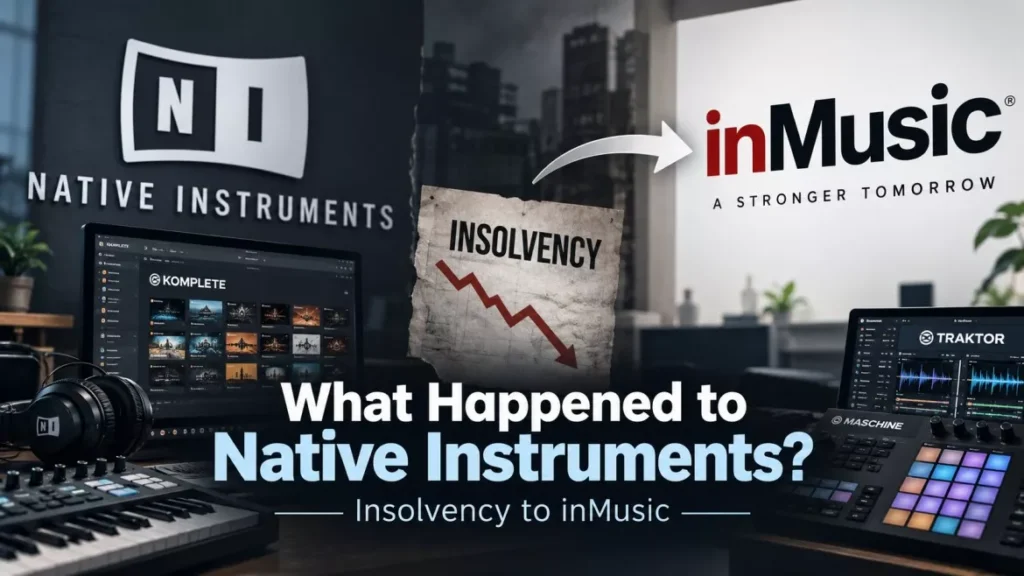

Native Instruments filed for preliminary insolvency at the Berlin-Charlottenburg district court on 27 January 2026, and inMusic, the owner of Akai Professional and Moog Music, agreed to buy it on 8 May 2026. The brand survived the sale; roughly 100 employees did not. Kontakt was last updated on 4 September 2026.
Why Did a Company With 25 Million Users Run Out of Money?
Debt built up under private equity ownership, not a collapse in demand for its software.
Native Instruments is a music software company founded in Berlin in 1996. Its catalogue sits underneath a large share of modern music production: Kontakt, the sampler that most commercial orchestral, cinematic and instrument libraries are built to run inside; Traktor, a DJ platform used in clubs and on radio; Maschine, a hardware groovebox paired with its own software; and Komplete, the bundle that packages most of the company’s instruments and effects together. inMusic put the registered user base at more than 25 million.
That reach is why an insolvency filing by a mid-sized German software firm became international news among producers. If Kontakt stopped working, thousands of third-party sample libraries from other companies would stop working with it.
The hardware side compounded the exposure. Native Instruments also sells Komplete Kontrol keyboards and Maschine controllers built to pair with its own software, and it distributes a free Kontakt Player that other developers depend on to deliver libraries to customers who do not own the full sampler. An abrupt shutdown would have stranded paying customers of companies that never had any commercial relationship with Native Instruments at all.
The ownership trail matters more than the product line. Native Instruments raised money from EMH Partners in 2018, and in January 2021 the private equity firm Francisco Partners took a majority stake. Francisco Partners then assembled a wider audio group, adding iZotope, Plugin Alliance and Brainworx, and briefly placed the brands under a holding name called Soundwide. Soundwide cut about 8 percent of its global workforce in January 2023, and the holding brand was retired later that year when Native Instruments became the parent name again.
According to Brian T. Majeski, editor of the trade magazine Music Trades, losses in the hundreds of millions accumulated across that period. Trade coverage of the filing consistently identified the cost of servicing that debt, rather than any loss of standing among musicians, as the reason the company ran out of room.
The Collapsed Sale That Triggered the January Filing
Francisco Partners had a buyer lined up, and the insolvency filing followed within weeks of that deal failing.
The European Commission cleared a proposed acquisition of joint control of the Native Instruments group by Bridgepoint and Bain Capital Credit in late 2025. The transaction never completed. On 27 January 2026, Native Instruments and several associated German holding companies entered preliminary insolvency proceedings, and the court appointed Prof. Dr. Torsten Martini as preliminary administrator.
What Preliminary Insolvency Actually Means
It is a protective process, not a shutdown. Under German law, preliminary insolvency suspends creditor enforcement and places an administrator alongside existing management while the business keeps trading and a buyer is sought. Liquidation is one possible outcome; a sale is another, and a sale is what happened here roughly three and a half months later.
Nick Williams, then the company’s chief executive, told customers at the time that products, platforms, services, downloads and customer service remained fully available. Plugin Alliance stated on 28 January 2026 that its Langenfeld operation and its United States business were not part of the proceedings.
The sequence matters for understanding the story. This was not a company that stopped selling software and then failed. It was a company whose owner needed to sell it in order to service borrowings, could not close that sale, and filed when the alternative ran out. Trading continued throughout.
Who Owns Native Instruments Now?
inMusic, a privately held American audio group, has owned Native Instruments since signing a definitive acquisition agreement on 8 May 2026.
The agreement was signed at Superbooth, the Berlin synthesizer trade show, ending three months of uncertainty for customers and staff. inMusic’s other brands include Akai Professional, Moog Music, Denon DJ, Numark, Rane, M-Audio, Alesis and Alto Professional. That made the buyer an unusually close fit on paper: an owner whose revenue already comes from making musical instruments rather than from financial engineering.
Jack O’Donnell, inMusic’s chief executive, said in the announcement that Native Instruments offered “exceptional products, a deeply engaged community, and a clear point of view on what musicians want”, and told users that “the tools you rely on today will keep working, and the tools you will rely on tomorrow are actively being built”. Williams said the company had found “a partner whose beliefs and ambitions align with ours”.
Financial terms were not disclosed. iZotope, Plugin Alliance and Brainworx were named as part of the deal alongside Kontakt and Traktor.
What Changed After inMusic Took Over
Within about ten weeks of the deal, roughly 100 jobs went, the United Kingdom office closed, and both of the company’s most senior executives left.
The July 2026 Job Cuts
The cuts were first reported in July 2026 by Synth Anatomy and then by MusicTech, which put the figure at around 100 people across nearly every department, including the entire customer support team. That reporting rested on anonymous former employees rather than a company announcement. Native Instruments declined to comment when MusicTech approached it, and neither company has published an official number.
The UK Office Closure and Leadership Exit
In August 2026, MusicTech, MusicRadar and Synth Anatomy reported that inMusic had closed the Native Instruments office in the United Kingdom. Roles said to have gone with it included product manager, engineering manager, chief financial officer, vice president of global marketing and vice president of product design, several of them attached to work on Maschine, Kontakt and Komplete.
Company filings from July 2026 showed that chief executive Nick Williams and chief product and technology officer Simon Cross had been removed, with Richard Seymour, chief executive of inMusic Europe, taking over. inMusic has characterised the restructuring as simplifying an organisational and legal structure that grew during the private equity years.
One caution worth stating plainly, because most coverage does not: the headcount figure is credible and consistently reported across several outlets, but it is not a number either company has confirmed. Read it as well-sourced reporting, not as an official disclosure.
Native Instruments From 1996 to 2026
| Date | Event |
|---|---|
| 1996 | Founded in Berlin |
| 2018 | EMH Partners invests in the company |
| January 2021 | Francisco Partners takes a majority stake |
| 2022 | Grouped with iZotope, Plugin Alliance and Brainworx under Soundwide |
| January 2023 | Soundwide cuts about 8 percent of its global workforce |
| 2023 | Soundwide brand retired; Native Instruments becomes the parent name |
| Late 2025 | EU clears a Bridgepoint and Bain Capital Credit deal, which then fails |
| 27 January 2026 | Preliminary insolvency filed in Berlin; administrator appointed |
| 8 May 2026 | inMusic signs a definitive agreement to acquire the company |
| July 2026 | About 100 jobs reportedly cut across most departments |
| August 2026 | UK office reportedly closed; chief executive and CPTO depart |
| 4 September 2026 | Kontakt 8.13 released |
Is Native Instruments Still Operating?
Yes. As of 5 September 2026, Native Instruments trades as an inMusic brand and is still shipping software updates.
The most recent verified release is Kontakt 8.13, issued on 4 September 2026. It added interface work to the Navigator and to the instrument headers, including level meters, favourites buttons and instrument reordering, along with a new save dialogue for snapshots, further tooling for instrument builders and a set of bug fixes. Downloads, licence activations and the account system have run without interruption through the insolvency, the sale and the restructuring.
Berlin remains the operational base. What is genuinely unsettled is the roadmap. With the support team and several product staff gone, response times and release cadence over the next year are the things worth watching, and neither company has published a public product roadmap since the takeover.
What the Takeover Means If You Own Kontakt, Komplete or Traktor
Your licences still work, and nothing you have already bought has been withdrawn.
Both companies committed at the point of sale to keeping products, platforms, downloads, licences and customer support available, and that has held through September 2026. Third-party Kontakt libraries continue to load, and other developers have carried on releasing for the platform, which is the practical signal that matters most: Kontakt functions as shared infrastructure for a large part of the sample library industry, and that industry has not moved away from it.
Two practical notes. Keep your own copies of installers and licence details rather than depending entirely on a download portal. That is ordinary caution during any change of ownership, not a prediction of failure. And if you are weighing an upgrade, the fair reading is that the platform sits on firmer ground under an instrument company than it did under a debt-loaded holding structure, while slower customer support is a realistic consequence of the cuts.
The group with the most genuine reason for caution is anyone who has recently bought a Native Instruments hardware controller and expects years of firmware support, since hardware development was among the areas reported to be affected by the July 2026 cuts.
What to Watch Between Now and 2027
Four things will show whether the rescue worked, and all four are checkable rather than speculative.
- Support response times. The customer support team was reportedly cut in full in July 2026. Whether inMusic rebuilds that function, outsources it or leaves it thin is the clearest near-term test.
- Release cadence. Kontakt 8.13 on 4 September 2026 is the benchmark. Steady point releases through 2027 would indicate the engineering base survived the cuts; a long silence would suggest otherwise.
- A published roadmap. Neither company has issued one since the takeover. A stated plan for Kontakt, Maschine and Traktor would settle most of the remaining questions.
- Leadership stability. Richard Seymour took charge after the removal of Nick Williams and Simon Cross. Further senior turnover would suggest the integration is still unsettled.
Nothing in the public record as of September 2026 points to the products being discontinued. The open question is quality of service, not survival.
Frequently Asked Questions
Did Native Instruments Go Out of Business?
No. It entered preliminary insolvency on 27 January 2026 and was acquired by inMusic on 8 May 2026. The company continues to trade and to release software.
Who Owns Native Instruments Now?
inMusic, the American audio group behind Akai Professional, Moog Music, Denon DJ, Numark, Rane, M-Audio and Alesis, has owned it since May 2026.
Will Kontakt and Traktor Keep Working?
Yes. Licences, activations and downloads have continued without interruption, and Kontakt received a version 8.13 update on 4 September 2026.
Why Did Native Instruments Become Insolvent?
Debt accumulated under private equity ownership. A sale to Bridgepoint and Bain Capital Credit was cleared by the European Commission in late 2025 but did not complete, and the insolvency filing followed weeks later.
How Many People Lost Their Jobs?
Around 100, according to reports published in July 2026 that were based on anonymous former employees. Neither inMusic nor Native Instruments has confirmed an official figure.
Is iZotope Still Part of Native Instruments?
Yes. iZotope, Plugin Alliance and Brainworx were named as part of the inMusic acquisition. Plugin Alliance said its Langenfeld and United States operations were not included in the January 2026 insolvency proceedings.