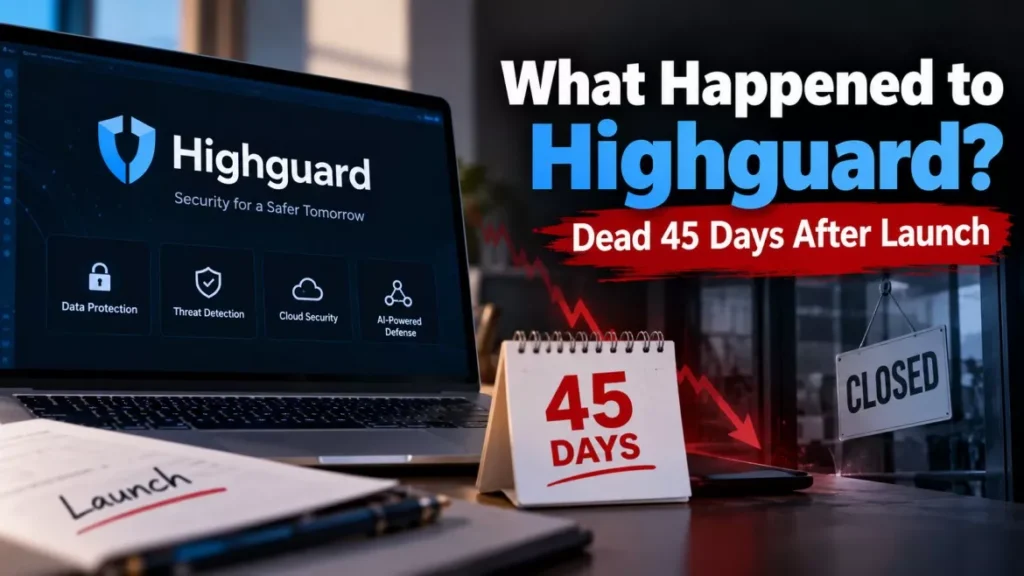

Highguard shut down permanently 45 days after launch. Wildlight Entertainment released the free-to-play hero shooter on 26 January 2026 and took its servers offline on 12 March 2026. The studio said it had not been able to build a sustainable player base to support the game long term.
How Fast Did Highguard Collapse?
Highguard lost roughly 80% of its Steam players within 24 hours of release and never came close to its launch numbers again.
The game arrived with unusual visibility. It was revealed in December 2025 as the closing world premiere of The Game Awards, a slot the show’s host Geoff Keighley gave it, and Forbes reported the placement was not paid promotion. The reveal trailer drew heavy criticism, and Wildlight chief executive Dusty Welch later said the studio shared the blame for how it landed.
The figures after release left little room for interpretation.
| Date | Development |
|---|---|
| December 2025 | Revealed as the final world premiere at The Game Awards |
| 26 January 2026 | Launches free-to-play on PC, PlayStation 5 and Xbox Series X and S; peaks above 97,000 concurrent players on Steam |
| 27 January 2026 | Steam concurrents fall below 20,000 |
| 11 February 2026 | Wildlight confirms layoffs, keeping only a core group of developers |
| Mid-February 2026 | Daily Steam peaks sit near 1,600 |
| Late February 2026 | Daily Steam peaks drop below 600 |
| 3 March 2026 | Wildlight announces the permanent shutdown |
| 12 March 2026 | Servers go offline shortly after 18:00 UTC |
| 17 to 18 March 2026 | Sony begins refunding PlayStation 5 purchases; Wildlight’s website and LinkedIn page come down |
Wildlight said in its shutdown announcement that more than two million players had entered Highguard since launch. Almost none of them stayed.
Why Did Highguard Shut Down?
Highguard closed because it could not retain enough players to justify running it, not because nobody tried it.
Player reviews on Steam sat at “Mostly Negative” during the opening days and recovered only as far as “Mixed” over the first week. Critics were lukewarm rather than hostile: the PC version finished on 63 out of 100 on Metacritic across 29 reviews, and the PlayStation 5 version on 62 across 10.
The complaints were consistent. Reviewers and players described the three-versus-three matches as slow, the systems as needlessly complicated, and the maps as too large for the player counts they were built around. Wildlight responded after launch by adding a five-versus-five mode, but the audience had already gone.
The game had been in development for more than three years. Former staff told The Ringer that leadership declined to run wider public testing before release, relying instead on the playbook the team had used at Respawn Entertainment on Apex Legends.
Who Paid for Highguard, and Why Did the Money Stop?
Reporting in February 2026 identified TiMi Studio Group, a Tencent subsidiary, as Highguard’s undisclosed primary financial backer, and said Tencent then withdrew its funding.
Game File reported the TiMi backing, citing unnamed sources. Bloomberg reported, also through unnamed sources, that Wildlight management told staff at an all-hands meeting that Tencent had pulled out. The Ringer reported that the financing had been tied to retention targets the game never approached.
Two points are worth stating plainly. First, Wildlight had presented itself publicly as an independent studio, which is why the reported backing became a story of its own. Second, neither Tencent, TiMi nor Wildlight has ever confirmed the arrangement, so it remains reported rather than established.
What is confirmed is the consequence. On 11 February 2026, a little over two weeks after launch, Wildlight acknowledged it had laid off most of its staff and retained only a core group to support the game.
Was Highguard a Worse Failure Than Concord?
Highguard survived 45 days, which is 31 days longer than Concord managed in 2024.
The two failures are not the same shape. Concord, made by Firewalk Studios for Sony, sold for about $40, drew a tiny audience, and was withdrawn after 14 days with refunds. Highguard was free, so it had no price barrier at all and pulled in more than two million players.
That difference matters for anyone reading Highguard as a story about marketing. Highguard did not fail to find an audience. It found one of the larger launch audiences of any new shooter that year and lost it inside a week, which points at the game rather than at the pitch. Live-service shooters that close this quickly, such as Call of Duty: Warzone Mobile, usually leave behind the same question about how much runway a publisher is willing to fund.
Can You Still Play Highguard?
No. Highguard is completely unplayable and cannot be bought on any platform.
The game was multiplayer-only and ran entirely on Wildlight’s servers. There is no single-player mode, no offline mode and no sanctioned private-server option, so an installed copy launches into nothing. It was delisted from digital storefronts before the servers closed, which means it cannot be downloaded again either.
This is the same outcome Anthem reached in January 2026, and the reason campaigns such as Stop Killing Games argue for mandatory offline modes. No fan preservation project or revival for Highguard has been reported.
Did Highguard Players Get Their Money Back?
PlayStation 5 players were refunded automatically from around 17 March 2026, while no comparable programme was reported for Steam or Xbox.
Players reported that Sony returned money spent on in-game currency and additional content without anyone having to ask for it. That drew attention because Sony’s refund rules are normally stricter than Steam’s, and because the studio behind the game had effectively stopped responding by then.
Sony never issued a public statement explaining the scope of the refunds, and Wildlight did not comment. The total amount returned, and whether every PlayStation buyer was covered, was never officially confirmed.
What Happened to Wildlight Entertainment?
Wildlight Entertainment stopped operating in public in March 2026 without ever announcing that it had closed.
The studio was founded largely by veterans of Respawn Entertainment who had worked on Apex Legends, and Highguard was the only game it ever released. Its directors were Chad Grenier and Jason McCord.
The signs came in sequence. Wildlight’s website went down around 17 February 2026, and a developer told players on Discord that fixing it was a low priority because the reputational damage had already been done. By mid-March the website returned a 404 error and the company’s LinkedIn page had been deleted. Grenier’s own LinkedIn profile lists his time at Wildlight as ending in March 2026.
As of 30 October 2026, there has been no formal closure announcement from Wildlight, no public statement from the studio since March 2026, and no new project announced by its former leadership. Quiet disappearances of this kind are now common enough to have a pattern, as the liquidation of Spiders Studio showed two months later.
Frequently Asked Questions
When Did Highguard Go Offline?
Highguard’s servers were switched off shortly after 18:00 UTC on 12 March 2026. Wildlight had announced the date nine days earlier, on 3 March 2026.
How Many People Played Highguard?
Wildlight said more than two million players tried the game in total. Its highest recorded concurrent figure was above 97,000 on Steam on launch day, 26 January 2026.
Was Highguard a Paid Game?
No. Highguard was free to play, and its revenue came from optional in-game purchases such as cosmetics and premium passes.
Did Steam and Xbox Players Receive Highguard Refunds?
No automatic refunds were reported on either platform. The refunds that were reported in March 2026 applied to PlayStation 5 purchases only.
Who Made Highguard?
Wildlight Entertainment developed and published Highguard using Unreal Engine 5, under directors Chad Grenier and Jason McCord. The studio’s chief executive was Dusty Welch.