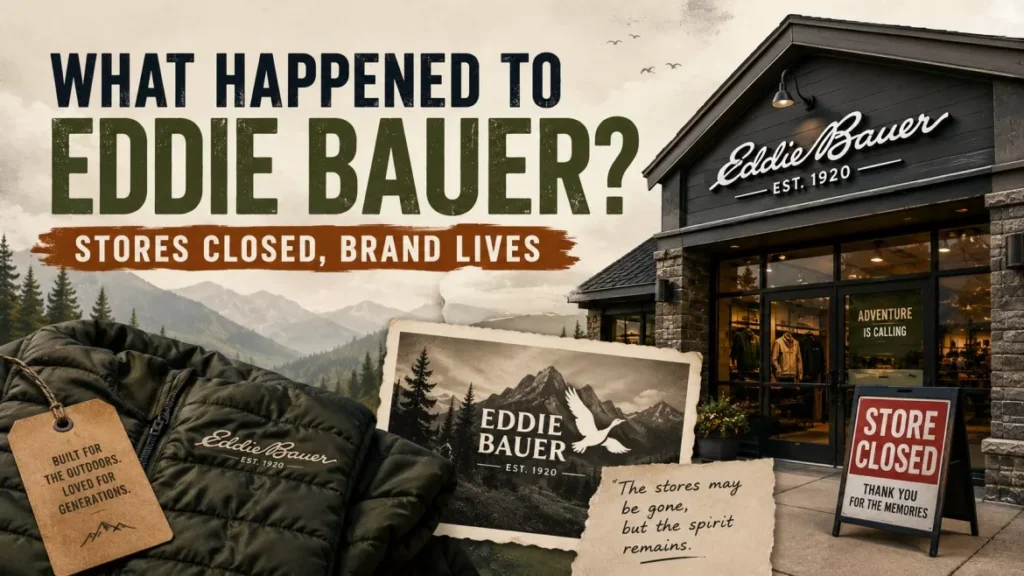

Eddie Bauer’s North American stores are gone. The company that ran them, Eddie Bauer LLC, filed for Chapter 11 bankruptcy on 9 February 2026 and shut all roughly 175 remaining locations in the United States and Canada by 30 April. The brand outlived the company, and Eddie Bauer products are still sold online.
Why the Stores Closed but the Brand Did Not
The business that failed was a store operator, not the brand itself. Eddie Bauer had been split into separate pieces for years: one company owns the name, another pays for the right to sell products under it, and a third ran the shops.
When Eddie Bauer LLC filed for bankruptcy, only the shop-running piece collapsed. The trademark and the licensing rights sat with a different owner and were never part of the case.
That is why shoppers saw closing-down signs in malls through March 2026 while the website kept taking orders. Two separate companies were involved, and only one of them ran out of money.
This structure is common across American retail, and it changes what a bankruptcy means. When a brand owner licenses a name to an operator, the operator carries the rent, the staff, the stock and the licence fees, while the owner collects a fee and keeps the trademark.
If the operator fails, the brand owner simply appoints a different licensee. The name survives because it was never the thing that went bankrupt.
Who Owns Eddie Bauer Now?
Authentic Brands Group owns the Eddie Bauer trademark and licenses it to operating partners. Authentic acquired the brand together with SPARC Group in June 2021 and has held the intellectual property since.
The stores were run by Catalyst Brands, a joint venture created in January 2025 by merging SPARC Group with JCPenney. Its shareholders include Simon Property Group, Brookfield, Authentic Brands Group and Shein, and its wider portfolio covers Aeropostale, Brooks Brothers, Lucky Brand and Nautica.
The online and wholesale side had already moved before the collapse. On 8 January 2026, Authentic announced an expanded partnership with Outdoor 5, LLC, a long-standing licensee, covering Eddie Bauer’s e-commerce, wholesale, and design and product development across the United States and Canada.
Jarrod Weber, Authentic’s Global President for Sports and Lifestyle, said in that announcement that the relationship with Oved had been “built on trust, shared vision, and operational excellence”. Outdoor 5 chief executive David Oved said the company saw “tremendous opportunity to meet consumers where they are, shopping online and through leading multi-brand retailers”.
Three Bankruptcies in Two Decades
Eddie Bauer opened his first shop in downtown Seattle in 1920, at the age of 21. In 1940 he patented the first quilted goose-down insulated jacket in the United States and sold it as the Skyliner, a design that shaped modern outerwear.
February 2026 was the third insolvency connected to the name in just over twenty years, and each involved a different corporate owner. The first came in 2003, when parent company Spiegel filed for Chapter 11. Eddie Bauer Holdings then filed its own Chapter 11 case in June 2009 and was sold.
The 2026 filing was structurally different. By then the brand had already been separated from the operating company, so only the retail arm went into court. That difference is the reason this bankruptcy killed the shops without killing the label.
What the Court Filings Revealed About the Money
Sales had been sliding for years before the filing. Court filings show revenue fell about 19 percent, from roughly $711 million in 2022 to about $577 million in 2025.
Losses widened far faster than sales shrank. The operator lost roughly $2 million in 2022 and about $10 million in 2023, then about $82 million in 2024 and about $80 million in 2025.
The licence itself became part of the trap. Fixed fees owed to the brand owner did not fall when sales did, and the filings put roughly $220 million of future licensing obligations at stake. Stephen Coulombe, a managing director at Berkeley Research Group who served as co-chief restructuring officer, told the court that sales “had declined to an extent that they could no longer support payment of the fixed licensing fees”.
Court filings listed about $1.7 billion in total debt. Marc Rosen, chief executive of Catalyst Brands, pointed to declining sales and supply chain problems that predated the joint venture, compounded by inflation and tariff uncertainty.
Footfall told the same story from the outside. Analysis published by the location-data firm Placer.ai found visits to Eddie Bauer stores fell 9.7 percent year on year in 2024, against 4.1 percent for sportswear and athleisure brands and 3.7 percent for traditional apparel.
The same analysis pointed to a mismatch between where the chain traded and who it sold to. Eddie Bauer leaned heavily on outlet centres, but its 2025 customer base skewed older and more affluent than the typical outlet shopper, with a smaller share of families and younger buyers than outlet malls usually draw.
Meanwhile the category moved. Shoppers shifted towards athleisure, technical performance wear and fast fashion, while mall traffic thinned and digital-native rivals took share. Eddie Bauer is not the only heritage retail name to reach insolvency this decade, and The Body Shop’s bankruptcy and United States store closures followed a broadly comparable path.
How the Wind-Down Unfolded, Step by Step
The case moved quickly from a rescue attempt to a liquidation. It was assigned to Judge Stacey L. Meisel in the United States Bankruptcy Court for the District of New Jersey as case number 26-11422, with a parallel insolvency process covering the Canadian stores.
| Date | What Happened |
|---|---|
| 8 January 2026 | Authentic moves Eddie Bauer e-commerce and wholesale licence to Outdoor 5 |
| 9 February 2026 | Eddie Bauer LLC and four affiliates file Chapter 11 in New Jersey |
| 23 February 2026 | Plan and disclosure statement filed |
| 3 March 2026 | Bid deadline passes with no qualified offer |
| 6 March 2026 | Auction cancelled for lack of bidders |
| 12 March 2026 | Last day gift cards and rewards points accepted in stores |
| 16 April 2026 | Plan confirmation hearing |
| 30 April 2026 | Store closing sales end and the last North American shops shut |
| 6 May 2026 | Plan effective date; the business becomes a wind-down estate |
A single offer for the store business arrived in late February, but the company’s advisers judged it inadequate and it did not qualify as a bid. With nothing else on the table, the sale track closed and the wind-down became the only route.
The company had begun 2026 with about 220 shops. Some leases lapsed in January, leaving roughly 175 trading when the petition was filed.
Why No Buyer Came Forward
The company entered bankruptcy on a dual track, hoping to sell the stores as a going concern while preparing an orderly wind-down if that failed. The restructuring support agreement behind that plan was backed by all of the company’s existing lenders, which gave the sale process a firm deadline rather than an open-ended search.
The stores were marketed as property rather than as a business. Real estate advisers RCS Real Estate Advisors were brought in to sell roughly 174 store leases, spread across about 150 locations in 40 American states and 24 locations in six Canadian provinces.
That framing tells you what was actually for sale. A buyer would have taken on mall leases attached to a chain losing about $80 million a year, without owning the brand on the door, and would still have had to negotiate a licence with Authentic Brands Group to keep trading under the name.
The deadline for a stalking horse bidder passed on 27 February with no qualifying offer. Once the 3 March bid deadline came and went, the auction set for 6 March had nothing to auction.
Can You Still Buy Eddie Bauer?
Yes. As of 26 August 2026, the Eddie Bauer website is trading normally, taking orders, running seasonal promotions and operating its Adventure Rewards loyalty programme.
The site is run under licence by Outdoor 5, not by the bankrupt store operator. Eddie Bauer products have also continued to reach shoppers through wholesale partners, including JCPenney.
What no longer exists is the shop. There is no Eddie Bauer store to walk into anywhere in the United States or Canada, and no announcement of any plan to open one.
What Happened to Gift Cards, Rewards Points and Returns?
Gift cards and Adventure Rewards points stopped being accepted in the closing stores after 12 March 2026. Customers had roughly a month from the February filing to use them.
Purchases made during the closing-down sales were final. The liquidation ran on an all-sales-final basis, without returns or exchanges.
Those deadlines were set out for the closing stores. The court filings did not describe a separate arrangement for the online business, which is operated by a different licensee, so anyone holding an older card is dealing with a changed corporate structure rather than the company that issued it.
Claims against the store operator now sit with a wind-down estate rather than a trading business. A plan administrator took over responsibility for distributions and remaining claims after 6 May 2026, and the court set 10 August 2026 as the bar date for government claims.
Is Eddie Bauer Still Open Outside North America?
Yes. The Chapter 11 case covered only the United States and Canada, and shops outside North America are run by separate licensees that were never part of the filing.
The largest of those markets is Japan, where about 20 Eddie Bauer stores were trading when the bankruptcy began. Those businesses were unaffected by the American proceedings.
For readers outside North America, the practical result is that a local Eddie Bauer presence depends on the local licensee, not on what happened in a New Jersey courtroom.
Frequently Asked Questions
Is Eddie Bauer Out of Business?
Not entirely. The company that operated its North American stores went through Chapter 11 and closed every shop by 30 April 2026, but the brand is still owned by Authentic Brands Group and still sells online and through wholesale partners.
Why Did Eddie Bauer Close Its Stores?
Sales fell about 19 percent between 2022 and 2025 while losses reached roughly $80 million a year, and fixed licensing fees did not fall with revenue. No qualified buyer emerged for the store business by the March 2026 bid deadline, so the stores were liquidated.
Who Owns Eddie Bauer Now?
Authentic Brands Group owns the Eddie Bauer trademark. Outdoor 5, LLC holds the licence for e-commerce and wholesale in the United States and Canada, an arrangement announced on 8 January 2026.
When Did the Last Eddie Bauer Stores Close?
Store closing sales ended on 30 April 2026, which was the final trading day for the last North American locations. The Chapter 11 plan took effect on 6 May 2026.
Can I Still Use an Eddie Bauer Gift Card?
Gift cards and Adventure Rewards points were not accepted in the closing stores after 12 March 2026. Because those stores no longer exist, any remaining balance relates to a business now in wind-down.
Are Eddie Bauer Stores in Japan Still Open?
Yes. About 20 stores in Japan are run by a separate licensee and were not included in the United States bankruptcy, so they were not affected by the North American closures.