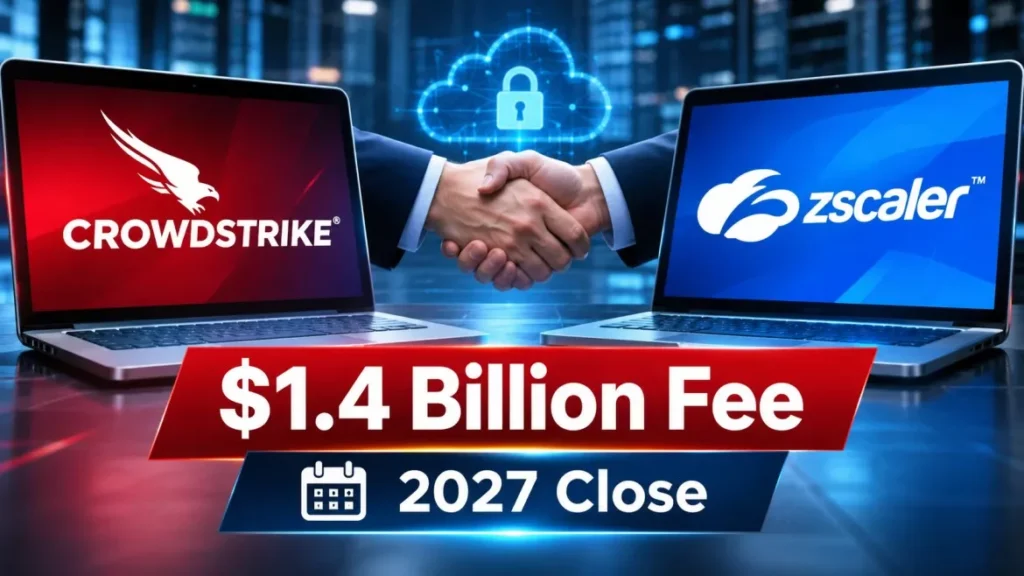

CrowdStrike has agreed to buy Zscaler in an all-stock deal valued at about $43.9 billion. The CrowdStrike Zscaler deal hands Zscaler holders 1.135 CrowdStrike shares for each share they own, worth about $260.41 based on CrowdStrike’s 20 November closing price. Both companies announced the agreement on 23 November 2026.
The two are United States-listed cybersecurity vendors selling worldwide, and the terms below come from their joint announcement and from CrowdStrike’s merger filing with the Securities and Exchange Commission, the US markets regulator. Nothing changes for either company’s customers on signing. The filing sets out a timetable that runs well into 2027.
What CrowdStrike Agreed to Pay for Zscaler
CrowdStrike is paying entirely in its own shares, with no cash component. The exchange ratio is the number of CrowdStrike shares a Zscaler holder receives for each Zscaler share.
| Term | Detail |
|---|---|
| Structure | All-stock acquisition, no cash |
| Exchange ratio | 1.135 CrowdStrike shares per Zscaler share |
| Implied value per Zscaler share | About $260.41, based on CrowdStrike’s 20 November 2026 close |
| Enterprise value | About $43.9 billion |
| Premium | About 34% to Zscaler’s 20 November 2026 close |
| Ownership after close | CrowdStrike holders about 84.1%, Zscaler holders about 15.9% |
| Announced | 23 November 2026 |
Both boards approved the agreement unanimously. Jay Chaudhry, Zscaler’s founder, chairman and chief executive, together with affiliated trusts holding about 34% of Zscaler’s outstanding shares, has signed a voting and support agreement committing those shares in favour of the deal. A second agreement commits Chaudhry to vote his CrowdStrike shares in line with the CrowdStrike board’s recommendation after closing, running until the later of the third anniversary of closing and the date he leaves that board.
Measured by headline value, the deal is larger than the recent comparisons in enterprise security. Google agreed to pay $32 billion for the cloud security company Wiz, after an earlier approach at a lower figure, and Palo Alto Networks bought CyberArk for about $25 billion.
Why the $43.9 Billion Figure Is Already Out of Date
The headline price is a snapshot, not a fixed sum. Because CrowdStrike is paying in shares at a set ratio rather than in dollars, the value Zscaler holders receive moves with CrowdStrike’s share price every day until closing.
The $260.41 per share and the $43.9 billion in the companies’ joint announcement both rest on CrowdStrike’s closing price of about $229.44 on Friday 20 November 2026. CrowdStrike shares fell sharply once the deal was announced. Reported intraday readings on Monday 23 November put the stock down roughly 9% to 11%, with one snapshot at $204.48 at 2:17pm New York time. At that price the 1.135 ratio implies about $232 a Zscaler share rather than $260.41. Zscaler shares rose roughly 15% to 16% over the same session. The New York session had not closed when this article was published, so these are intraday figures and not confirmed closing prices.
The agreement contains no collar and no price floor, meaning no mechanism that adds shares if CrowdStrike’s price falls. There is one exception, and it moves in the other direction: the filing states the ratio is automatically reduced by the smallest amount necessary if the shares to be issued would otherwise exceed one share less than 20.0% of CrowdStrike’s outstanding stock, a Nasdaq listing threshold. At the announced split of about 15.9% to Zscaler holders, that ceiling is not currently in play.
When the CrowdStrike Zscaler Deal Can Actually Close
The companies expect to close “in the second half of CrowdStrike’s fiscal year 2028”, which is not a calendar date. CrowdStrike’s financial year ends on 31 January, so its fiscal 2028 runs from 1 February 2027 to 31 January 2028, and the second half of it runs from 1 August 2027 to 31 January 2028.
In plain calendar terms, the companies are guiding to a close between August 2027 and January 2028 — roughly nine to fourteen months after the announcement. The merger agreement then sets hard outer limits:
- 23 November 2027: the End Date. If the merger has not taken effect by then, either company may terminate the agreement.
- 23 February 2028: the End Date extends automatically to this date, but only if the sole outstanding conditions relate to antitrust or foreign direct investment law.
- Up to 60 further days: a United States government shutdown that suspends or delays review under the Hart-Scott-Rodino Act extends the date day for day, capped at 60 days in total.
As of 23 November 2026, the agreement is signed but not closed, no regulatory decision has been announced in either direction, and Zscaler shareholders have not yet voted. Until closing, the filing states the two businesses operate independently of each other.
What Has to Happen Before Closing
Four sets of conditions stand between signature and completion, according to the merger filing.
- Zscaler shareholder approval: Zscaler holders must adopt the merger agreement. Chaudhry’s roughly 34% block is already committed in favour.
- Antitrust and investment clearance: the waiting period under the Hart-Scott-Rodino Antitrust Improvements Act must expire or terminate, along with any other applicable antitrust or foreign direct investment review.
- Registration and listing: CrowdStrike’s Form S-4 registration statement must become effective, and Nasdaq must approve the new shares for listing.
- No blocking order: no final, non-appealable injunction, order or law prohibiting the merger may be in force.
One clause gives CrowdStrike unusual latitude. Clearance must arrive without any “Burdensome Condition” that CrowdStrike has not accepted in its sole discretion — meaning CrowdStrike is not obliged to accept remedies a competition authority might demand, such as divesting a business or giving binding undertakings, in order to get the deal through.
Zscaler has also agreed not to solicit, initiate or knowingly facilitate alternative acquisition proposals, and, subject to exceptions, not to negotiate with other bidders or withdraw its board recommendation.
The $1.4 Billion Fee Runs One Way
Zscaler would owe CrowdStrike a termination fee of $1,400,000,000 in specified circumstances, chiefly if its board changes its recommendation or if it terminates to accept a superior proposal. According to CrowdStrike’s 8-K filing, the fee runs in one direction only: no corresponding payment from CrowdStrike to Zscaler is provided for, and the filing specifies no fee if a regulator blocks the transaction. For scale, the site’s earlier reporting on the Proofpoint acquisition of Varonis recorded a break fee of $211.7 million on a roughly $6.3 billion deal.
What Changes for Customers, and When
In the near term, nothing. Both companies remain independent until closing, which on their own guidance is at least nine months away, so existing contracts, support arrangements and product roadmaps continue as they are.
The two already work together. The companies say they share more than 2,000 customers and 16 product integrations. CrowdStrike’s Falcon platform covers endpoint, identity and cloud security, while Zscaler sells cloud-delivered network security and zero trust access — an architecture that authenticates every request rather than trusting anything inside a network perimeter. The companies describe the products as largely complementary rather than overlapping.
After closing, the companies say customers of either business will be able to buy the other’s products on a single Falcon Flex contract. CrowdStrike has identified about 8,000 Zscaler customers that are not yet CrowdStrike customers as its cross-selling target, and estimates the deal expands its addressable market by more than $185 billion in calendar year 2029.
Industry analysts quoted on the day flagged integration as the open question rather than strategy. Yih Khai Wong of IDC said CrowdStrike is “buying into adjacent control points rather than building them organically”, and noted that the existing partnership already delivers much of the value, with ownership mainly adding control over roadmap and integration pace. Today the Falcon sensor and Zscaler’s client run as separate software agents, on separate clouds, with separate release schedules; Wong cautioned that a merged agent would mean a single incident “could affect both the endpoint agent and the access control plane”. Piper Sandler described the deal as carrying meaningful execution risk, while Jefferies said the limited overlap between the two businesses makes regulatory risk look manageable. These are analyst assessments, not findings by any regulator.
Both Companies Reported Earnings the Same Day
The announcement landed alongside two quarterly reports, both for the quarter ended 31 October 2026. That is what makes the combined revenue claim checkable.
| Measure | CrowdStrike, Q3 FY2027 | Zscaler, Q1 FY2027 |
|---|---|---|
| Revenue | $1.58 billion, up 28% | $949.3 million, up 20% |
| Annual recurring revenue | $6.26 billion, up 27% | $3.88 billion, up 21% |
| Net new ARR | $419.2 million, up 58% | About $111 million |
| Free cash flow | $474.4 million (30% margin) | $416.5 million (44% margin) |
| Earnings per share | $0.02 GAAP, $0.34 non-GAAP | Net loss of $27.4 million; $1.23 non-GAAP |
Annual recurring revenue, or ARR, is the annualised value of subscription contracts in force. The two figures together come to about $10.1 billion, which supports the companies’ statement that the combined business would start with more than $10 billion in combined ARR at closing.
Zscaler withdrew its previously issued financial guidance and cancelled its scheduled results call, replacing it with a joint call with CrowdStrike on 23 November. CrowdStrike raised its own full-year fiscal 2027 outlook, guiding to ARR of $6,712.2 million to $6,716.2 million and revenue of $6,078.1 million to $6,084.1 million. CrowdStrike says the acquisition would be significantly and immediately accretive to free cash flow per share before synergies, and expects about $1 billion of annualised revenue synergies over the first 30 months after closing and $500 million of annualised cost synergies within 18 to 24 months, from data centre, vendor and operational changes. Those are company projections, not results.
Frequently Asked Questions
When Will the CrowdStrike Zscaler Deal Close?
The companies guide to the second half of CrowdStrike’s fiscal year 2028, which runs from 1 August 2027 to 31 January 2028. Either side may terminate if the merger has not taken effect by 23 November 2027, a date that extends automatically to 23 February 2028 if only antitrust or foreign investment conditions remain.
What Do Zscaler Shareholders Receive?
Each Zscaler share converts into 1.135 CrowdStrike shares, plus cash in place of any fractional share. There is no cash consideration beyond that.
Does the $43.9 Billion Value Change if CrowdStrike’s Share Price Moves?
Yes. The exchange ratio is set and the price is not, so the value of the consideration moves with CrowdStrike’s share price until closing. The $43.9 billion figure and the $260.41 per-share value both rest on CrowdStrike’s 20 November 2026 closing price.
Who Pays the $1.4 Billion Termination Fee?
Zscaler would pay it to CrowdStrike, in specified circumstances such as a change in its board’s recommendation or terminating to accept a superior proposal. The filing provides for no payment in the other direction and specifies no fee if a regulator blocks the deal.
Does Anything Change for CrowdStrike or Zscaler Customers Now?
No. The filing states both companies operate independently until closing. The companies say that after closing, customers of either business will be able to buy the other’s products under a single Falcon Flex contract.
Do CrowdStrike Shareholders Have to Approve the Deal?
The closing conditions set out in the merger filing require approval by Zscaler shareholders and do not include a CrowdStrike shareholder vote. The agreement caps the share issuance just below the Nasdaq 20% threshold, reducing the exchange ratio automatically if necessary to stay under it.