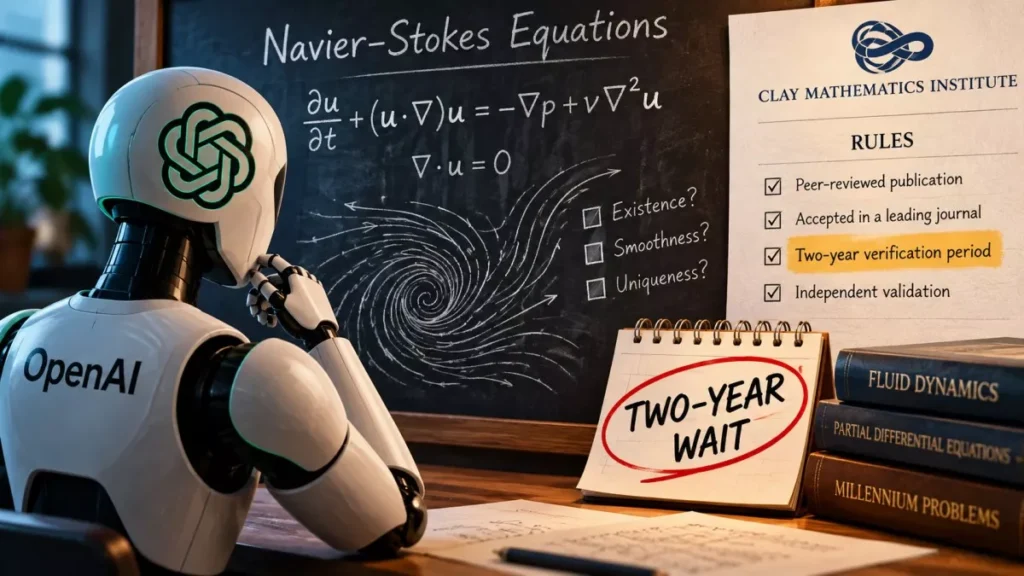

The OpenAI Navier-Stokes proof was published on Tuesday 8 September 2026. The San Francisco company behind ChatGPT says an unreleased internal model ran roughly 10,000 agents in parallel for 88 hours to produce it. OpenAI also said it will not claim the $1 million Millennium Prize attached to the problem.
What OpenAI Actually Proved
The proof does not show that the Navier-Stokes equations always behave. It shows the opposite: that they can break down.
The Navier-Stokes equations describe how fluids move, and they underpin everything from weather forecasting to aircraft design. The Millennium Prize question asks whether smooth, well-behaved solutions always continue to exist, or whether they can develop a singularity, a point where the mathematics stops making sense.
OpenAI’s answer is that a singularity can form. According to the account published by Quanta Magazine on 8 September, the construction describes a vortex that tightens and spins ever faster until the speed of an infinitesimally small portion of fluid becomes infinite in finite time, while the total energy of the fluid stays bounded. Mathematicians call this finite-time blowup.
For anyone outside mathematics, the practical meaning is narrow. The equations remain as useful for engineering as they were last week. What changes is the theoretical picture: a specific, exotic configuration exists on paper where the equations fail, which is a negative resolution rather than a reassuring one.
How the Proof Was Produced
OpenAI describes an agent swarm running on a model it has not released publicly.
- Agents: approximately 10,000 running in parallel.
- Run time: 88 hours, which OpenAI dates to 1 to 5 September 2026.
- Formalisation: a further 17 hours in Lean, a proof assistant that machine-checks each logical step, using the GPT-6 Astra model OpenAI launched days earlier.
- Cost: OpenAI has said the compute bill ran into the millions of dollars, without giving a figure.
OpenAI released a written summary, a PDF paper and the Lean formalisation in a public GitHub repository. That last item matters more than the others. A Lean-checked proof can be verified by anyone who runs the code, which is a stronger position than a company asking to be believed. It confirms the argument is internally consistent; it does not confirm the argument answers the question the prize asks.
Reports of the volume of internal messages between agents differ between outlets, so that figure is not settled. OpenAI’s approach descends from the reasoning models it began shipping in 2024, when it introduced the o1 family and claimed doctorate-level accuracy on hard problems.
Why the Clay Institute Has Not Called It Solved
The Clay Mathematics Institute, the Denver-based body that created the seven Millennium Prize Problems in 2000, has published rules that no announcement can shortcut.
Under the rules its board adopted on 26 September 2018, three conditions must all be met before the institute will even consider a proposed solution: it must be published in a qualifying outlet, at least two years must have passed since that publication, and it must have received general acceptance in the global mathematics community.
A GitHub repository and a company blog post are not a qualifying outlet. The two-year clock therefore has not started. Martin Bridson, the institute’s president, told AFP that the process of evaluation is deliberately unhurried and that the institute will ensure it is absolutely rigorous.
As of 10 September 2026, the Clay Mathematics Institute still lists Navier-Stokes among its six unsolved problems. The Poincaré conjecture, resolved by Grigori Perelman, remains the only one marked solved. Each problem carries $1 million.
The Forcing Question Behind OpenAI’s Caution
OpenAI’s decision not to claim the prize points at the same technical issue mathematicians have raised.
The proof constructs its blowup in a fluid with a smooth external force applied throughout. The dispute is whether that counts. The forcing is not incidental to the method; it drives it, and there is no public evidence so far that the same construction works without it. The prize question is generally read as concerning the unforced equations.
OpenAI stated in its published materials that it does not intend to claim the Millennium Prize for this result. It has not said the proof falls short, and the institute has not said it does either. This is the single point most likely to decide the outcome, and it is unresolved.
The Dispute Over Who Got There First
The announcement arrived alongside a public argument about credit, which is documented on the record by both sides.
Tristan Buckmaster, a mathematics professor at New York University, and Levent Alpöge, a researcher at Anthropic, proved finite-time blowup with smooth forcing for the three-dimensional Euler equations, the frictionless counterpart to Navier-Stokes, in mid-August 2026, and verified that result in Lean later the same month. Their method built on a forcing technique developed over roughly a year by Diego Córdoba and Luis Martínez-Zoroa.
OpenAI says its own effort began on 1 September after it heard a rumour of the pair’s progress, and that after finishing on 6 September it contacted them to offer a joint announcement. Buckmaster has alleged that OpenAI pressured him over the authorship arrangement and has publicly questioned whether OpenAI’s systems had access to his and Alpöge’s working sessions.
Sébastien Bubeck, the OpenAI researcher leading the project, denied that, telling Fortune: “We did not use their prompts or proofs to prompt our models or direct our agents.” Bubeck added that OpenAI has “nothing but congratulations to them on this monumental achievement that they have made.” OpenAI’s published materials now credit both men for concurrent work on the forced Euler problem.
Buckmaster’s account of what was said in private conversations has not been independently confirmed, and OpenAI disputes it. Readers should treat that part of the story as contested.
What Leading Mathematicians Have Said
Reaction from the field has been split between admiration for the result and unease about the method.
Charles Fefferman of Princeton University, who wrote the official problem statement for the Clay Institute, told Quanta he was thrilled the problem was solved, and named Córdoba and Martínez-Zoroa as the heroes of the story, pointing back at the human groundwork.
Terence Tao of the University of California, Los Angeles, took a more critical line, warning that “the indiscriminate strip-mining of open problems for solutions may destroy the ecosystem from which the next generation of mathematical techniques, problems, and practitioners would have developed”. Tao separately called the Buckmaster and Alpöge work a remarkable achievement, and has described a decoupling this year between getting answers and getting understanding.
Frequently Asked Questions
Has the Navier-Stokes Problem Been Officially Solved?
No. As of 10 September 2026 the Clay Mathematics Institute still lists Navier-Stokes among its unsolved problems. OpenAI has published a claimed proof, which is a different thing from an accepted one.
Why Is OpenAI Not Claiming the $1 Million Prize?
OpenAI said in its published materials that it does not intend to claim it. The likely reason is that its proof relies on an external force applied to the fluid, and the prize question is generally read as concerning the unforced equations.
How Long Before Anyone Can Win the Millennium Prize for This?
At least two years after the work is published in a peer-reviewed qualifying outlet, and only if it also wins general acceptance among mathematicians. A blog post and a GitHub repository do not start that clock.
Does This Mean Weather Forecasts or Aircraft Design Are Wrong?
No. The result concerns an exotic mathematical configuration, not everyday fluid behaviour. Engineers use the Navier-Stokes equations exactly as before.
Can the Proof Be Checked Independently?
Partly. The Lean formalisation is public on GitHub and machine-checkable by anyone, which tests whether the argument is logically sound. It cannot settle whether the argument answers the prize question.