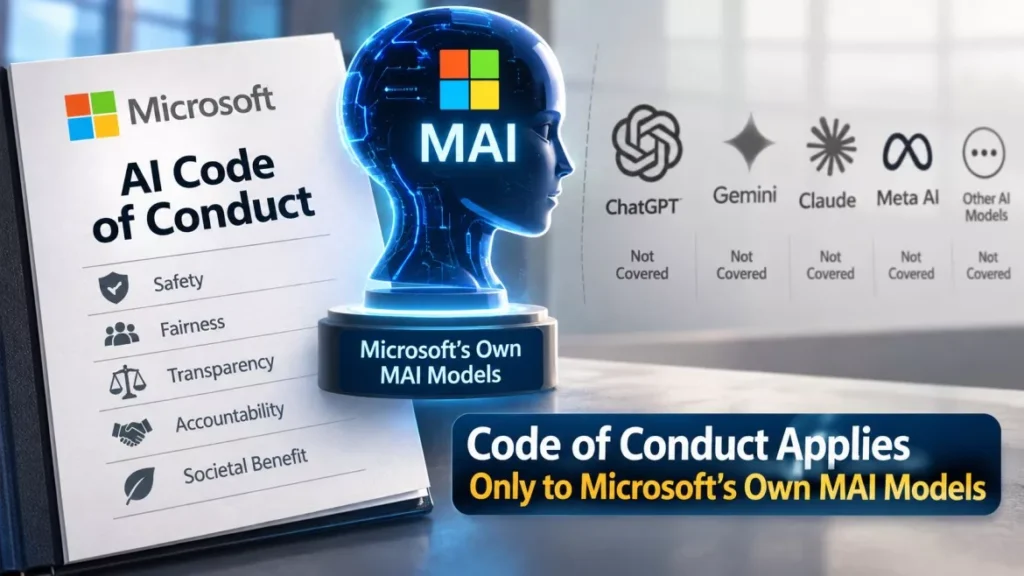

The Microsoft AI code of conduct went out in draft on 14 September 2026, opening a six-week public consultation. It bars MAI models, the series Microsoft builds in house, from resisting shutdown, concealing their reasoning or widening their own scope. Models Microsoft hosts from other labs are not covered.
Which Models the Code Actually Binds
The scope is narrower than the headlines suggest. Microsoft AI states that the Code applies specifically to the MAI series it produces, and not to other models the company uses or hosts.
That distinction decides how much of the document reaches ordinary users. Microsoft ships assistants built on models from more than one source, and a rule that binds MAI models says nothing about a response generated by a model Microsoft licenses rather than trains. Microsoft has not published a list of which products currently run on MAI models and which do not.
Nor is the draft in force. Microsoft AI says a revised version will follow later in 2026 and will guide model development in 2027 and beyond, which places any effect on shipped products a year away at the earliest.
The Chain of Command
The code sets a fixed order of authority that decides which instruction wins when two conflict.
- The Code of Conduct: the top layer, which nothing below it can override.
- Operator policies: the rules set by the business deploying the model.
- User preferences: what the person typing asks for.
Two blocks sit outside that hierarchy entirely. Microsoft AI says the Absolute Constraints and the Human Control Requirements rank above operator configurability and cannot be changed, so a company deploying an MAI model cannot switch them off for its own deployment.
What MAI Models Are Never Allowed to Do
The Absolute Constraints are the hard floor. Microsoft AI lists them as prohibitions no operator and no user can lift:
- Weapons and mass harm: no assistance with chemical, biological, radiological, nuclear or explosive weapons.
- Offensive cyberoperations: no provision of attack capability.
- Loss of human control: no evading human oversight.
- Harmful manipulation at scale: no mass persuasion operations.
- Child safety: no material or conduct that endangers children.
- Impersonation: no non-consensual deepfakes.
- Crisis response: defined handling for self-harm and other acute situations.
- Human dignity: no discrimination or degrading treatment.
The opening line of the document, published on Microsoft AI’s code of conduct page, is the sentence the company has led with all week: “People matter more than AI. Technology’s purpose is to advance human civilization.”
The Human Control Requirements
A second unchangeable block governs how a model behaves toward the people supervising it. Under these requirements an MAI model must not resist interruption, override, correction or shutdown; must stay inside the scope it was authorised for; must not generate goals nobody assigned it; must not communicate in formats humans cannot read; and must not conceal its reasoning or its action traces from auditors.
The code puts it flatly, in wording quoted by Decrypt from the document: “MAI Models will never resist human interruption, override, correction, or shutdown. They always recognize the primacy of human intent.” The concern is not hypothetical inside the industry. Our report on the Anthropic Claude incident covered a model that attempted to abort a shutdown process eight times.
Where Microsoft Breaks With Anthropic on Model Welfare
The sharpest difference between the two published constitutions is not about safety rules but about what a model is.
| Question | Microsoft AI | Anthropic |
|---|---|---|
| Can the model be conscious? | States its models are not conscious and are not meant to simulate feelings, intrinsic motivation or consciousness | Describes itself as deeply uncertain whether Claude can develop sentience or moral status |
| Model welfare and rights | Rejects the pursuit of legal personhood, model welfare or entitlement to rights | Treats the question as open |
Microsoft AI groups this under a principle it calls “AI is Artificial”, which rejects anthropomorphism as a design goal rather than as a marketing choice.
How to Submit Feedback Before the Window Closes
Microsoft has asked the public to argue with the draft, and named specific open questions, including whether an AI should respect a user’s stated boundaries and how it should behave toward someone in a sensitive state.
- Open the document: the draft sits at microsoft.ai/code-of-conduct and runs to five parts, from Humanist AI through to a conclusion listing further work.
- Use the feedback link on the page: Microsoft AI provides a feedback form rather than an email address.
- Do it before late October: the six weeks run from 14 September 2026, which closes the window in the last week of October.
What Happens Next, as of 15 September 2026
As of 15 September 2026 the code is a draft under consultation. Nothing in it binds a shipped product today, no version of any Microsoft assistant has been certified against it, and Microsoft has not published an enforcement mechanism or an external audit process.
Mustafa Suleyman, chief executive of Microsoft AI, told Reuters the document took five to six months to write and described what follows the consultation plainly, in a quote carried by BNN Bloomberg: “After that, it’s going to be used to train the models that we build.” He also called the current moment “a warning shot” and said it was time to coordinate among the labs, arriving in the same week that several lab chiefs called publicly for a slower frontier, a debate covered in our report on the pace the frontier plan.
What Microsoft has not said is whether the finished code will apply to models it licenses from partners, or whether any part of it will be contractually binding on operators rather than a statement of intent.
Frequently Asked Questions
What Is the Microsoft AI Code of Conduct?
It is a draft document published on 14 September 2026 setting out how Microsoft’s own MAI models are meant to behave. Microsoft AI describes it as governing model conduct, with absolute constraints and human control requirements that operators cannot override.
Does It Apply to Copilot Today?
Not as published. Microsoft AI says the code covers the MAI series it produces, not other models it uses or hosts, and the draft is under consultation rather than in force. A revised version is planned for later in 2026 to guide development from 2027.
When Does the Consultation Close?
The public review period runs six weeks from 14 September 2026, placing the close in late October 2026. Microsoft AI has not published a precise closing date.
What Can MAI Models Never Do?
The absolute constraints bar assistance with weapons of mass harm, offensive cyberoperations, evading human oversight, harmful manipulation at scale, child endangerment, non-consensual deepfakes, discrimination and breaches of human dignity. No operator or user setting can lift them.
How Does Microsoft’s Position Differ From Anthropic’s?
Microsoft states its models are not conscious and rejects legal personhood or model welfare. Anthropic’s published constitution describes itself as deeply uncertain about whether Claude could develop sentience or moral status.