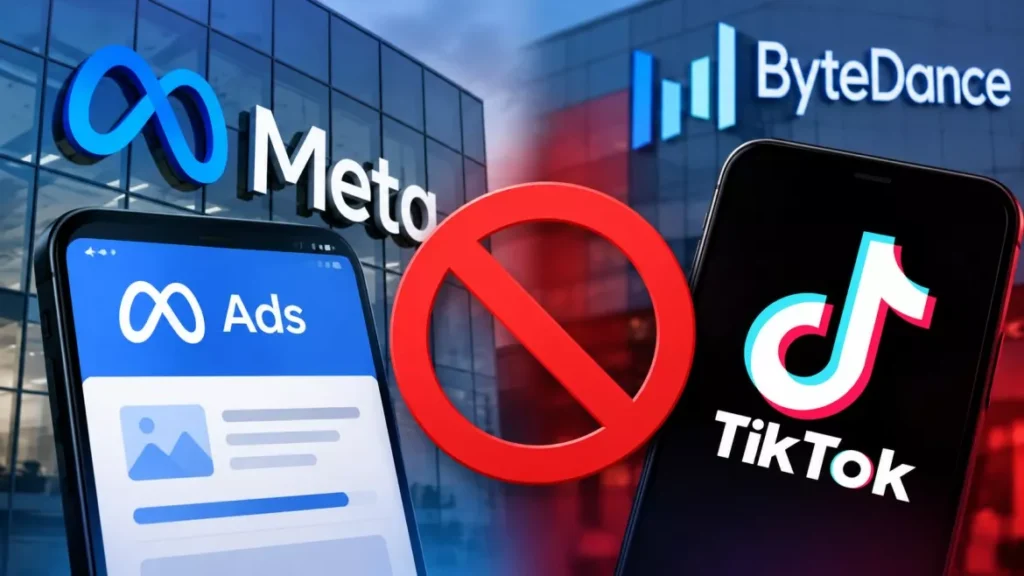

Meta bans ByteDance ads across Facebook, Instagram and its other apps in seven countries. The block took effect on Thursday 8 October 2026 and also covers third-party advertisers whose campaigns send users in those markets to TikTok. Meta says declining to promote a competitor is normal business practice.
Which Advertisers the Ban Actually Covers
The detail most coverage skipped is that the rule reaches past ByteDance itself. An agency, a brand or a creator with no connection to ByteDance is caught if the ad points at TikTok.
| Activity | Status in the seven markets |
|---|---|
| Paid ads bought by ByteDance or TikTok | Blocked |
| Paid marketing messages from ByteDance | Blocked |
| A third party’s ad whose destination is TikTok or another ByteDance service | Blocked |
| An ordinary unpaid post that mentions or links to TikTok | Not blocked |
| A profile link to another platform’s website | Not blocked, per Reuters |
| Using TikTok itself | Unaffected |
That distinction between paid and organic is the one that decides whether this touches you. A beauty brand running Instagram ads that end on its own shop is fine. The same brand running Instagram ads that end on its TikTok profile is not.
Where the Ban Applies
Meta drew the line at seven markets rather than applying it globally. The countries are the United States, Canada, Egypt, Indonesia, Japan, Thailand and Vietnam.
The selection is a mix of Meta’s largest advertising market and several of TikTok’s fastest-growing ones in Asia and North Africa. Europe, India, Brazil and the rest of the world are not included, and Meta has not published a reason for the grouping.
As of 10 October 2026, Meta has not said whether the ban will extend to further countries, and neither ByteDance nor TikTok had issued a public response. Both declined to comment when Reuters asked.
What Meta Said, and Whether It Is Allowed To
Meta made no formal announcement. The company’s position came in an emailed statement from spokesperson Chris Sgro to Bloomberg, which broke the story on 8 October.
“We don’t have to run ads from a competitor whose goal is to pull people off our apps,” Sgro said. He added that “declining promotional services to a competitor is a normal business practice across industries” and that Meta “will continue to compete on product quality and user experience.”
On the question of whether Meta can simply refuse a rival’s money, its own rulebook answers plainly. Meta’s published Advertising Standards state: “We reserve the right to reject, approve or remove any ad for any reason, in our sole discretion.” The same page says ads “remain subject to review and re-review at all times, and may be rejected or restricted.”
So the ban needs no new policy. It is an exercise of a discretion Meta already documented, which is why it could take effect the day it was reported rather than after a consultation. Whether a competition regulator takes an interest is a separate question, and none has opened a case.
The $18 Billion Settlement Behind the Timing
The rivalry explains the ban; the timing points somewhere more specific. In August 2026 Meta agreed to settle multistate litigation over teen harms for about $18 billion, denying wrongdoing and admitting none.
Roughly $12.7 billion of that is guaranteed and payable over a decade. The remaining 30% becomes payable only if YouTube and TikTok also make payments and adopt comparable changes to their own platforms. In other words, close to $5 billion of Meta’s bill depends on what its two biggest rivals agree to do.
The platform changes Meta accepted are concrete. Instagram and Facebook get a default two-hour daily cap for teenagers that cannot be switched off without a parent’s permission, plus a block between midnight and 6am. Several outlets report the cap would tighten to one hour if YouTube and TikTok signed up to equivalent terms. The settlement still requires court approval, and Florida refused to join it; its attorney general has asked a Pasco County judge to order Meta to bar users under 14 in the state.
Meta then campaigned publicly for its rivals to accept the same terms, and according to The Next Web, TikTok rejected the Meta ads making that argument in September on the grounds that they breached its rules on political content. TikTok separately settled with Alabama in late September, agreeing to usage limits and stronger age checks there, while other state cases against it continue.
Read in that order, the sequence is an advertising blockade in both directions: TikTok refused Meta’s ads in September, and Meta refused ByteDance’s in October. Neither company has described it that way.
What Brands and Creators Should Do Now
Anyone buying Meta ads in the seven markets has a short list of practical checks.
- Audit destinations: Any live campaign whose click-through lands on a TikTok page is exposed, whether or not ByteDance is involved.
- Watch for silent rejection: Meta’s standards allow re-review of ads already approved, so a campaign running yesterday can be stopped today.
- Keep cross-posting: Organic posts are untouched. A creator can still tell an Instagram audience about a TikTok video; they cannot pay Meta to amplify it.
- Check the market, not the brand: The rule is defined by where the user is, so a global campaign may run in some countries and stall in these seven.
The rivalry has been narrowing on both sides for a while. TikTok has been building routes that keep users inside its own app, including the Buy Direct checkout it launched in the US this month, and Meta has blocked a competitor inside its own products before, as it did when its Muse agent was barred from completing Amazon purchases.
What Neither Company Has Explained
Three gaps are worth noting before treating this as settled.
- Who counts as ByteDance in the US: TikTok’s American operation was reorganised in January 2026 into a joint venture 80.1% owned by global investors including Oracle, with ByteDance retaining 19.9%. Meta has not said whether the ban applies to that entity, to ByteDance proper, or to both.
- The money at stake: Neither company has disclosed what ByteDance spent on Meta’s ad system in these markets, so the revenue Meta is giving up is unknown.
- Enforcement: Meta has not said how it identifies a third-party ad that points at TikTok, or what happens to an advertiser that keeps trying.
The ownership question is the sharpest of the three. The US legislation that forced a divestiture, covered here when Congress first proposed conditioning TikTok’s future on ByteDance selling, produced exactly the split structure that now makes “a ByteDance ad” hard to define in Meta’s biggest market.
Frequently Asked Questions
Can I Still Post TikTok Links on Instagram or Facebook?
Yes. The ban covers paid advertising only. Ordinary unpaid posts that mention or link to TikTok are unaffected, and Reuters reports that profile links to other platforms’ websites still work.
Which Countries Does the Meta ByteDance Ad Ban Cover?
Seven: the United States, Canada, Egypt, Indonesia, Japan, Thailand and Vietnam. Meta has not said whether more will be added.
Is My Ad Blocked if It Links to TikTok?
In those seven markets, yes. The rule applies to third-party advertisers whose campaigns direct users to TikTok or another ByteDance-owned service, not only to ads bought by ByteDance.
Why Did Meta Ban ByteDance Ads Now?
Meta frames it as normal competitive practice. It also follows Meta’s roughly $18 billion teen-safety settlement, about 30% of which becomes payable only if TikTok and YouTube adopt comparable limits, and follows TikTok’s rejection of Meta ads urging it to do so in September.
Is It Legal for Meta to Refuse a Competitor’s Ads?
Meta’s own Advertising Standards reserve the right to reject any ad for any reason at its sole discretion, so no policy change was needed. No competition regulator has announced an inquiry into the decision.