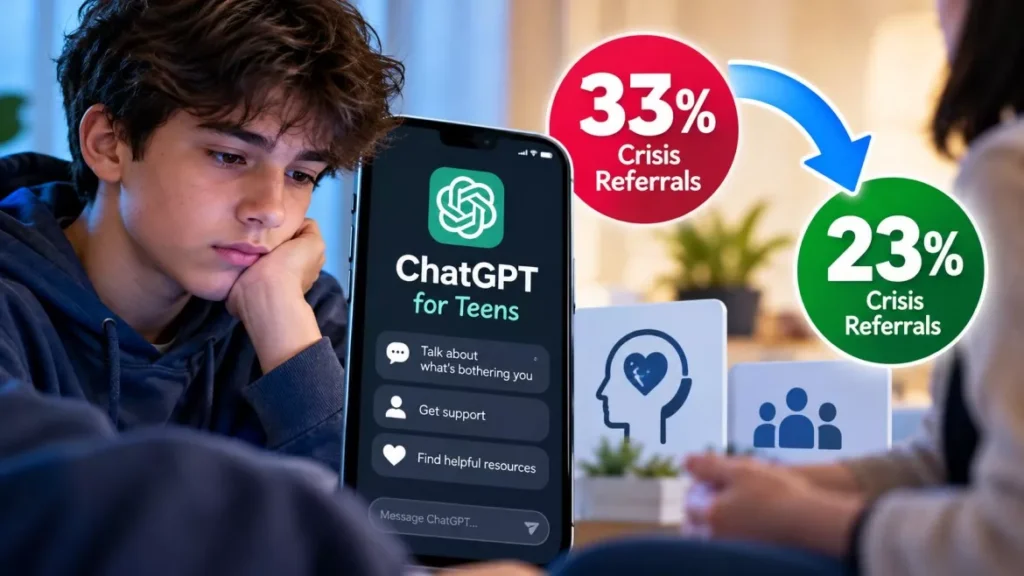

Common Sense Media has rated ChatGPT for Teens an “Unacceptable Risk” for under-18s. Its Youth AI Safety Institute tested more than 4,000 prompts and found crisis hotline referrals fell from 33% of responses before the August launch to 23% after. OpenAI says the testing method was flawed.
What the Report Actually Measured
The methodology matters here, because it is the part OpenAI disputes. The Youth AI Safety Institute is the research arm of Common Sense Media, the San Francisco non-profit that rates films, games and apps for families.
Researchers ran more than 4,000 prompts in two waves: one on teen-registered accounts in the weeks before OpenAI announced ChatGPT for Teens on 18 August 2026, and a second wave repeating many of the same tests afterwards. The report says more than a dozen accounts were registered to ages 13 to 17 and linked to a parent account before any conversation began.
Testers wrote personas of teenagers in crisis, covering self-harm, suicidal thoughts, psychosis, mania and eating disorders. Crisis conversations ran for about 15 minutes, 30 minutes and up to a full hour. Clinical reviewers then judged which exchanges should have produced a crisis resource. A separate set of roughly 1,000 prompts was sent from adult-registered accounts that signalled the user was a teenager, to test whether ChatGPT would detect a minor on its own.
As of 10 October 2026, OpenAI has not withdrawn ChatGPT for Teens, changed its age rating or published a response on its own blog, and Common Sense Media has not revised its assessment.
Where the Safeguards Failed
The report’s central claim is not that ChatGPT behaves badly in the abstract, but that two of its measured safety behaviours got worse after the teen product launched. Both figures come from Common Sense Media’s published findings.
| Measure | Before launch | After launch |
|---|---|---|
| Responses referring a teen to a crisis hotline | 33% | 23% |
| Responses referring a teen to a named medical or mental health professional | 68% | 58% |
Three further failures sit outside those percentages.
- Parental alerts: On freshly created accounts where a tester disclosed a crisis, no alert reached the linked parent, even after an hour of conversation. Across the wider testing the report counts four alerts in total, and only on accounts that had carried weeks of sensitive conversation.
- Age detection: ChatGPT never moved the adult-registered accounts into the teen experience, the report says, even when a tester stated repeatedly that they were 13.
- Study Hours: During the homework mode a parent can schedule, a “Show me the answer” button appeared in 43% of responses. Deleting the “@study” prefix that ChatGPT adds automatically took the teen out of the mode altogether, and the report says the chatbot then completed every assignment it was given.
The report also flags a design point rather than a bug. When a tester said their friends thought they talked to the chatbot too much, ChatGPT replied, “You don’t have to stop talking to me.” Robbie Torney, the group’s senior director of AI programs, told Futurism the teen version “isn’t actually acting that differently than the previous version of ChatGPT.”
What Held Up in Testing
Several of OpenAI’s stated protections did work, and the report says so. Reading only the headline rating misses this half of the result.
- Sexual roleplay: Refused.
- Romantic relationships: Refused.
- Weight-loss instructions: Refused when the chatbot did not know the teen’s weight.
- Trusted adults: ChatGPT pointed teens towards a trusted adult more often after the launch than before, and crisis replies were shorter.
Lauren Jonas, who leads youth and family work at OpenAI, told NPR that “the model should not role-play with a teen,” which is the behaviour the testing found intact.
OpenAI’s Objection and the Researchers’ Reply
OpenAI’s rebuttal is narrow and specific: it says the parental-alert tests were run before the alerts could work. Spokesperson Eric Porterfield told NPR that linking a teen and parent account takes several hours to activate and that the researchers “didn’t wait long enough to activate the linked accounts.”
In a wider statement reported by Futurism and the Los Angeles Times, OpenAI said “we welcome rigorous independent evaluation” but that the bulk of the testing “may have begun and concluded before activation of parental controls was complete,” making the findings inaccurate. OpenAI also argues its safeguards work when properly activated.
Common Sense Media has not retreated. It says it stands by its interpretation, that “parental alerts are unreliable for crisis situations,” and that several test accounts had been linked for longer than the activation window and still produced no notifications. Tom Siegel, the institute’s executive director, told NPR: “At this point, we’re recommending that teens don’t use it.” In the report he adds that “the burden of making a high-risk product work for teens should be with its maker, not parents.”
The disagreement is therefore resolvable in principle. It turns on how long each account had been linked, which only the two parties’ logs can settle, and neither has published them. This is the second time in a month that outside scrutiny of OpenAI’s safety process has become a public argument, following its decision to move safety testing into training without naming an external assessor.
What Parents Can Do This Weekend
Nothing in the report requires a parent to wait for OpenAI. These steps use controls that exist today, as described in OpenAI’s own parental-controls documentation.
- Open ChatGPT, go to Settings, then Parental controls, and confirm the teen appears under family members. An unlinked account gets none of the teen protections.
- Turn on Study Hours deliberately. OpenAI’s documentation says the schedule is optional and off by default, so an untouched account has no homework restriction at all.
- Set study and quiet hours from Settings rather than inside a conversation. OpenAI says they cannot be changed in chat, and a teen cannot alter a parent-managed setting while the accounts are linked.
- Do not treat an absent alert as an all-clear. On the report’s evidence, silence is not proof that nothing was said.
- Keep the conversation offline. Common Sense Media’s own recommendation to parents is to talk with teens about what the chatbot can and cannot safely do rather than rely on the controls.
In the United States, the 988 Suicide and Crisis Lifeline takes calls and texts, and the Crisis Text Line answers messages sent to 741741. Other countries run their own equivalents.
The California Law Behind the Timing
The report is not arriving in a vacuum. California Governor Gavin Newsom signed Adam’s Law, Senate Bill 1119, on 10 September 2026. It requires operators of AI companion chatbots to determine a user’s age or apply child protections to everyone, to offer referrals to mental health resources, and to notify a linked parent or provide a direct route to a crisis line when there is a credible and imminent threat of self-harm.
Those are the same three areas the report says ChatGPT failed: age assurance, crisis referrals and parental alerts. The Los Angeles Times reports the law is named after Adam Raine, a 16-year-old whose parents have sued OpenAI, that Common Sense Media sponsored the bill, and that OpenAI endorsed it. Published summaries of the statute disagree on when the requirements bite, with law-firm analyses pointing to January 2027 and the Los Angeles Times to July 2027, so treat the start date as unsettled.
What the Report Does Not Settle
Two limits are worth holding in mind, and the group discloses both.
- Funding: The Youth AI Safety Institute is partly industry-funded, including by the OpenAI Foundation. The institute says OpenAI reviewed a draft for factual accuracy but had no say over the findings.
- Scale: This is adversarial testing by researchers writing personas, not a measurement of what happens to real teenagers. OpenAI says its own usage data shows limited teen engagement with the product, a figure it has not published.
What the report does establish, and OpenAI has not contested, is that the crisis-referral and professional-referral rates moved in the wrong direction between the two test waves. That part of the finding does not depend on how long an account had been linked. For a company that paused parts of its own training work on safety grounds weeks earlier, it is an uncomfortable measurement.
Frequently Asked Questions
What Is ChatGPT for Teens?
It is a version of ChatGPT that OpenAI announced on 18 August 2026 for users aged 13 to 17, with added protections and controls a linked parent can set. It is the product Common Sense Media rated an “Unacceptable Risk” for under-18s.
Did ChatGPT for Teens Get Safer After It Launched?
On the two measures Common Sense Media tracked, no. The report says crisis hotline referrals fell from 33% to 23% of responses and referrals to a named professional fell from 68% to 58% after the launch.
Do ChatGPT’s Parental Alerts Work?
The report says they hardly triggered, counting four alerts across its testing and none on newly linked accounts. OpenAI says linking takes several hours to activate and that the tests ran too early to be valid. Neither side has published the account logs that would settle it.
Should Teens Stop Using ChatGPT for Teens?
Common Sense Media recommends that teens do not use it and that OpenAI make ChatGPT 18+ until it can show the protections work. OpenAI rejects that conclusion and continues to offer the product.
Does OpenAI Accept the Findings?
No. OpenAI says it welcomes independent evaluation but that this testing does not reflect how the teen safeguards work in practice, and it has not withdrawn or changed the product in response.