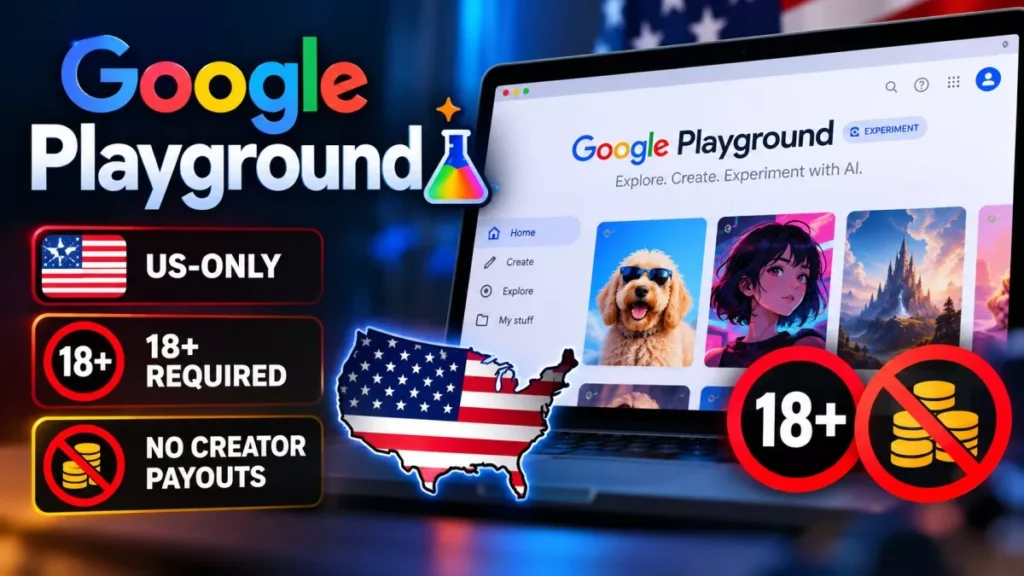

Google Playground launched on 7 October 2026, a browser platform from Google Labs that turns text prompts into playable games. It is free, limited to users aged 18 and over in the United States, and runs on Gemini, Nano Banana and Lyria. Google says more countries will follow but has named none.
What Google Playground Lets You Build
Playground generates a working browser game from a description typed into a chat box, with no code written by the user. The site is at playground.google.com, and the games it produces run on both phones and computers.
The creation flow starts either from a blank prompt or from a genre template, with trivia and racing among the examples Google gives. Before generating, the creator picks whether the game is 2D or 3D and whether it is single-player or multiplayer, then describes the mechanics, the rules and the visual style.
From there the work is conversational. Rules, physics, characters and environments are changed by asking for changes and testing the result, rather than by editing files. Creators can also upload their own images, which the system converts into game assets matched to the game’s art style, according to TechCrunch’s launch report.
- Private: the game stays visible only to its creator.
- Link sharing: anyone with the URL can play it.
- Explore gallery: the public catalogue, where published games are listed.
Published games pass a safety review against Google’s community guidelines, and other users can report them. Selected genres support leaderboards and multiplayer matchmaking through a Google Play Games profile, and creators can keep editing a game after publishing it.
Which Models Power Playground
Three existing Google models do the work, each on a different part of the game. Google spokesperson Nia Carter named them to The Verge as Gemini, Nano Banana and Lyria.
Gemini is Google’s general-purpose model and handles the text and logic. Nano Banana is the image generation and editing model, which produces the art. Lyria is Google DeepMind’s music generation model, which supplies the audio. Google says these are paired with custom software it tuned on games the company built itself.
Notably, Google has not published a technical paper, a benchmark or any description of how reliably the system produces a working game on the first attempt. Every capability claim at launch is the company’s own.
What It Costs and Who Can Use It
Playing and browsing games in the Explore catalogue is free and unmetered. Generating a game is not: creation draws on a weekly token allowance, and the size of that allowance depends on whether the user pays for a Google subscription.
Google has not published the numbers. The free tier is described only as a limited allowance, and Google One AI subscribers, whose Gemini limits changed earlier this month, get higher weekly limits that vary by plan. No outlet at launch was given the token counts for any tier, so the practical ceiling on how many games a free user can make in a week is unknown.
Access is restricted in three ways that Google has stated plainly. Creation requires a valid Google Account, the user must be 18 or over, and the user must be in the United States. The age floor is notable against the nearest comparison: Roblox opened its own AI creation tool, Build, to users aged nine and over in testing.
Who Owns a Game You Make in Playground
This is the question the launch coverage largely skipped, and the answer sits in a separate document. The Playground Additional Terms of Service, which Unite.ai reports was last modified on 20 September 2026, sets out the arrangement. The following account of those terms comes from Unite.ai’s reading of them and has not been reported by a second outlet.
On ownership, Unite.ai reports that Google “will not claim ownership over a user’s games”, while retaining all rights in the Google-provided features, services and assets used to generate them. In other words the creator keeps the game; Google keeps the machinery and the generated assets it supplied.
The advertising clause runs the other way. Creators grant Playground “the right to monetize their games on the platform”, including displaying advertising on or within them, and Unite.ai reports that Google will seek the creator’s permission before doing so. The asymmetry is worth stating directly: Google has described a route by which it may earn from a creator’s game, and has described no route by which the creator earns from it.
Three further restrictions are reported from the same document. Creators may not generate or include third-party intellectual property such as copyrighted characters from other games without written permission from the rights holder. They may not remove, obscure or alter the watermarks, labels or metadata that mark content as AI-generated. And games may not include features designed to facilitate bullying or harassment, or attempt to bypass the platform’s safety filters. A creator can unlist a game at any time, leaving it visible only to themselves and anyone holding the link, or delete it from the service entirely.
Playground and Unity Spark Compared
Google announced Playground alongside a partnership with Unity, the game engine company, on a second product called Unity Spark. Only one of the two is available.
| Google Playground | Unity Spark | |
|---|---|---|
| Status | Live | Closed beta, waitlist open |
| Available since | 7 October 2026 | No date announced |
| Who can use it | US users aged 18+ | Not stated |
| Price | Free, weekly token limits | Not announced |
| Graphics | 2D and 3D browser games | High-fidelity 3D, Unity runtime |
| Asset library | Generated by Google models | Unity Asset Store |
| Where games are played | Browser, mobile and desktop | Published through Playground |
Unity’s own Spark page carries a “Coming Soon” label and a “Join the waitlist” button, and names no date, no price and no eligibility criteria. Unity is still settling its commercial terms: GamesBeat reports the company will offer free access alongside paid tiers, with details to follow. Unity’s last major change to its pricing, the 2023 runtime fee that it was forced to walk back, makes those details worth waiting for.
Matthew Bromberg, Unity’s chief executive, set out the division of labour in a CNBC interview on launch day, describing Playground as “a little more of a simple, broader consumer play” and Spark as the graduation path for more complex projects. He said the aim was to help people build “a real piece of interactive entertainment”, not “AI slop”, and that Spark would launch on the web, then mobile, then other platforms. Asked whether users would eventually be able to build console games, he answered: “I hope so.”
What Google Has Not Announced
The gaps at launch are specific, and most of them determine whether Playground is a toy or a tool.
- Creator earnings: no payout mechanism, revenue share or storefront has been described.
- Token counts: no figures for the free tier or any paid tier.
- Country expansion: Google says more countries are planned but has named no country and no date, which leaves the United Kingdom, the European Union and everywhere else without access.
- Unity Spark timing: a closed beta “later this year” with no date and no price.
- Console and app distribution: games are browser-only; Unity’s chief executive expressed hope rather than a plan.
The absence of a payout route is the sharpest difference from the platform Playground is most often compared with. Roblox built its creator economy on revenue sharing; Playground, at launch, offers leaderboards and a public gallery.
Where Playground Stands as of 8 October 2026
As of 8 October 2026, Google Playground is live and free at playground.google.com for Google Account holders aged 18 and over in the United States only. Unity Spark is not available to anyone outside a closed beta, and its waitlist is the only way in.
Google calls Playground an experiment, which is the label it has previously attached to products it later withdrew. The company has given no commitment on how long Playground will run, and no migration path for games built in it should it close.
Frequently Asked Questions
Is Google Playground Free?
Yes. Playing and browsing games costs nothing, and game creation is free within a weekly token allowance. Google One AI subscribers get larger allowances, but Google has not published the figures for any tier.
Can I Use Google Playground Outside the United States?
Not yet. Creation is restricted to users in the United States who are 18 or over. Google says it plans to add more countries but has not named any or given a date.
Can Creators Make Money From Playground Games?
Google has announced no way for creators to earn from their games. The terms reportedly allow Playground itself to monetise games, including showing advertising, with the creator’s permission.
Do I Own the Games I Make?
According to Unite.ai’s reading of the Playground terms, Google does not claim ownership of a user’s game but keeps all rights in the Google-supplied features, services and assets used to build it.
When Does Unity Spark Open?
No date has been announced. Unity’s Spark page shows a waitlist and a “Coming Soon” label, and both companies describe a closed beta later in 2026.