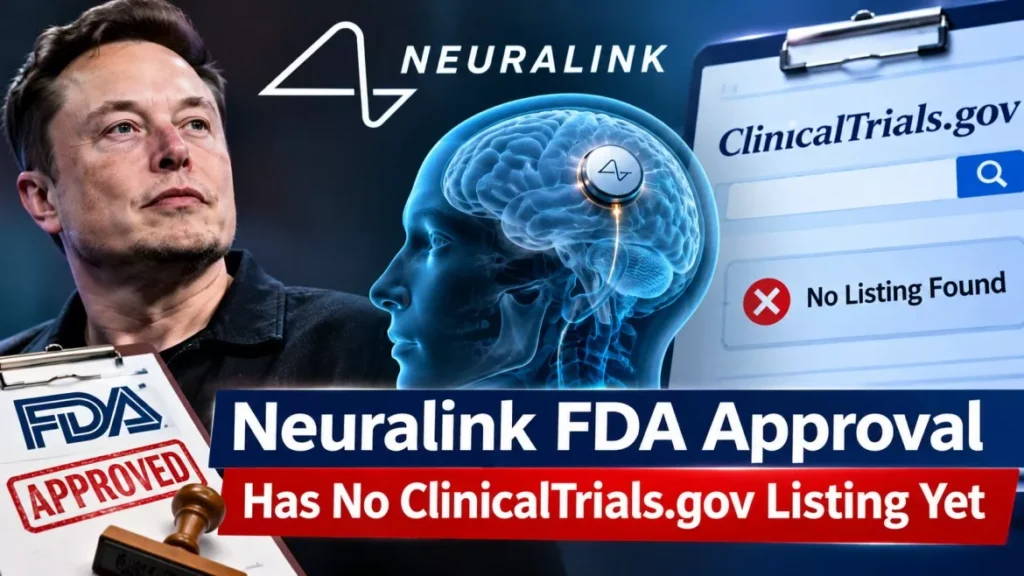

Neuralink has received FDA approval to start LINK, a late-stage trial of the firm’s brain-computer interface implant. The company disclosed it on X on 25 November 2026, and enrollment is now open to adults with ALS in the United States. The Neuralink FDA approval covers the study only, not sale of the device.
What the FDA Approval Actually Permits
The approval allows the firm to conduct one clinical study and nothing more. It is not permission to sell the implant, and it is not an endorsement of its effectiveness. Neuralink’s own trials page states that Neuralink devices are investigational and have not been approved by the FDA or other regulatory authorities.
A pivotal trial is the late-stage clinical study that a medical device company needs to complete before applying for FDA approval of its product. Neuralink says LINK is the first pivotal trial for an implantable brain-computer interface in the US. Previous Neuralink studies were early feasibility studies, a smaller and more exploratory category, and they produced both the first participant to operate a computer with the implant and reported problems with that first implant.
What Neuralink Has Published, and What It Has Not
The information about LINK is very limited, and most of it is contained in one post by Neuralink on X on 25 November 2026, which runs to three sentences. The firm said it had received FDA approval to launch LINK, that the study “builds off of our work with 30+ participants with Neuralink to date”, and that “those with ALS may be eligible”. It added that “enrollment for the LINK Pivotal Study is now open”.
| Detail | Published by Neuralink? |
|---|---|
| Approval to run LINK | Yes, in the 25 November post |
| Who may be eligible | Yes, adults with ALS in the US |
| Enrolment target | No |
| Named clinical sites | No |
| Primary endpoints | No |
| Date the FDA granted approval | No |
| Trial registry entry | No, as of 29 November 2026 |
According to Engadget, The Next Web and Digital Trends, the study will assess whether participants can control digital devices by thought, how far that improves their independence in everyday activities, and the long-term safety and reliability of the system.
The Trial Registry Has No LINK Record
There is no record of LINK on the public clinical trial registry. A search by sponsor on ClinicalTrials.gov on 28 November 2026 returned eight Neuralink-sponsored studies, none of which is LINK.
None of them is a pivotal trial. Their registered purposes are device feasibility, supportive care or other, and their planned enrolments range from three participants to 60. They are conducted in four countries, the United States, Canada, the United Kingdom and the United Arab Emirates, which is one more country than the reporting on the approval has mentioned.
As of 29 November 2026, there is no record of LINK on ClinicalTrials.gov, and it is not listed on Neuralink’s trials page either, which sets out the company’s studies by purpose rather than by name. A registry entry is where a trial’s enrolment target, endpoints and sites can usually be found, so until one is posted, those details depend on the company’s word.
Who Can Apply, and How
Neuralink says that adults with ALS may be eligible for LINK, and that applications are submitted through the firm’s Patient Registry. Neuralink has not provided any further criteria, so the announcement does not say whether a specific diagnosis, age or stage of the illness makes someone eligible.
Digital Trends set out the stages an applicant goes through. Anyone interested in LINK should put the eligibility question to the clinicians conducting the study rather than to a news report.
- An initial assessment and neuroimaging.
- Implantation with the R1 surgical robot.
- Training to move a cursor by thought.
- Follow-up for about 24 months, with some visits done remotely.
Which Hospitals Neuralink Names on Its Trials Page
Every publication covering the approval mentioned that no LINK sites have been named, and that is still the case. Neuralink’s trials page does, however, name six partner centres for its clinical programme: Barrow Neurological Institute, University College London Hospitals, University Health Network, University of Miami Health System, The Miami Project to Cure Paralysis and UT Southwestern Medical Center.
These are the centres that collaborate with Neuralink, but not necessarily the LINK sites. Neuralink has not said which, if any, of them will run the pivotal trial, and two of the six are located outside the United States, whereas LINK is described as a US trial.
The Road From This Trial to a Device on Sale
Finishing LINK is not the final step. A medical device company has to file a Premarket Approval application and receive approval before the product can be sold.
One account of that schedule exists, and it does not come from Neuralink’s own announcement. Neuralink president DJ Seo was reported as saying that the trial will enroll 20 participants, that the primary endpoint is assessed at day 90, and that the firm will file the Premarket Approval application once the 20th participant reaches those endpoints, followed by an FDA review of several months. Those remarks reached the public through Neura Pod and a few smaller outlets, and Neuralink has not published them. Other publications, including Tech360 and TechTimes, state that the number of enrollees has not been revealed.
Frequently Asked Questions
What Did the FDA Approve for Neuralink?
The FDA has cleared Neuralink’s LINK Pivotal Study, a late-stage clinical trial of its implantable brain-computer interface. The approval allows the study to be conducted. It is not permission to sell the implant, and it is not a conclusion about whether the implant works.
Who Is Eligible for the Neuralink LINK Trial?
Neuralink says that adults in the United States with ALS may be eligible for LINK, and that applications are submitted through its Patient Registry. No further criteria have been published, and the decision about eligibility is made by the clinicians running the study.
Is the Neuralink Implant Approved for Sale?
No. Neuralink’s trials page says that its devices are investigational and have not been approved by the FDA or other regulatory authorities. A Premarket Approval application has to be filed and granted first.
How Many People Will the LINK Trial Enrol?
Neuralink has not said. Its president DJ Seo was quoted as putting the number of enrollees at 20, but that figure is not mentioned in the company’s announcement, and several outlets report that the enrolment target has not been disclosed.
Where Can I Find the LINK Study on the Trial Registry?
It is not there yet. A sponsor search of ClinicalTrials.gov on 28 November 2026 returned eight Neuralink studies, none of which is LINK and none of which is a pivotal trial.