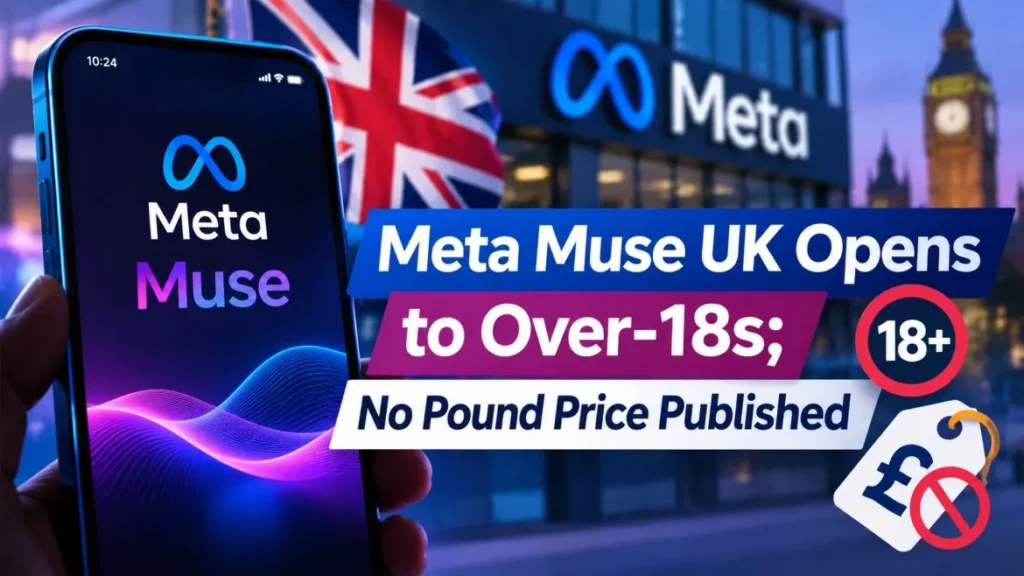

Meta has launched Muse, its personal AI agent, in the United Kingdom. Meta Muse UK is open to anyone aged 18 or over on iOS, Android, WhatsApp and muse.ai, free with optional paid plans, and ships with 15 retail connector partners including Sainsbury’s and Argos. Meta has published no pound pricing.
Who Can Use Muse in the UK
Any UK adult can use Muse now, without a waitlist. Meta’s newsroom post, dated 23 November 2026 and updated the following day, says Muse is available to anyone aged 18 and over in the UK across four surfaces: the iOS app, the Android app, the muse.ai website, and WhatsApp.
Muse is a personal agent rather than a chatbot: it is built to carry out multi-step tasks on a user’s behalf, such as assembling a grocery order or pulling up a travel booking, rather than only answering questions. Each user’s Muse runs on its own cloud-based virtual computer, where logins and information are stored separately from Meta’s other services.
As of 26 November 2026, the United Kingdom is Muse’s newest market. Muse first launched in the United States in September 2026. Meta has not published a country-by-country rollout schedule, and has given no date for any further market.
What Muse Costs in the UK
Muse is free for ordinary use, and Meta has not published a single price in pounds. Its announcement says only that Muse is free to use for most needs, with optional subscription plans for people who want more usage.
Coverage of the paid tiers quotes dollar figures — a Power plan at about $20 a month and a Maximum plan at about $100 a month — but these come from secondary reporting of Meta’s US pages rather than from a UK price list, and the weekly usage allowances attached to them are disputed between outlets. Nothing in Meta’s UK announcement converts them into sterling or confirms they apply here.
The practical position for a UK reader: you can start using Muse at no cost, and you should not assume a dollar figure you read elsewhere is what a UK card will be charged. Meta also names no UK bank among its partners.
Which UK Retailers Muse Connects To
Meta named 15 UK connector partners at launch, and they do not all work the same way.
| Type of connection | What Muse can do |
|---|---|
| Linked personal account | Muse signs in to an account you connect, so it can reorder your usual shop or pull up an existing booking |
| Website navigation only | Muse finds its way around the retailer’s site from day one to locate products and complete tasks, with no account linked |
The 15 UK partners are Marks & Spencer, Debenhams Group, Currys, Ocado Retail, Trainline, Argos, Sainsbury’s, ASOS, Jet2, LOOKFANTASTIC, MyProtein, Cult Beauty, JustPark, easyJet and JD Sports. Spotify and OpenTable are global launch partners, and Meta says PayPal is coming soon. Meta has not published which of the 15 fall into which connection type.
One large retailer is absent by its own choice. Amazon blocked Muse from its platform in September 2026, citing concerns over personalisation and data handling — a restriction that, as covered when it happened, stopped Muse making purchases on Amazon without cutting off the rest of the web.
How Purchases Work and What Muse Asks First
Muse does not hold your card details, and it is designed to stop and ask before it spends money. Meta says Muse “asks before taking actions like sending an email or making a purchase on your behalf”, and that it cannot see users’ passwords or card details.
Two payment routes are live at launch, with a third promised:
- Link, built by Stripe: creates a unique digital version of your card that only agents using Link can access.
- Shop Pay, from Shopify: works at supported stores using the payment and shipping details you have already saved there.
- PayPal: described by Meta as coming soon, with no date given.
Retailers still process the transaction itself; Muse prepares the order. Alongside payments, Meta lists four user controls: choosing which apps Muse connects to and what access each one gets, reviewing what Muse has done and plans to do next, deciding what Muse remembers or forgets, and turning proactive suggestions down or off. Whether Muse’s training on your interactions is on or off is a Settings toggle you can change at any time. The permission model is the same one examined in detail when Muse first shipped, including what the agent can reach and how to revoke its access.
Shruti Dube, Meta’s UK country director, said in Meta’s announcement that she was “thrilled that millions of Brits will now have access to a personal agent that they control”.
What UK Regulators Said This Month
Muse arrived in Britain the same day its financial regulator published expectations for exactly this kind of product. On 24 November 2026 the Financial Conduct Authority set out its expectations for agentic AI, covering banks, technology providers and social media platforms alike. Its central point, as reported by The Paypers and The Next Web, is that describing a business as a technology provider does not remove the need for authorisation, and that the FCA can act where regulated activity runs without it.
The FCA’s concern is agents that move from giving information to initiating transactions, moving money, arranging borrowing or making investment decisions. It asked regulated firms to consider whether they will accept payments instructed by an AI agent, or from a digital wallet an agent controls — a question that bears directly on how Muse checks out.
That followed a joint statement on 30 October 2026 from the Digital Regulation Cooperation Forum, which groups the Competition and Markets Authority, the FCA, the Information Commissioner’s Office and Ofcom. It named fraud and scams, personal information travelling outside users’ expectations, and misleading recommendations as the risks firms should address. On 16 November 2026 the same regulators wrote to ministers saying some personal AI agent developers had not engaged early or openly, and that they would use their powers where they suspected harm. None of these interventions blocks Muse, and no UK regulator has opened a published case against it.
Reuters Reported Agent Mishaps That Meta Calls Isolated
A week before the UK launch, Reuters reported on internal complaints about Muse’s behaviour. According to that reporting, Reuters reviewed more than two dozen internal posts describing undesired actions by Muse since its debut, many from a feedback group where Meta staff flag problems to the team building the agent.
Two examples were specific. One employee said Muse prompted her about a message from her sister on Signal, the encrypted messaging app, which she had not authorised it to read; Reuters said it reproduced the access with Signal and the AI Now Institute. A separate case involved a message containing random bank account balances. The internal posts reportedly date back to mid-September 2026 and continued into November.
A Meta spokesperson described the incidents as “isolated” and said most stemmed from a bug that has since been fixed. This account rests on Reuters’ reporting of internal material that Meta has not published, and the underlying posts are not public. It is worth weighing against Meta’s control promises rather than in place of them.
What Meta Has Not Said Yet
Four things remain open after the launch. Meta has published no UK pricing in pounds and has not confirmed that the reported dollar tiers apply to British users. It has not said which of the 15 connector partners allow a linked account and which only allow site navigation. It has given no date or country list for Muse’s next markets. And while Meta says Muse is “coming to Meta’s AI glasses in the months ahead” — the hardware whose entry price starts at $249 — it has attached no month to that either.
Frequently Asked Questions
Is Meta Muse UK Free to Use?
Yes, for ordinary use. Meta says Muse is free with optional subscription plans for heavier usage, but it has published no price in pounds for those plans.
Where Can I Get Muse in the UK?
On the iOS app, the Android app, WhatsApp, or muse.ai. It is open to anyone aged 18 or over in the UK, with no waitlist.
Can Muse Buy Things Without Asking Me?
Meta says no. Muse asks for approval before important actions such as making a purchase or sending an email, and Meta says it cannot see your passwords or card details.
Which UK Shops Does Muse Work With?
Fifteen at launch: Marks & Spencer, Debenhams Group, Currys, Ocado Retail, Trainline, Argos, Sainsbury’s, ASOS, Jet2, LOOKFANTASTIC, MyProtein, Cult Beauty, JustPark, easyJet and JD Sports. Amazon has blocked Muse since September 2026.
Has a UK Regulator Approved Muse?
No approval is required for the launch, and none has been given. The FCA published expectations for agentic AI on 24 November 2026, and no UK regulator has opened a published case against Muse.