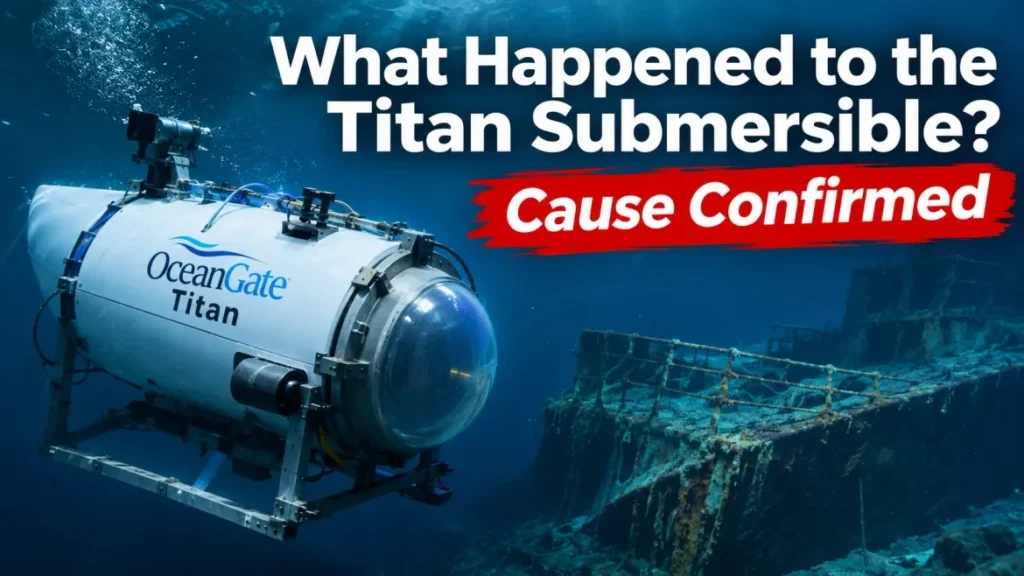

The Titan submersible imploded on 18 June 2023 during a dive to the Titanic wreck, killing all five people on board. US investigators concluded that OceanGate’s inadequate engineering process was the probable cause. Canada’s Transportation Safety Board closed the last of three official investigations on 17 June 2026.
What Caused the Titan Implosion?
The US National Transportation Safety Board blamed the way the submersible was engineered. In its final report, released on 15 October 2025, the board said “the probable cause of the hull failure and implosion of the submersible Titan was OceanGate’s inadequate engineering process”.
The board found that the process produced a vessel with multiple anomalies that did not meet the strength and durability it needed for repeated dives to Titanic depth. It also found that OceanGate had not tested the submersible adequately and did not know its real limits.
That answer replaced two years of speculation about viewports, electrical faults and lost thrust. The pressure hull itself failed.
The Hull Was Already Damaged Before the Final Dive
The Titan was carrying damage from earlier dives when it went down. The NTSB concluded that “the existing delaminations and additional damage that deteriorated the condition of the pressure vessel between dive 82 and the casualty dive (dive 88) resulted in a local buckling failure that led to the implosion of the Titan”.
In other words, the carbon-fibre hull degraded progressively, dive by dive, and OceanGate kept using it. Canada’s investigators reached the same conclusion, finding that damage accumulated with each dive and that the as-built properties of the carbon-fibre cylinder were never validated.
Contact with the surface vessel was lost about one hour and 45 minutes into the descent on 18 June 2023. A debris field was found four days later, on 22 June, roughly 500 metres from the bow of the Titanic wreck.
Who Died on the Titan?
Five men were aboard, and none survived. They were:
- Stockton Rush: OceanGate’s co-founder and chief executive, who was piloting the submersible.
- Paul-Henri Nargeolet: A French former navy commander and Titanic expert who had made dozens of dives to the wreck.
- Hamish Harding: A British businessman, aviator and record-setting explorer.
- Shahzada Dawood: A Pakistani-British businessman and director of Dawood Hercules Corporation.
- Suleman Dawood: Shahzada’s son, a university student, and the youngest person on board.
What the Three Official Investigations Concluded
Three separate bodies investigated, and all three faulted the operator rather than bad luck. Their reports were published across ten months.
The US Coast Guard’s Marine Board of Investigation published its findings on 5 August 2025. It called the loss preventable and criticised OceanGate’s design, certification, maintenance and inspection practices, along with the company’s safety culture.
The NTSB followed on 15 October 2025 with the probable-cause determination, and recommended that the Coast Guard convene a panel of experts to examine submersibles and other pressure vessels built to carry people.
Canada’s Transportation Safety Board closed its investigation, numbered M23A0169, on 17 June 2026. Because the Titan operated from St. John’s, Newfoundland, aboard the Polar Prince, Canada had jurisdiction over the support vessel. The TSB found the submersible received no oversight from Transport Canada even though the department knew it was working out of St. John’s, and said federal bodies held relevant information that nobody was responsible for pulling together. It issued six recommendations, including a call for the International Maritime Organization to make voluntary submersible guidelines mandatory.
Is OceanGate Still in Business?
No. OceanGate stopped operating in July 2023 and has announced no missions since. Its website states that the company “has suspended all exploration and commercial operations”.
As of 6 November 2026, there is no public record that OceanGate has filed for bankruptcy or been legally dissolved, and the most recent detailed reporting on its corporate status dates from mid-2025. Business databases list the company as closed or out of business. The practical position is a company that exists on paper and does nothing.
The Titan was built and run by OceanGate, founded in 2009 and based in Everett, Washington. Our earlier report on the 2023 Titan submersible incident covers the search and the first days of the response.
Has Anyone Been Held Liable?
Not yet, in any publicly reported outcome. In August 2024 the administrator of Paul-Henri Nargeolet’s estate filed a wrongful death suit in King County Superior Court in Washington state, seeking more than $50 million.
The claim names OceanGate, the estate of Stockton Rush and other people and companies involved in building the submersible, and alleges gross negligence. It also disputes the idea that the implosion was instantaneous, arguing the crew knew a failure was under way.
There is no verified public update on a ruling, settlement or trial date, and no reported criminal charges. The newest confirmed development in the whole affair remains the Canadian report of 17 June 2026.
Frequently Asked Questions
Was the Titan Submersible Ever Recovered?
Parts of it were. Debris was raised from the seabed in late June 2023, together with presumed human remains that were later identified by the US military’s DNA identification laboratory.
Who Owned the Titan Submersible?
OceanGate Inc., a private US company founded in 2009 and based in Everett, Washington. It designed, built and operated the vessel itself.
How Long Was the Titan Missing Before It Was Found?
Four days. It lost contact on 18 June 2023 and the debris field was located on 22 June 2023, after an international search.
Did the Titan Implosion Lead to New Safety Rules?
Not automatically. Investigators recommended changes, including making the International Maritime Organization’s submersible guidelines mandatory, but recommendations are not binding and no adoption has been confirmed.