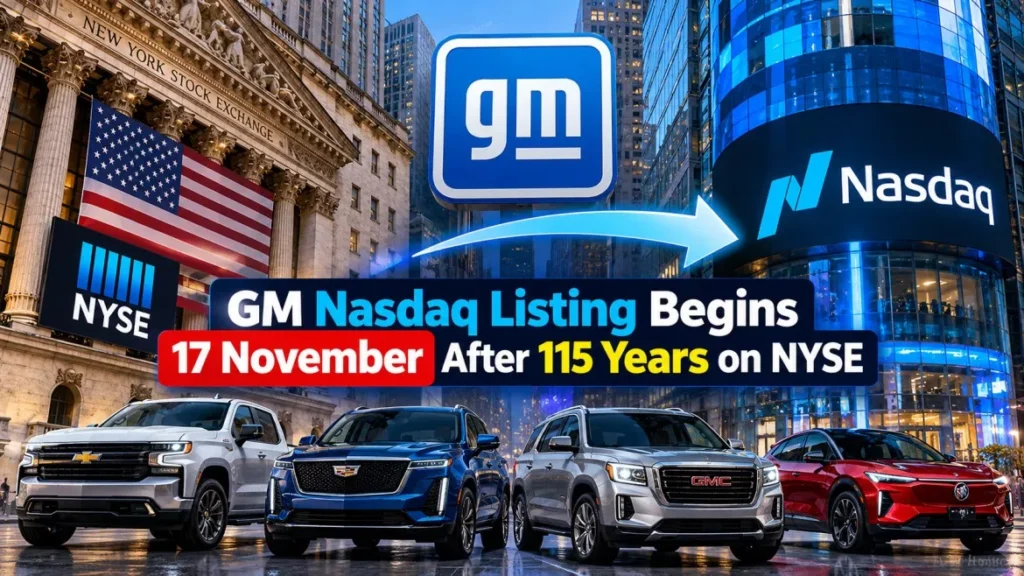

General Motors is moving its share listing from the New York Stock Exchange to the Nasdaq Global Select Market. The GM Nasdaq listing begins on 17 November 2026, after the stock trades on the NYSE through the close on 16 November. The ticker stays “GM” and shareholders need do nothing.
The Two Dates That Matter
The switch happens overnight between two trading sessions. General Motors set out the timetable in a press release filed with the United States Securities and Exchange Commission at 6:30 a.m. Eastern Time on 27 October 2026:
- Monday 16 November 2026: The last session on the New York Stock Exchange, where the shares remain listed under “GM” through the market close.
- Tuesday 17 November 2026: The expected first session as a Nasdaq-listed company, on the Nasdaq Global Select Market.
The symbol does not change, the share count does not change, and the company says no action is required by existing stockholders in connection with the transfer. Holders do not need to re-register, exchange certificates or instruct their broker.
What General Motors Said About the Move
GM framed the decision around its technology ambitions rather than cost. Paul Jacobson, the company’s Executive Vice President and Chief Financial Officer, said GM’s strategy is creating value and described Nasdaq as “a natural home for our listing as we grow”.
Jacobson also said the company is “grateful for our long-standing partnership with the New York Stock Exchange and its remarkable legacy”. The release notes that a Nasdaq listing makes the stock eligible for potential inclusion in the Nasdaq-100 Index.
GM has not disclosed what it will pay, or save, in listing fees. Reporting by AOL, citing Investopedia, says Nasdaq generally charges lower initial listing fees and has lighter ongoing compliance costs than the NYSE, but neither exchange has published figures for this transfer and GM has not commented on them.
What the Nasdaq-100 Rules Actually Require
Eligibility for the Nasdaq-100 is not the same as selection, and the index has published criteria that a transferring company must meet. The index is designed to track 100 of the largest Nasdaq-listed non-financial companies, and its published methodology sets these tests:
- Listing exchange: A company must be primarily listed on a United States Nasdaq-affiliated exchange, excluding the Nasdaq Capital Market. The Nasdaq Global Select Market, GM’s destination, qualifies.
- Industry: A company must not be classified in the Financial Industry under the Industry Classification Benchmark, the FTSE International classification system the index uses.
- Seasoning: A security must generally have been listed and traded on a seasoning exchange for at least three full calendar months. The methodology counts the NYSE as a seasoning exchange, so GM’s existing listing history satisfies this test and no waiting period applies.
- Liquidity: A security must have a three-month average daily value traded of at least $5 million.
- Market capitalisation: There is no minimum or maximum. Size matters only through the ranking used to pick constituents.
That last point is the one the eligibility language conceals. Clearing every criterion puts a company into the pool of eligible names; it does not put it in the index.
When GM Could Join the Index, and What Would Decide It
Any addition at the next annual review would take effect on 21 December 2026. The Nasdaq-100 is reconstituted once a year in December, and the methodology fixes the calendar as follows: the reference date is the last trading day of November, which in 2026 falls on Monday 30 November; changes are announced after the close on the sixth trading day before the effective date; and the effective date is the market open on the first trading day after the third Friday in December, which is Monday 21 December 2026.
GM’s first Nasdaq session on 17 November 2026 therefore falls nine trading days before that reference date. Selection then runs in a fixed order, based on a ranking of all eligible companies by full market capitalisation:
- Step one: The top 75 ranked companies are selected.
- Step two: Existing constituents ranked within the top 100 and not already picked are retained.
- Step three: Remaining existing constituents ranked 101st to 125th are selected in rank order, subject to conditions on their previous ranking.
- Step four: Any remaining companies ranked within the top 100 that are not already constituents are selected in rank order, until the index reaches 100 members.
A newcomer such as GM would enter through step one or step four, which means its rank by full market capitalisation on 30 November 2026 decides the outcome. GM’s market value was in the region of $68 billion during trading on 27 October 2026, according to market data published by Finviz and Robinhood that day, a figure that moves with the share price. Nasdaq has not announced any index change, and the company itself claims only eligibility.
What Changes for Shareholders, and What Does Not
Mechanically, almost nothing changes for an existing holder. The shares keep the same symbol and the same ISIN, dividends and voting rights are unaffected by a venue change, and the position in a brokerage account does not need to be moved.
The consequence that would matter is indirect. Index funds and exchange-traded products that track the Nasdaq-100 buy a company’s shares when it is added to the index, which can create one-off demand. That is contingent on a selection decision that has not been made, and the mechanism works in reverse on removal.
Shares rose on the announcement. GM traded at about $81 in late-morning New York time on 27 October 2026, against a close of $76.31 the previous day, with the intraday gain reported variously between about 2.4 per cent in pre-market trading and about 6 per cent later in the session, depending on when each outlet measured it. GM reported third-quarter results earlier in October.
Why GM Is Leaving an Exchange It Joined in 1911
The departure ends a relationship that began 115 years ago. General Motors first listed on the New York Stock Exchange in 1911. The present company, General Motors Company, is a successor created in the 2009 restructuring; it returned to the NYSE through a public offering in November 2010 that raised roughly $20 billion, after the predecessor’s shares were moved to over-the-counter trading and later cancelled.
For Nasdaq the transfer lands in a notable week, alongside Anthropic’s initial public offering filing. Coverage by Bloomberg and Automotive News placed GM’s move in the context of competition from electric-vehicle makers and from Chinese manufacturers, and of GM’s own positioning as a technology company. The NYSE has not issued a statement on losing the listing.
Frequently Asked Questions
When Does the GM Nasdaq Listing Start?
General Motors expects to begin trading on the Nasdaq Global Select Market on Tuesday 17 November 2026. Its shares remain listed on the New York Stock Exchange through the close of trading on Monday 16 November 2026.
Does the GM Ticker Symbol Change?
No. The symbol remains “GM” on Nasdaq. General Motors says no action is required by existing stockholders in connection with the transfer.
Will General Motors Join the Nasdaq-100?
Nasdaq has not said. The listing makes GM eligible to be considered, but constituents are chosen by ranking eligible companies on full market capitalisation at the annual December reconstitution, whose reference date is 30 November 2026. Any change takes effect on 21 December 2026.
Why Is General Motors Moving to Nasdaq?
Chief Financial Officer Paul Jacobson pointed to the company’s growth and technology strategy, calling Nasdaq “a natural home for our listing as we grow”. GM has not published a cost comparison between the two exchanges.
How Long Was General Motors Listed on the NYSE?
GM first listed on the New York Stock Exchange in 1911, 115 years before this move. The current corporate entity relisted there in November 2010 following the 2009 restructuring of its predecessor.