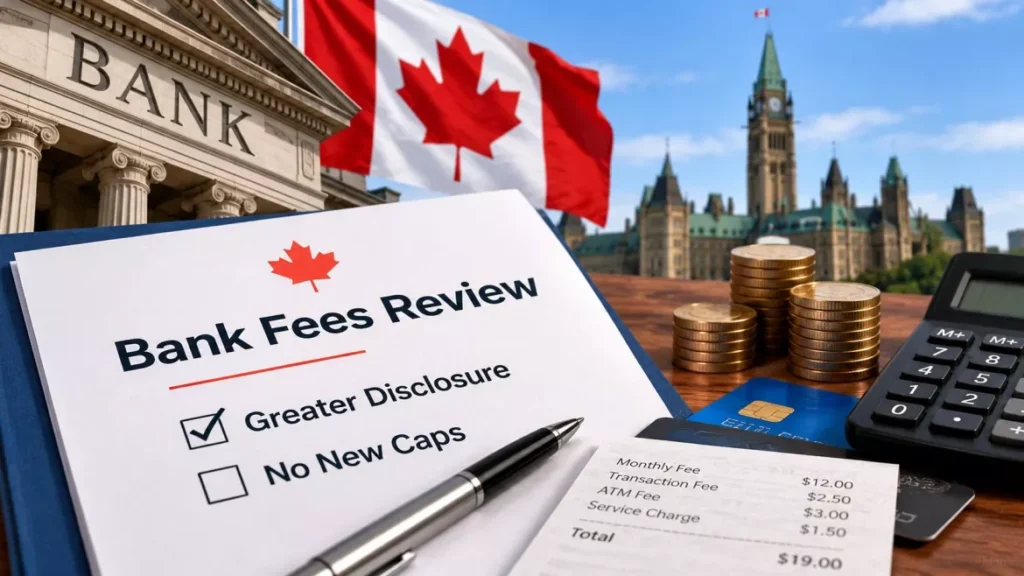

A federal review of Canada bank fees recommends better disclosure rather than new limits on what banks charge. The Financial Consumer Agency of Canada published A Review of Banking Fees in Canada on 23 October 2026, at the government’s request in Budget 2025. It imposes no new caps.
What the Review Found
The agency’s central finding is about visibility, not the size of individual charges. The Financial Consumer Agency of Canada, the federal body that supervises banks’ conduct towards customers, said the way fees are structured makes the total cost hard to see and hard to compare between banks.
Four findings sit at the centre of the review:
- Stacked charges: Several fees can apply to a single transaction, raising its total cost.
- Embedded currency costs: Foreign exchange and cross-border debit fees are built into transaction costs, which makes them less visible than a separately itemised charge.
- Unpredictable usage fees: Fees tied to how often a customer transacts are hard to anticipate, particularly when people cannot easily track how many transactions they have made.
- Cumulative effect: Individually the fees may appear small, but the review found they can add up over time.
Commissioner Shereen Benzvy Miller said in the agency’s announcement of the review that “Canadians should be able to clearly understand what they are paying for banking services”.
Which Fees the Review Examined
The agency’s own release names three structural categories: multiple per-transaction fees, foreign exchange and cross-border debit fees, and usage-based fees. Canadian press coverage of the full report lists the specific charge types examined as account maintenance, excess transactions, ATM use, non-sufficient funds, overdraft protection, currency conversion and cross-border debit, payments on prepaid products, and fees for transferring funds out to another bank.
That fuller list comes from news coverage rather than the agency’s release, and has not been separately confirmed here. The Globe and Mail reported that financial institutions took in $2.45 billion of revenue in 2025 across nine customer fee categories; that figure is from a single outlet.
What the Review Does Not Do
The review changes no rules. It is an evidence-gathering exercise, and the agency’s release announces no new fee caps, no price controls and no binding requirements on banks.
What the agency says it identified were “opportunities to improve fee transparency and provide more personalized information about fees paid over time”. It also framed the findings as input to wider policy discussions on transparency, comparability, switching, competition and consumer-driven banking, the Canadian framework for letting customers share their banking data with other providers.
Separately, in an interview reported by Investment Executive, Benzvy Miller said she would like banks to take an active role in reducing fees. That is an expressed preference rather than a regulatory requirement.
The Fee Limits Canada Already Has
Two measures already cap certain costs, and both predate this review. They remain in force whatever follows from the report.
| Measure | Limit | In force from | Who is covered |
|---|---|---|---|
| Non-sufficient funds fee cap | $10 Canadian per NSF fee | 12 March 2026 | Federally regulated banks |
| Low-cost and no-cost account commitment | No more than $4 Canadian a month | 1 December 2025 | 14 federally regulated institutions, including the six largest banks |
A non-sufficient funds fee is charged when an account lacks the money to cover a payment. When the $10 cap took effect on 12 March 2026, François-Philippe Champagne, Minister of Finance and National Revenue, said “more than one in three Canadians are affected by these fees”.
Who the Agency Says Is Most Affected
The agency has said the cumulative cost falls unevenly. On the earlier NSF measure, Benzvy Miller said that “these fees disproportionately affect Canadians who are already struggling financially”.
Coverage of the new review reports the same pattern, with the heaviest effect on people on modest incomes, those with limited savings and those who rely on day-to-day banking services. The review deals in patterns across the market, so no figure in it describes what any individual customer pays. What a person is charged depends on their institution, their account type and how they use it.
What Happens Next
No deadline or legislative step has been attached to the review. As of 27 October 2026 the report is published, the government has not announced a response, and no new fee regulations have been laid before Parliament.
The agency’s stated route is for the evidence to feed policy discussion on competition and switching. Readers who want to check what their own bank charges can consult the fee disclosure their institution is required to provide, and the agency’s own account-comparison material on its website, rather than relying on market averages.
Frequently Asked Questions
What Did the Canada Bank Fees Review Conclude?
That bank fees in Canada are hard to see and hard to compare, because several can apply to one transaction, currency charges are embedded in transaction costs, and usage-based fees are difficult to predict. It found the charges can add up over time.
Does the Review Cap Any Bank Fees?
No. The review published on 23 October 2026 recommends better disclosure and more personalised information about fees paid over time. It introduces no caps and no new obligations on Canadian banks.
Is There a Limit on NSF Fees in Canada?
Yes. A $10 Canadian cap on non-sufficient funds fees at federally regulated banks took effect on 12 March 2026, under regulations separate from this review.
What Is the Cheapest Account Banks Must Offer?
Under a modernised commitment effective 1 December 2025, 14 federally regulated institutions, including Canada’s six largest banks, offer accounts costing no more than $4 Canadian a month. Eligibility and features vary by institution.
Which Country Do These Findings Apply To?
Canada only. The review covers fees charged by Canadian banks and was commissioned by the Canadian federal government in Budget 2025.