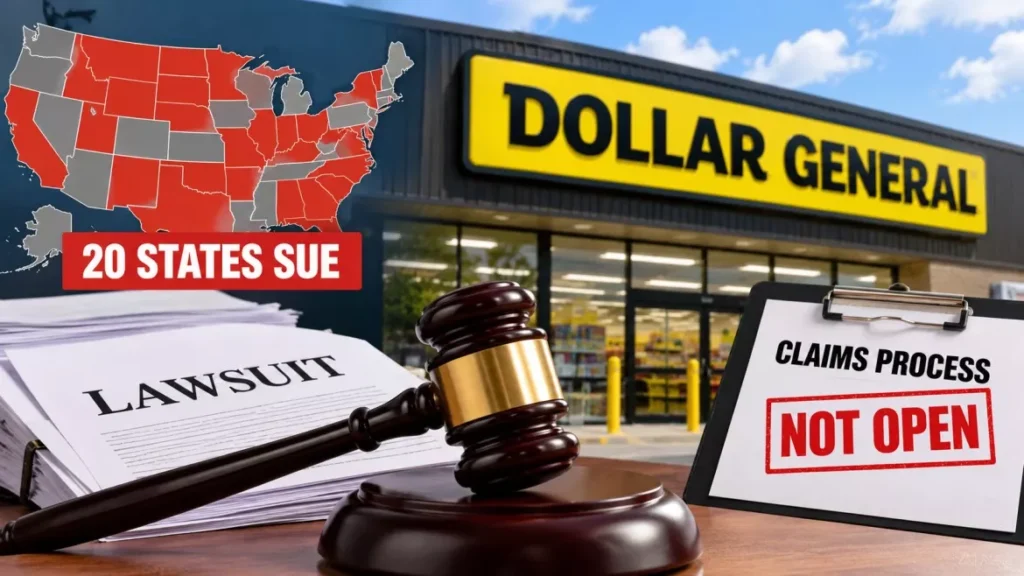

The Federal Trade Commission and 20 United States state attorneys general have sued Dollar General, alleging it charged shoppers more at the register than the prices shown on shelves, tags and advertisements. The Dollar General lawsuit was filed on 26 October 2026 in the United States District Court for the Middle District of Tennessee. Nothing has been decided, and no money has been ordered.
What the FTC and the States Allege
The complaint accuses the retailer of a long-running failure to match register prices to displayed prices. According to the Commission’s announcement, the plaintiffs allege that Dollar General mislabelled prices for years, knew about the problem at corporate level, and did not put adequate policies in place to fix it, with thousands of stores taking millions of dollars in overcharges.
Christopher Mufarrige, Director of the FTC’s Bureau of Consumer Protection, said “Dollar General has betrayed the trust of millions of American consumers”. The Commission voted 2-0 to authorise staff to file the complaint. Dollar General operates more than 21,000 stores across the United States.
The complaint cites tens of thousands of consumer complaints about prices not being honoured. Reporting on the filing puts the figure at nearly 30,000, logged through March 2026, although accounts of when the count begins differ: Claims Journal dates it from 2019, while other coverage of the filing dates it from January 2023. The complaint also refers to seven earlier settlements Dollar General reached in six states between 2019 and 2026 over pricing accuracy, carrying about $6 million in penalties, according to Claims Journal.
These are allegations in a civil complaint. A complaint is the document that starts a case; it is not a finding, and no court has ruled on any of it.
The 20 States That Joined the Case
Twenty state attorneys general are co-plaintiffs alongside the FTC, and the case is brought under the FTC Act and state consumer protection laws. The states are:
- Alabama, Arizona, Arkansas, California, Connecticut
- Florida, Illinois, Iowa, Kansas, Louisiana
- Michigan, Mississippi, Nebraska, New Jersey, North Carolina
- Ohio, Oklahoma, Tennessee, Utah, Wisconsin
Shoppers in the other 30 states and the District of Columbia are not represented by a state plaintiff here, although the FTC’s own claims are federal. The civil penalties the plaintiffs seek arise under state law, which is why the list of states matters to what any eventual remedy could cover.
What Dollar General Says
The company disputes the characterisation and says discrepancies are occasional rather than systemic. In a statement quoted by CBS News, Dollar General said: “Our goal is 100% accuracy between shelf and register prices in every store,” adding that “as with other retailers and despite our policies and procedures, occasional price discrepancies can occur”.
The company said that when that happens, “our store teams are instructed, empowered, and expected to make things right for the customer”, and that “in recent years, we have enhanced our price-accuracy processes and remain committed to continuous improvement”. In a separate statement reported by the Associated Press, Dollar General said the suit suggests it had “abandoned our mission and willfully disregarded the affordability needs of our customers”, and that “nothing could be further from the truth”.
CNBC reported that Dollar General shares fell about 4 per cent after the lawsuit was announced on 26 October 2026. Share prices move daily and that reading is a single day’s reaction.
Is There Any Money for Shoppers Right Now?
No. There is no claim form, no settlement fund and no deadline attached to this case, because it has only just been filed. What the plaintiffs are asking the court for, and what a court might eventually order, are different things.
The relief sought, as described in the FTC’s announcement and in reporting on the complaint, includes:
- A permanent injunction: A court order requiring Dollar General to change how it sets and displays prices.
- Monetary relief and restitution: Money returned to consumers, in an amount the court would have to determine.
- Civil penalties: Fines available under the individual states’ consumer protection statutes.
- Pricing controls: Court-supervised requirements on price accuracy, reported by Claims Journal among the remedies requested.
Whether any of that is granted depends on the outcome of the litigation, and civil cases of this kind routinely take years. Anyone directed to a website offering to register them for a payout from this case should treat it with caution; official information about FTC refunds is published by the Commission itself, as happened with the separate FTC refund programme for Walmart customers.
How This Differs From the Settlement That Already Closed
A separate, private class action over the same subject has already run its course, and the two are easy to confuse. That case, Braun v. Dolgencorp LLC, produced a settlement reported at $15 million; its claim window closed on 13 April 2026, after a final fairness hearing on 19 March 2026.
| Braun v. Dolgencorp settlement | FTC and states case | |
|---|---|---|
| Brought by | Private class action lawyers | The FTC and 20 state attorneys general |
| Stage | Settled; claims closed | Complaint just filed |
| Purchases covered | Reported as 10 October 2016 to 19 November 2025 | Not defined; no class has been certified |
| Claim deadline | 13 April 2026, now passed | None exists |
| Money available | Reported $15 million fund | None ordered |
Dates and amounts for the private settlement come from settlement-tracking coverage rather than the court’s own docket, and at least one tracker lists the final outcome as not publicly posted. A reader with a question about that settlement should go to the court record or the named settlement administrator rather than to a third-party claims site.
What Happens Next, and What Is Unknown
As of 28 October 2026 the case is at its earliest stage, with no hearing date reported. Dollar General has not yet filed a response to the complaint, and a defendant in a federal civil case normally answers or moves to dismiss before any substantive ruling.
Several things are not known. The FTC’s announcement does not specify the sections of the FTC Act relied on or the number of counts, and no case number has appeared in the coverage reviewed for this article. The complaint’s own figure for total overcharges is described only as millions of dollars. And neither the Commission nor the states have said whether they would accept a settlement, as six states separately did between 2019 and 2026.
Multistate actions of this shape have become more common: a coalition of state attorneys general sued OpenAI earlier in 2026 seeking injunctive relief and fines under state law.
Frequently Asked Questions
Who Filed the Dollar General Lawsuit?
The Federal Trade Commission, the United States agency that enforces federal consumer protection law, together with the attorneys general of 20 states. It was filed on 26 October 2026 in the United States District Court for the Middle District of Tennessee.
Can Shoppers Claim Money From This Case?
Not at present. The case is a newly filed complaint with no settlement fund, no claim form and no deadline. Any consumer payment would require a court order or a settlement that does not yet exist.
Has a Court Found That Dollar General Overcharged Customers?
No. The overcharging described in the complaint is an allegation. No court has ruled on the claims, and Dollar General disputes them.
Which States Are Part of the Dollar General Lawsuit?
Alabama, Arizona, Arkansas, California, Connecticut, Florida, Illinois, Iowa, Kansas, Louisiana, Michigan, Mississippi, Nebraska, New Jersey, North Carolina, Ohio, Oklahoma, Tennessee, Utah and Wisconsin.
What About the Earlier Dollar General Pricing Settlement?
That was a separate private class action, Braun v. Dolgencorp LLC, reported at $15 million and covering purchases through 19 November 2025. Its claim deadline of 13 April 2026 has passed, and it is unconnected to the FTC case filed in October 2026.