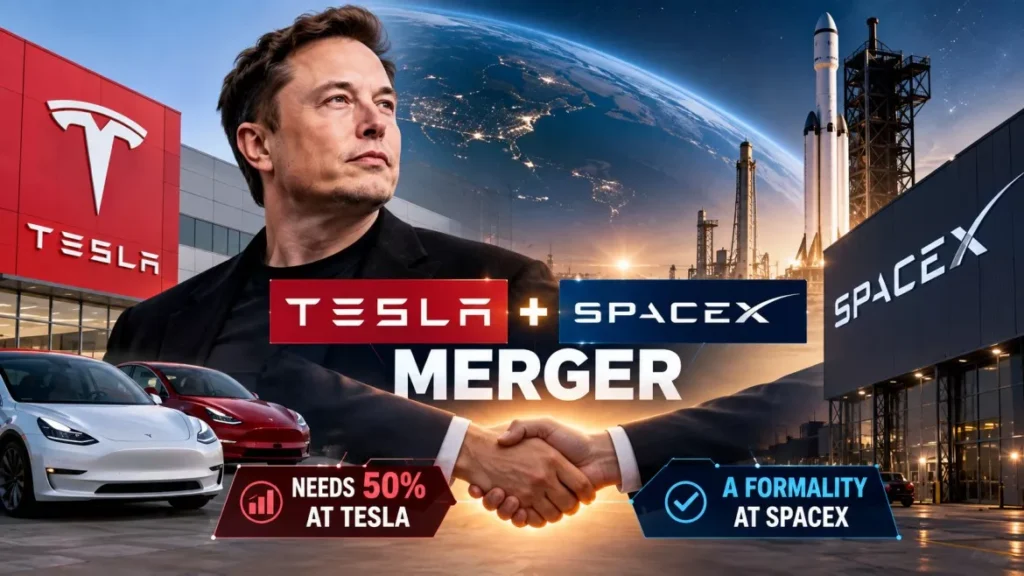

Tesla and SpaceX have each formed a special committee of independent directors to review a merger of the two United States companies. Elon Musk disclosed the committees on SpaceX’s third-quarter earnings call on 20 October 2026. No terms have been agreed, and Musk said a Tesla SpaceX merger is not guaranteed.
What Musk Said on the Earnings Call
Musk made the disclosure while answering an analyst’s question on the call, held on Tuesday 20 October 2026. He said each board had formed its committee from independent directors, and that the committees were set up at the request of shareholders. He did not name a single member of either one.
He was explicit that he is not in the room. “Because I’m a conflicted party, I can’t actually be in the discussions of the special committees,” he said. He described the arrangement as “an odd Kabuki dance, where groups of people are talking and I can’t be in the conversation”, and said that answering the question at all felt like “dancing through a minefield”.
A conflicted party, in this context, is someone who stands on both sides of a proposed transaction. Musk is chief executive of both companies and the largest individual shareholder in each, so under United States securities practice the negotiation is handed to directors who have no such dual interest.
He also pushed back on the idea that a combination is settled. “I think some people out there assume that a SpaceX and Tesla merger is a certainty, and I think that would be overstating it,” he said, while adding that he sees “a lot of merit to combining the companies”. On approval, he said: “At the end of the day, the shareholders have to be supportive of this.”
Why Tesla’s 50% Threshold Is the Hard Part
The approval bar at Tesla is higher than a normal corporate vote, and Musk said so on the call. A merger would need the support of 50% of all outstanding Tesla shares, not 50% of the shares actually voted.
That distinction decides the outcome. In a vote measured against shares cast, shareholders who ignore the ballot are irrelevant. In a vote measured against every share in existence, they are not: a share that is never voted has the same practical effect as a share voted against. Tesla has an unusually large base of individual retail shareholders, who historically turn out at lower rates than institutions, which is why Musk characterised the threshold as a high hurdle.
Not every change of control needs that kind of mandate. Bumble’s take-private deal earlier in 2026 closed without a shareholder vote at all, because its structure did not require one. A Tesla-SpaceX combination would.
Neither company has disclosed a price, an exchange ratio, or whether any combination would be paid in stock or cash. Without terms there is nothing for either shareholder register to vote on.
At SpaceX, the Same Vote Is a Formality
The approval risk sits almost entirely on the Tesla side, and this is the part most coverage of the story leaves out.
SpaceX listed on Nasdaq on 12 June 2026 under the ticker SPCX, at a valuation reported at about $1.77 trillion, making it the largest initial public offering on record. Musk kept majority voting control through a dual-class share structure that gives his Class B stock ten votes per share. The exact figure depends on which document you read: the May 2026 registration statement put his combined voting power at 85.1%, while the final prospectus was reported by CNN and CBS News at 82.4% after the offering.
Either figure clears a simple majority outright. So while a merger would formally require the approval of both sets of shareholders, Musk can deliver SpaceX’s approval on his own voting power, and cannot deliver Tesla’s. That asymmetry, rather than the existence of the committees, is what determines whether a deal can reach completion.
Nothing Can Be Voted On Before 3 December
As of 21 October 2026, no merger proposal appears on any Tesla shareholder ballot, and the company’s next scheduled shareholder meeting cannot produce one.
Tesla filed its definitive proxy statement with the United States Securities and Exchange Commission on 19 October 2026, the day before Musk’s disclosure. Tesla’s proxy statement sets the annual meeting for 3 December 2026 at 3:00 p.m. Central Time, held online and in person at Gigafactory Texas in Austin, with a record date of 13 October 2026. It lists three company proposals:
- Proposal one: Elect three Class I directors — Elon Musk, board chair Robyn Denholm and JB Straubel — to three-year terms.
- Proposal two: A non-binding advisory vote approving 2025 executive compensation.
- Proposal three: Ratify PricewaterhouseCoopers LLP as the company’s auditor for the financial year ending 31 December 2026.
None is a merger vote. In the proxy, SpaceX appears only in director biographies and in a reference to the former xAI Holdings becoming a SpaceX subsidiary. Any merger would therefore require a separate shareholder meeting, convened after terms exist.
What Would Have to Happen Before Any Merger Vote
The procedural sequence for a transaction of this kind in the United States is fixed, and the companies have completed only the first step of it:
- Committees negotiate: The two special committees, advised separately, would have to agree terms — a price or exchange ratio and a structure. Musk said they have not done so.
- Boards approve: Each board would need to approve a definitive merger agreement and recommend it to shareholders.
- Registration and proxy filing: A stock-financed merger is registered with the SEC, and shareholders receive a proxy statement setting out the terms before they vote.
- Shareholder meetings: Each company convenes a meeting. Tesla’s would need 50% of all outstanding shares in favour.
- Regulatory clearance: A combination of this size would draw antitrust and, given SpaceX’s defence and space contracts, national-security review.
Nothing in the public record indicates that steps two through five have begun.
The Director Who Sits on Both Boards
Neither company has said who serves on its committee, which leaves an open question about how arm’s-length the review can be.
Tesla’s proxy identifies seven directors as independent under Nasdaq listing standards: Denholm, Ira Ehrenpreis, Straubel, Joe Gebbia, Jack Hartung, James Murdoch and Kathleen Wilson-Thompson. Elon Musk and Kimbal Musk are not independent. SpaceX’s investor relations page lists six independent directors: Ehrenpreis, Randy Glein, Donald Harrison, Steve Jurvetson, Luke Nosek and Roelof Botha, with Musk, Antonio Gracias and Gwynne Shotwell outside that group.
Ehrenpreis appears on both lists. A committee is meant to represent one company’s shareholders against the other’s, and a director seated on both boards sits on both sides of that line. Because neither company has published its committee roster, it is not known whether he serves on either committee. Gracias, who is not independent at SpaceX, founded Valor Equity Partners, which holds a 3.4% SpaceX stake and has financed SpaceX hardware purchases through leaseback arrangements.
The Quarter That Set This Off
The disclosure came attached to a set of results that changed SpaceX’s financial position. The figures below were reported by SpaceX on 20 October 2026 and are drawn from earnings coverage and the call transcript rather than from a filing, which had not been published at the time of writing.
| Measure | Q3 2026 | Comparison |
|---|---|---|
| Revenue | About $14.58 billion | Up 161% year on year; analysts expected about $12.7 billion |
| Net income | About $4.4 billion | Against a loss of about $1.1 billion a year earlier |
| Diluted earnings per share | $0.35 | Consensus was about $0.13 to $0.16 |
| Capital expenditure | About $19.6 billion | Guided to $35 billion to $40 billion in Q4 2026 |
Much of the growth came from a business that did not exist at the company two years ago. SpaceX acquired xAI Holdings in February 2026, and its superintelligence segment — which includes renting computing capacity to artificial-intelligence firms — contributed roughly $7.6 billion, overtaking connectivity at about $5.25 billion, the division that also covers Starlink and its recent low-band spectrum purchase. Musk pointed to shared work on AI software, robotics, an orbital data-centre project called Starmind and a joint chip-manufacturing effort called Terafab as the industrial case for combining the two companies. The two already share facilities: Tesla unveiled the production Roadster at a SpaceX rocket test site in Texas in October 2026, though its price remains unannounced.
Investors reacted to the results and the merger remarks together, so the two cannot be separated. SpaceX shares rose between roughly 8% and 10% during trading on Wednesday 21 October 2026, depending on the time of the reading: CNN reported a gain of more than 8% in the morning session, and Forbes reported nearly 10% at 10:30 a.m. Eastern Daylight Time. Tesla’s move was smaller, reported at 1.4% in premarket trading and above 3% on Wednesday morning. Those are intraday readings, not closing prices.
What Is Still Unknown
The gaps in the public record are substantial, and several of them are the things that would decide the outcome:
- Terms: No price, exchange ratio, structure or valuation for either company has been disclosed.
- Committee membership: Neither board has named the directors on its special committee, or its advisers.
- Timing: No deadline, target date or meeting has been set for a decision by either committee.
- Whether it proceeds at all: Musk said the committees have not reached agreement and there is no guarantee they will.
Reported timelines circulating in analyst commentary, including suggestions that a deal could be announced before December, are projections by outside firms rather than statements by either company.
Frequently Asked Questions
Have Tesla and SpaceX Agreed to Merge?
No. As of 21 October 2026 both boards have formed special committees of independent directors to review a possible merger, but Musk said on 20 October that no terms have been agreed and that a deal is not guaranteed.
How Many Tesla Shares Would Have to Approve a Merger?
Musk said a merger would need 50% of all outstanding Tesla shares in favour, not 50% of the shares actually voted. On that basis a share that is never voted counts in practice against the deal.
Will Tesla Shareholders Vote on a Merger on 3 December 2026?
No. Tesla’s proxy statement, filed on 19 October 2026, lists three proposals for the 3 December annual meeting: the election of three directors, an advisory vote on 2025 executive pay and the ratification of its auditor. A merger vote would need a separate meeting.
Why Can Elon Musk Not Take Part in the Talks?
He is chief executive and the largest individual shareholder of both companies, which makes him what he called a “conflicted party” — someone on both sides of the transaction. The negotiation is handled by directors without that dual interest.
Does SpaceX Face the Same Approval Problem as Tesla?
Not in practical terms. After the June 2026 listing, Musk retained majority voting control of SpaceX through ten-vote Class B shares, reported at between 82.4% and 85.1% depending on the filing, so he can supply SpaceX’s shareholder approval himself.