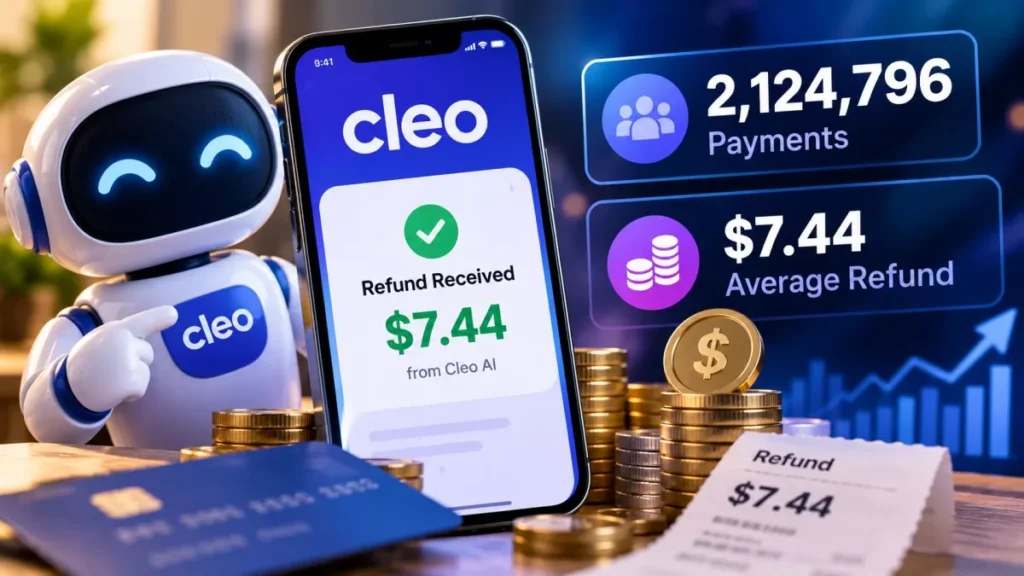

The Cleo AI refund averages about $7.44 a payment: the United States Federal Trade Commission is sending more than $15.8 million across 2,124,796 PayPal payments. Email notifications run from 8 to 26 October 2026, and payments begin on 27 October. The FTC says recipients should accept a payment within 30 days.
Who Is Being Paid, and How
Payments go to people who paid Cleo AI for eligible instant cash advances. Cleo AI is a cash advance app, a service that fronts a small sum before payday and charges for faster delivery of the money.
The FTC, the US agency that polices unfair and deceptive business practices, is making the payments by PayPal rather than by cheque or bank transfer. Eligible people receive an email from [email protected], and the refund administrator is Rust Consulting, which the FTC lists on 1-877-788-4958 for questions about a payment.
The FTC has not published how individual amounts were worked out, and its refund page does not define which advances count as “eligible” beyond saying the person paid for one. Amounts will differ from person to person.
What the Refund Works Out To
Dividing the announced total by the announced number of payments gives about $7.44 each. That is arithmetic on the FTC’s two published figures, not a figure the FTC itself has issued, and it is an average rather than anyone’s actual payment.
| Figure | Amount |
|---|---|
| Total being distributed | More than $15.8 million |
| Number of PayPal payments | 2,124,796 |
| Arithmetic average per payment | About $7.44 |
| Original settlement paid by Cleo AI | $17 million |
The gap between the $17 million settlement and the $15.8 million being distributed is not explained on the FTC’s pages, and the agency has published no breakdown of it.
Because payments are expected to track how much each person paid for instant advances, a person who used the service once will not receive the same sum as a person who paid for advances repeatedly over months. The $7.44 figure describes the pool, not an entitlement.
The Dates, in Order
Four dates govern the programme, and the last of them is the one that can cost someone the money.
- 8 October 2026: The FTC announced the distribution and began sending email notifications.
- 26 October 2026: The last day on which notification emails are sent, according to the FTC’s refund page.
- 27 October 2026: PayPal payments begin going out.
- 30 days from receipt: The window to accept a PayPal payment. The FTC’s wording is “please accept it within 30 days.” The agency has not published a single calendar end date, because the window runs from each payment.
As of 13 October 2026, the notification window is open and no payments have yet been issued; the first are due on 27 October 2026.
What the FTC Alleged, and What No Court Decided
The refunds stem from a case the FTC brought against Cleo AI in the US District Court for the Southern District of New York. The agency announced a $17 million settlement on 27 March 2025.
In its own summary of the complaint, the FTC said Cleo AI:
- Overstated the money available: It advertised access to “hundreds of dollars” in cash advances, though almost no customer received an amount close to what was advertised.
- Charged for speed it did not deliver: It levied fees for same-day or instant advances that often did not arrive until the next day.
- Made cancelling hard: It made it difficult for users to cancel their subscriptions.
These are allegations, and the distinction matters. The case ended in a stipulated order for a permanent injunction and monetary judgment, which is a negotiated settlement. No court ruled on whether the FTC’s allegations were true, and the FTC’s published pages record no admission by the company.
The order requires Cleo AI to stop misleading customers about the material terms of its advances, to disclose subscription terms clearly, to obtain express informed consent before charging for a subscription and to provide a simple way to cancel. Law firms summarising the order report that its compliance obligations run for 10 years; the FTC’s own case page does not state a duration.
The FTC’s distribution in this case sits alongside other consumer redress it has run this autumn, including the Amazon Prime refunds that began on 1 October 2026.
Telling a Real Payment From a Fake One
Large, well-publicised refund programmes attract impersonation, and this one has a specific profile that makes fakes easy to build: an unexpected email, a payment platform and a 30-day deadline.
The FTC states on its refund pages that “the Commission never requires people to pay money or provide account information to receive a payment”, and that “the FTC will never demand money, make threats, tell you to transfer money, or promise you a prize.”
The official channels are the ones the agency itself publishes: its Cleo AI refunds page, which names Rust Consulting and the number 1-877-788-4958, and ftc.gov/refunds for its refund programmes generally. Any request for a fee, a card number or account credentials in order to release a refund does not come from the FTC.
Frequently Asked Questions
How Much Is the Cleo AI Refund?
The FTC is distributing more than $15.8 million across 2,124,796 PayPal payments, which averages about $7.44 each. Individual amounts are not published and will vary with how much each person paid for instant cash advances.
When Do Cleo AI Refund Payments Arrive?
PayPal payments begin on 27 October 2026. Notification emails were sent between 8 and 26 October 2026 from [email protected]. These dates apply to the United States programme run by the FTC.
What Happens if a Payment Is Not Accepted?
The FTC asks recipients to accept a PayPal payment within 30 days. The agency has not published what happens to funds that go unaccepted in this programme.
Who Can I Contact About a Cleo AI Payment?
The FTC names Rust Consulting as the refund administrator, reachable on 1-877-788-4958. The agency’s own Cleo AI refunds page at ftc.gov is the authoritative source for the programme’s terms.
Did a Court Find That Cleo AI Broke the Law?
No. The case was resolved by a stipulated order in the US District Court for the Southern District of New York, a negotiated settlement in which no court ruled on the FTC’s allegations.