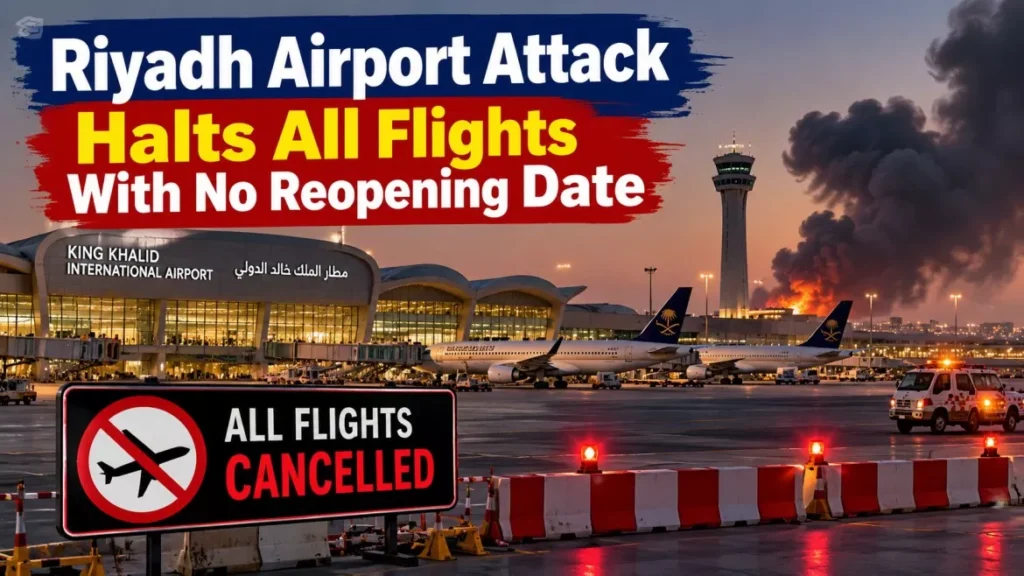

The Riyadh airport attack on Saturday killed 12 people and wounded 309 at King Khalid International Airport, Saudi Arabia’s General Authority of Civil Aviation said. The strike hit on 10 October 2026, and a second projectile struck the same airport on Sunday evening. Flights remain suspended with no reopening date announced.
It was the third assault on the Saudi capital’s main airport in a week, and the deadliest reported in the kingdom in more than a decade, according to Al Jazeera. It follows the launch in early October of a Yemeni government offensive against the Houthi movement, backed by air power from the Saudi-led coalition. Everything in this article applies to Saudi Arabia and to flights serving it.
What Saudi Authorities Have Confirmed
The General Authority of Civil Aviation, the Saudi regulator known as GACA, is the body publishing the official toll. Its follow-up statement, carried by the state-run Saudi Press Agency, put the 10 October death toll at 12 and the number of injured at 309, some of them in critical condition.
GACA listed the dead as four Saudi citizens and residents, two Bangladeshi nationals, and one person each from the United States, Egypt, Jordan, Syria, Palestine and Sudan. It said Umrah pilgrims and visitors to Islam’s two holiest mosques were among those killed and injured. Bloomberg, Gulf News and Saudi Gazette reported the same figures.
Two things the statement did not do are worth noting, because much of the coverage filled the gaps on its behalf. GACA did not specify the type of weapon used, and it did not name the party it held responsible. The attribution to the Houthis in most headlines comes from the Saudi-led coalition and from foreign governments, not from the aviation regulator’s own statement.
The toll may already be out of date. NBC News reported on 11 October that the Indian Embassy in Saudi Arabia said an Indian national wounded on Saturday had died, which would raise the count to 13. GACA had not revised its published figure of 12 at the time of writing. CBS News, meanwhile, published a nationality list of 11 and attributed the American death only to a statement by US Secretary of State Marco Rubio.
For the second strike, on the evening of Sunday 11 October, GACA said the attack targeted King Khalid International Airport and had “resulted in injuries”, without giving a number. The Saudi-led coalition said the projectile struck Terminal 4 and started a fire, and that it had intercepted and destroyed a cruise missile near the airport.
Riyadh Airport Status as of 12 October 2026
As of 12 October 2026, King Khalid International Airport in Riyadh is closed to flights and no reopening date has been announced. That is the single point on which the ranking coverage is least clear, and travel guides that rank for the question are out of date: at least one was still reporting that air traffic had “returned to normal” as of 9 October, the day before the deadliest strike.
The sequence, drawn from GACA statements and reporting by ABC News in Australia and CBS News:
- Thursday 8 October 2026: GACA said operations at the airport had resumed after earlier attacks that week.
- Saturday 10 October 2026: Operations were suspended after the missile strike. An official notice to aviators put the suspension through midnight.
- Sunday 11 October 2026: Saudi Arabia extended the closure, and the airport was struck again that evening. Police blocked all entrances and lights around the complex were dimmed.
- As of 12 October 2026: No indication has been given of when the airport will reopen.
Flight tracking gives a sense of scale, though these are moving numbers rather than standing facts. FlightAware counted at least 291 cancelled flights at the airport over the 24 hours to CBS News’s report on 10 October. Flightradar24 showed flights to Riyadh either diverted or cancelled.
Several carriers had already pulled back before the 10 October strike. Air India, FlyDubai, the Lufthansa Group and Pakistan International Airlines suspended or changed services to Riyadh and other Saudi airports, for varying periods. The European Union Aviation Safety Agency, the EU regulator that issues airspace risk bulletins, expanded its guidance on Saudi airspace and warned of a heightened risk that civilian aircraft could be misidentified.
Travellers’ own airlines and GACA are the channels publishing live status. Several governments have issued advisories: the US Mission in Saudi Arabia strongly recommends that American citizens avoid the airport and the area around it, Australia’s Smartraveller advises against travel to King Khalid International Airport and asks citizens to reconsider travel to Saudi Arabia, and Britain, Germany and Canada have each told citizens to stay away from the airport. Riyadh schools were moved to remote learning for a week.
Who Claimed the Attacks, and What Is Disputed
On the deadliest strike, the reporting genuinely conflicts, and most coverage does not say so. Al Jazeera reported that the Houthis claimed responsibility for the Saturday attack. NBC News and CBS News both reported that the group had not claimed it, while renewing its warnings to stay away from Saudi airports. The Saudi-led coalition blamed the Houthis in both cases.
What is agreed is narrower than the headlines suggest:
- Agreed: Projectiles struck King Khalid International Airport on 10 and 11 October 2026; GACA published a toll of 12 dead and 309 injured for the first of those; operations are suspended.
- Claimed by the Houthis: Responsibility for earlier attacks on Riyadh and Abha airports this week; a missile and drone strike on an Aramco refinery at Rabigh, which Saudi authorities did not immediately confirm.
- Claimed by the coalition: That the Houthis carried out both weekend strikes; that it intercepted a ballistic missile aimed at al-Kharj province and a drone in the Eastern Province early on Sunday; that a projectile fell near King Fahd International Airport in Dammam.
- Unverified: That the Saturday projectile was a Houthi ballistic missile; accounts from unnamed regional officials that the strike hit the complex housing Terminals 3 and 4 and that three aircraft were damaged on Thursday; the Houthi assertion that Saudi Arabia struck Sanaa International Airport.
The Houthi movement has made its position on civil aviation explicit. It declared Saudi airspace a zone of military operations after the government offensive began, saying any aircraft there other than over Mecca and Medina is a target, and warned global airlines “for the last time” about flying in it. Airports, it said, are “exposed to targeting and constitute a theatre of operations for our forces”. Its military spokesman, Yahya Saree, wrote on X, in wording reported by Al Jazeera: “Take our warnings seriously, and Saudi Arabia bears responsibility for any failed interceptions.” The head of the group’s media office said it had “shut down Riyadh international airport”.
The coalition’s spokesman, Major-General Turki al-Maliki, called the 10 October attack a “full-fledged war crime” and said coalition forces would “respond decisively to this terrorist attack”.
How Yemen’s War Reached Saudi Airports
The escalation follows a change of direction on the ground in Yemen. Forces loyal to Yemen’s internationally recognised government announced an offensive called Operation Dawn of Yemen, aimed at restoring state authority across the country; Al Jazeera’s analysis dates the announcement to Monday 5 October 2026, while some accounts place the start a day earlier.
The Saudi-led coalition said 100 fighter jets took part on the opening day. Al Jazeera described that as the coalition’s first acknowledgement since the 2022 truce that it had resumed air attacks on the Houthis, although strikes had been reported in September. Air strikes have supported ground operations in Taiz, Marib and al-Jawf. The Giants Brigades, a force previously trained by the United Arab Emirates and now backed by Saudi Arabia, is leading the fighting on the Red Sea coast and in the al-Waziyah district of Taiz. A US official told Al Jazeera that 200 American advisers are stationed in Saudi Arabia to support the campaign; that figure rests on a single unnamed source.
Battlefield claims from both sides are far apart and none has been independently verified. A Yemeni government officer, Colonel Majed Abdullah al-Nazili, said at least 1,150 Houthi fighters had been killed in almost 2,000 operations and that more than 180 vehicles had been destroyed. Houthi-run health authorities said at least 83 civilians had been killed and 146 wounded since the offensive began, figures CNN said it could not verify. Each side has also published sharply different counts of its opponents’ military dead.
The maritime dimension predates the airport strikes. The Houthis imposed an embargo on Saudi shipping in July 2026, which they describe as retaliation for a blockade imposed on them, and their earlier advance along the Red Sea coast included the seizure of Mokha port near the Bab el-Mandeb strait. The humanitarian cost of the fighting has been running well ahead of the funding available, with displacement in Yemen passing 129,000 people in late September. Saudi Arabia had already seen attacks on energy facilities in its south in early September.
What Governments and the UN Have Said
US President Donald Trump said the United States was weighing whether to join Saudi military operations against the Houthis, without announcing a decision. “We may. We’re gonna look at it,” he told reporters, adding: “We just found out about the recent attack. So we’ll make a decision. We move very quickly.” He called the attack unacceptable and said he would speak to Crown Prince Mohammed bin Salman.
Secretary of State Marco Rubio confirmed that an American citizen was among the dead and said: “These reprehensible attacks demonstrate a blatant disregard for innocent civilian life. They must stop now.”
Hans Grundberg, the United Nations special envoy for Yemen, called the strike a “dangerous escalation”. Stéphane Dujarric, spokesperson for the UN Secretary-General, told a daily briefing that attacks on civilians and civilian facilities are prohibited under international humanitarian law and called for maximum restraint. Türkiye’s Ministry of Foreign Affairs, in press release No. 193 of 9 October 2026, condemned the attacks on Abha International Airport and King Khalid International Airport and said strikes targeting civilians and civilian infrastructure must stop “immediately”.
The Gulf Cooperation Council’s secretary-general described the attack as a terrorist act. Qatar’s foreign ministry blamed the Houthis and called the strike a direct threat to regional security. Egypt, Jordan and Oman expressed solidarity, and Pakistan’s Prime Minister Shehbaz Sharif called the attack heinous. On 5 October, Türkiye, Pakistan and Saudi Arabia agreed to activate “deterrence measures” under a mutual defence pact.
What Is Still Undecided
Four questions were open as of 12 October 2026. Whether the United States joins the campaign: Trump has said only that a decision will come quickly. When King Khalid International Airport reopens: no date has been set, and the airport reopened once already this week before being struck again. What form the coalition’s promised “decisive” response takes: al-Maliki gave no detail. And whether the official death toll rises: GACA’s figure of 12 stands, while the Indian Embassy’s account of a further death has been reported but not folded into the regulator’s count.
Riyadh Airport Attack: Questions Readers Are Asking
The answers below reflect the position on 12 October 2026 and apply to Saudi Arabia.
How Many People Were Killed in the Riyadh Airport Attack?
Saudi Arabia’s General Authority of Civil Aviation said 12 people were killed and 309 injured in the strike of 10 October 2026, some of them critically. NBC News reported on 11 October that the Indian Embassy said an injured Indian national had since died, which would make 13; GACA had not revised its figure.
Is King Khalid International Airport Open?
No. Operations were suspended on 10 October 2026, the closure was extended on 11 October, and no reopening date has been announced. GACA and the individual airlines are the channels publishing current status.
Have the Houthis Claimed the Riyadh Airport Attack?
Accounts differ on the 10 October strike. Al Jazeera reported that the Houthis claimed it; NBC News and CBS News reported that they had not. The group did claim earlier attacks on Saudi airports the same week, and the Saudi-led coalition blamed it for both weekend strikes.
Which Airlines Have Suspended Flights to Saudi Arabia?
Air India, FlyDubai, the Lufthansa Group and Pakistan International Airlines suspended or altered services to Riyadh and other Saudi airports before the 10 October attack, for varying periods. Other carriers have also halted Saudi routes, and each airline sets its own terms.
What Is Operation Dawn of Yemen?
It is the offensive announced by forces loyal to Yemen’s internationally recognised government, dated by Al Jazeera to Monday 5 October 2026, with the stated aim of restoring state authority nationwide. The Saudi-led coalition said 100 fighter jets took part on the opening day.