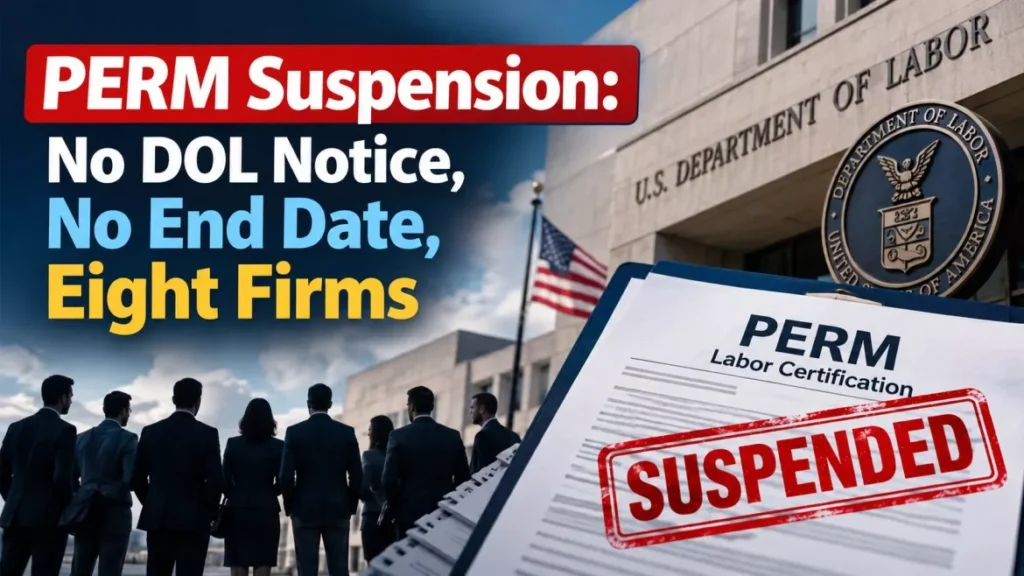

The PERM suspension announced on 8 October 2026 stops green card sponsorship at eight employers in the United States. Vice President JD Vance and Labor Secretary Keith Sonderling named Microsoft, Adobe, Cognizant, Infosys, Tata Consultancy Services, Wipro, HCL Technologies and Capgemini at a White House news conference. No charges have been announced against any of them.
The action applies to United States labour certification only. It does not reach visas, and it does not reach any other country’s immigration system. Two days later, the Labor Department had still published no written notice, cited no regulation and given no end date.
What PERM Is, and Which Firms Are Covered
PERM, the Permanent Labor Certification programme, is the first step an American employer takes to sponsor a worker for an employment-based green card. The Department of Labor must certify that no qualified United States worker is available for the role at the prevailing wage before the employer can file an immigrant petition with immigration authorities.
Eight employers were named. Six are information technology services companies and two are software firms:
- Microsoft: The Redmond, Washington software company, named by officials alongside Adobe as subject to multiple active federal investigations.
- Adobe: The San Jose, California software company, also cited in connection with active investigations.
- Cognizant: The Teaneck, New Jersey IT services firm, which officials said had already had PERM processing suspended in September 2026.
- Infosys, Tata Consultancy Services, Wipro and HCL Technologies: Four India-headquartered IT services companies with large United States workforces.
- Capgemini: The Paris-headquartered consulting and IT services group.
What the Suspension Stops and What It Leaves Alone
The suspension freezes one administrative pipeline; it does not cancel anyone’s immigration status. The distinction matters because the two are often reported together.
| Affected | Not affected by this action |
|---|---|
| New PERM applications involving the eight named employers | The validity of existing H-1B visas |
| PERM applications already filed and awaiting a decision | The status of current visa holders and their families |
| The start of any new green card sponsorship through these employers | Immigrant petitions already approved on a certified PERM |
India’s Ministry of External Affairs made the same point on the record, saying PERM is a separate programme from H-1B and that the suspension does not by itself affect H-1B validity or the status of visa holders and their families. It added that the measure could affect green card processing for eligible employees of the eight companies.
What the Labor Department Has Not Published
As of 10 October 2026, the action existed as a spoken announcement rather than a published decision. The Office of Foreign Labor Certification’s announcements page, where the department publishes programme notices for PERM, listed no notice of the suspension; its most recent entry was dated 2 September 2026 and concerned H-2A agricultural wage rules.
That leaves three things undocumented. The department has not issued a press release or a Federal Register notice. It has not cited the regulation it is relying on. And it has not said which categories of filing are covered, or whether written notices have gone to the eight employers.
Immigration lawyers reviewing the announcement have pointed to 20 CFR 656.31(b) as the probable authority. That provision allows the department to suspend processing while it investigates possible fraud or wilful misrepresentation in a labour certification. The department has not confirmed it is using that rule.
Why 180 Days Is Not a Deadline
The widely reported figure of 180 days is a review point, not an expiry date. Under 20 CFR 656.31(b), an initial suspension may run up to 180 days, after which the certifying officer may resume processing or extend the suspension while an investigation or a court proceeding remains open.
Vance was explicit that no end date applies. He said the suspension would last “as long as it needs to”. The department has not published criteria for lifting it. A comparable action in May 2026 suspended PERM processing for Cloudera for 180 days.
The Figures Officials Cited, and Microsoft’s Reply
Sonderling said the eight companies had between them received more than 230,000 H-1B approvals and more than 100,000 permanent labour certifications. Neither figure was broken down by company or by year in the announcement.
Vance’s specific charge against Microsoft was a comparison. He said the company laid off 6,000 American workers last year while obtaining 6,300 H-1B visas and almost 3,000 green cards, and he described foreign workers hired by the company as “indentured servants”. He also said the companies had hired foreign workers who did not meet the H-1B requirement that the role be a unique, highly specialised occupation.
Microsoft disputed the inference rather than the headcounts. The company said that of roughly 6,000 H-1B applications it submitted in the last fiscal year, about 80% were to extend or change the status of people already working for it, not to hire new staff. The scale of technology sector job cuts in the United States has been a running political argument through 2026.
These remain allegations. The department described active investigations; it has not announced charges, findings or penalties against any of the eight.
Why Indian IT Shares Rose Anyway
The market reaction split by day and by exchange. Infosys and Wipro American depositary receipts fell about 3% in United States trading on Thursday 8 October 2026, and Microsoft shares slipped about 1% while Adobe’s rose nearly 4%.
On Friday 9 October 2026 in Mumbai, the direction reversed. Tata Consultancy Services, Infosys, Wipro and HCL Technologies rose by up to 4% to 6% depending on the stock, and the Nifty IT sub-index gained between 2% and 3%; reports differ on the exact index move. TCS closed 4.31% higher at 2,165.50 rupees on the National Stock Exchange that day. Share prices change every trading session, and these are single-day readings rather than a settled verdict.
Two things drove the rebound. TCS had reported September-quarter results on 8 October 2026 showing net profit of 13,884 crore rupees, up about 15% year on year, and revenue of 73,188 crore rupees, up 11.2% in reported terms. Headcount stood at 598,056 after net additions of 4,258, with twelve-month attrition easing to 13.3% from 13.6%. Separately, Business Today reported that TCS said its PERM applications had been in single digits over the past two years, which would make the suspension close to immaterial for its workforce plans; that figure comes from one outlet and the company has not published it. Wipro is scheduled to report its September-quarter results on 15 October 2026.
India’s Formal Objection
India objected to the language more sharply than to the measure. Official spokesperson Randhir Jaiswal read the Ministry of External Affairs statement at a briefing in New Delhi on Friday 9 October 2026.
“Resorting to terminology that carries painful historical and colonial legacy connotations is deeply offensive,” Jaiswal said, referring to the “indentured servants” remark. He added that “the steps announced by the US do not advance the shared ambitions of both countries”, said Indian professionals in the United States are highly educated and contribute skilled work to its economy, and said India was monitoring developments.
What Happens Next
Three things would change the picture, and none had a date attached as of 10 October 2026.
- Written notices: The scope, the regulation and the start date become checkable only when the department issues notices to the employers or publishes a programme announcement.
- The investigations: Whether the cited federal investigations produce charges, findings or no action will determine how long the suspensions run.
- Legal challenge: None of the eight had announced litigation. A suspension imposed without a published basis is the kind of action employers have challenged in the past, but no filing had been reported.
Employees of the eight companies with pending labour certifications can check the status of the programme through the Office of Foreign Labor Certification’s own announcements and case-status pages, and sponsorship questions are specific to each person’s filing stage and employer.
Frequently Asked Questions
What Does the PERM Suspension Actually Do?
It stops the United States Department of Labor from accepting new PERM applications from eight named employers and from processing applications they have already filed. PERM is the labour certification step that must be completed before an employer can petition for an employment-based green card.
Does the PERM Suspension Cancel H-1B Visas?
No. India’s Ministry of External Affairs stated on 9 October 2026 that PERM is separate from the H-1B programme and that the suspension does not by itself affect H-1B validity or the status of visa holders and their families.
How Long Will the Suspension Last?
No end date has been announced. Under 20 CFR 656.31(b), the rule lawyers believe is being used, an initial suspension can run up to 180 days and can be extended while an investigation or court case is open. Vance said it would last “as long as it needs to”.
Which Companies Are Named?
Microsoft, Adobe, Cognizant, Infosys, Tata Consultancy Services, Wipro, HCL Technologies and Capgemini. Microsoft and Adobe were singled out as subject to multiple active federal investigations.
Have Any of the Companies Been Found to Have Committed Fraud?
No. Officials alleged misuse of the programmes and cited active investigations, but as of 10 October 2026 no charges, findings or penalties had been announced against any of the eight companies.