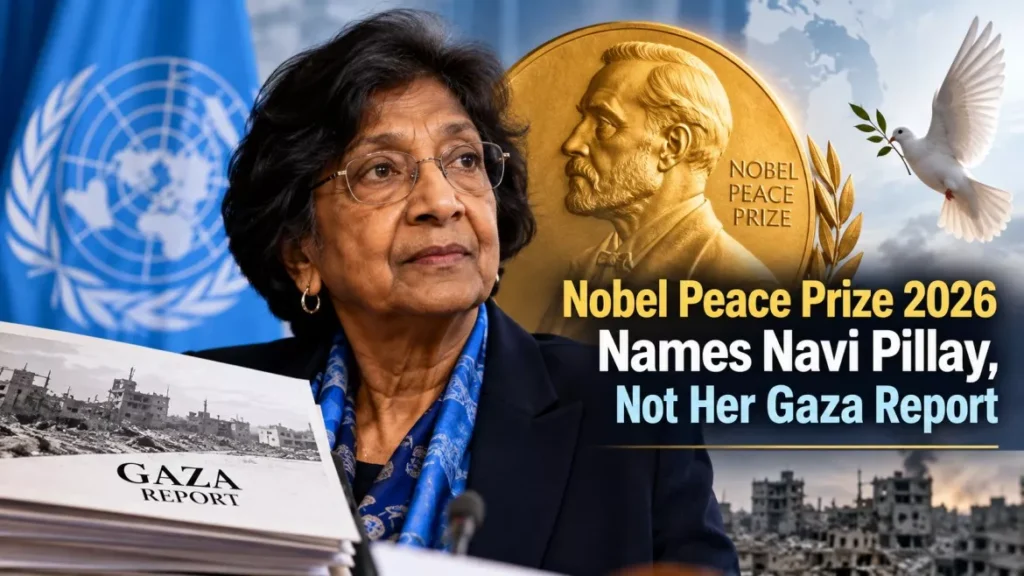

The Nobel Peace Prize 2026 was awarded to Navi Pillay, the South African jurist and former United Nations human rights chief. The Norwegian Nobel Committee announced the decision in Oslo on Friday 9 October 2026, citing “her efforts to promote peace and international law”. She receives the prize as sole laureate.
What the Norwegian Nobel Committee Cited
The committee framed the award around the condition of international law rather than any single case. Its citation honours Pillay “for her efforts to promote peace and international law”, and the committee said she has “led the way towards a more comprehensive global legal order”.
Jorgen Watne Frydnes, who chairs the committee, said Pillay had been “instrumental in ensuring that war crimes, crimes against humanity, and genocide are prosecuted”. He described the system of international law as “under tremendous pressure”, with its institutions “under attack”, and said judges “guard the thin red line between order and chaos”. The committee said international law “is no longer just a supplement to peace and security” but “an absolute necessity”.
Pillay is the fifth South African to receive the Nobel Peace Prize, after Albert Luthuli, Desmond Tutu, Nelson Mandela and F W de Klerk.
What the Committee Declined to Rule On
The committee explicitly did not endorse the genocide conclusion reached by the UN commission Pillay chaired. Asked about it, Frydnes said of the Gaza findings: “It’s her report, the Commission’s report,” and said that ruling on the question is a matter for international courts.
This distinction matters because much of the reaction to the award has treated the prize as a verdict on Gaza. On the committee’s own account, it is not. The citation rests on a legal career spanning three decades and several courts, and the committee’s public statement does not mention Gaza.
Who Navi Pillay Is
Pillay was born in Durban on 23 September 1941 and began practising law in South Africa under apartheid. She opened her own firm in 1967, defended anti-apartheid activists, and won a case securing access to lawyers for political prisoners held on Robben Island, among them Nelson Mandela. She took a master’s degree in law at Harvard University in 1982 and a doctorate there in 1988.
| Role | Body | Period |
|---|---|---|
| Judge | High Court of South Africa | From 1995 |
| Judge, later President | International Criminal Tribunal for Rwanda | 1995 to 2003, presiding from 1999 |
| Judge | International Criminal Court | 2003 to 2008 |
| High Commissioner for Human Rights | United Nations | September 2008 to August 2014 |
| Ad hoc judge | International Court of Justice | From 2019 |
| Chair | UN Independent International Commission of Inquiry on the Occupied Palestinian Territory | 2021 to 2025 |
At the Rwanda tribunal she sat on the bench in the Akayesu case, which established that rape and sexual violence could constitute acts of genocide. A commission of inquiry, unlike a court, investigates and reports; it does not try defendants or impose penalties.
What the Gaza Commission Concluded, and on What Standard
The commission Pillay chaired reported in September 2025 that there were reasonable grounds to conclude that Israel had committed genocide against Palestinians in Gaza. “Reasonable grounds” is an investigative threshold, not a criminal standard of proof, and the conclusion is a commission’s assessment rather than a court judgment.
Presenting the findings to the UN General Assembly, Pillay said: “We concluded that the State of Israel is responsible for the commission of four genocidal acts in Gaza.” The report found reasonable grounds that four of the five acts defined as genocidal under the 1948 Genocide Convention had been committed since 7 October 2023, and it said Israel’s president, prime minister and former defence minister had “incited the commission” of genocide. An earlier report from the same commission, in June 2024, concluded that Israeli authorities were responsible for war crimes and crimes against humanity in Gaza.
Israel has categorically rejected these conclusions and described the 2025 report as “distorted and false”. The commission reports to the UN Human Rights Council and has no enforcement power; neither it nor the council can impose any penalty on a state.
How Israel Responded to the Award
Israel’s government condemned the decision within hours. Israel’s Ministry of Foreign Affairs, posting on X, called the award “the grotesque weaponisation of an award to legitimise anti-Israel hatred and prejudice”, and in further posts said the Nazi propagandist Joseph Goebbels would be “applauding from hell”.
Prime Minister Benjamin Netanyahu said the Nobel committee “has lost its moral compass”. Daniel Meron, Israel’s ambassador to the UN in Geneva, told Reuters the decision was “disgraceful” and amounted to “an endorsement for proponents of antisemitism like Pillay herself”.
These are the responding government’s characterisations of the laureate and the committee. The committee has not replied to them beyond Frydnes’s statement that the genocide question is for the courts.
Which Bodies Could Actually Rule on the Question
Two international courts, not the commission and not the Nobel committee, have jurisdiction over the claims at issue. Both have related matters before them, and neither has issued a final ruling on whether genocide occurred in Gaza.
- International Court of Justice: hears disputes between states, including cases brought under the Genocide Convention.
- International Criminal Court: prosecutes individuals for genocide, war crimes and crimes against humanity. Pillay sat as a judge there from 2003 to 2008, and the court is currently hearing proceedings against the former Philippine president Rodrigo Duterte.
- UN commissions of inquiry: gather evidence and publish findings that prosecutors at either court may draw on, as happened with a separate UN fact-finding mission on the Iran conflict in September 2026.
As of 10 October 2026, the genocide question remains legally undetermined. What is agreed is that the commission reached its conclusion and published it; what is claimed, and disputed, is whether that conclusion is sound.
Reaction From the United Nations and From Pillay
The UN welcomed the award. Secretary-General Antonio Guterres said that “the force of law must prevail over the law of force” and called Pillay “a champion of international law and human rights, and a steadfast, independent voice of justice”, in a statement published by the United Nations. Volker Turk, the current High Commissioner for Human Rights, speaking in Geneva, said: “To say it is well deserved is a total understatement.”
Pillay said she would “dedicate this award to all of the survivors of international crimes” and that “we are living through an era when international law and human rights are under significant political attack”. Committee members were unable to reach her before the announcement; the Nobel Institute’s director delivered the news to her afterwards.
The Trump Question
The award arrives after a year in which the United States president has said publicly that he deserves the prize. Donald Trump has made no secret of wanting to win it since returning to office in January 2025, and his administration has repeatedly criticised international justice institutions.
Speaking in Nuremberg after the announcement, Pillay joked: “If you clap a little bit more I may share this prize with Trump.” Trump’s Truth Social account shared a post describing the commission’s genocide conclusion as the product of a “phony investigation”.
In January 2026 the 2025 laureate, Maria Corina Machado of Venezuela, presented her Nobel medal to Trump at the White House. The Nobel Committee said at the time that “a medal can change owners, but the title of a Nobel Peace Prize laureate cannot”.
What Happens Next
The prize will be presented in Oslo on 10 December 2026, the anniversary of Alfred Nobel’s death. The award consists of a gold medal, a diploma and a cash sum of 12 million Swedish kronor, about $1.2 million at current rates.
The Nobel Foundation sets the cash amount, and it rose by one million kronor from the 11.1 million awarded in 2025. Nothing in the award changes the status of any case before the international courts.
Frequently Asked Questions
Who Won the Nobel Peace Prize 2026?
Navanethem “Navi” Pillay, a South African jurist and former United Nations High Commissioner for Human Rights, announced as sole laureate by the Norwegian Nobel Committee on 9 October 2026.
Why Did Navi Pillay Win?
The committee cited “her efforts to promote peace and international law” and her role in ensuring that war crimes, crimes against humanity and genocide are prosecuted, across her service at the Rwanda tribunal, the International Criminal Court and the UN human rights office.
Did the Nobel Committee Endorse the Gaza Genocide Finding?
No. Committee chair Jorgen Watne Frydnes said the report belonged to the commission, not the committee, and that the question is for international courts to rule on. The committee’s citation does not mention Gaza.
How Much Is the Nobel Peace Prize Worth in 2026?
The cash award is 12 million Swedish kronor, about $1.2 million, alongside a gold medal and a diploma. The amount is set by the Nobel Foundation and rose from 11.1 million kronor in 2025.
When and Where Is the Ceremony?
In Oslo, Norway, on 10 December 2026. The Peace Prize is the only Nobel presented outside Stockholm.