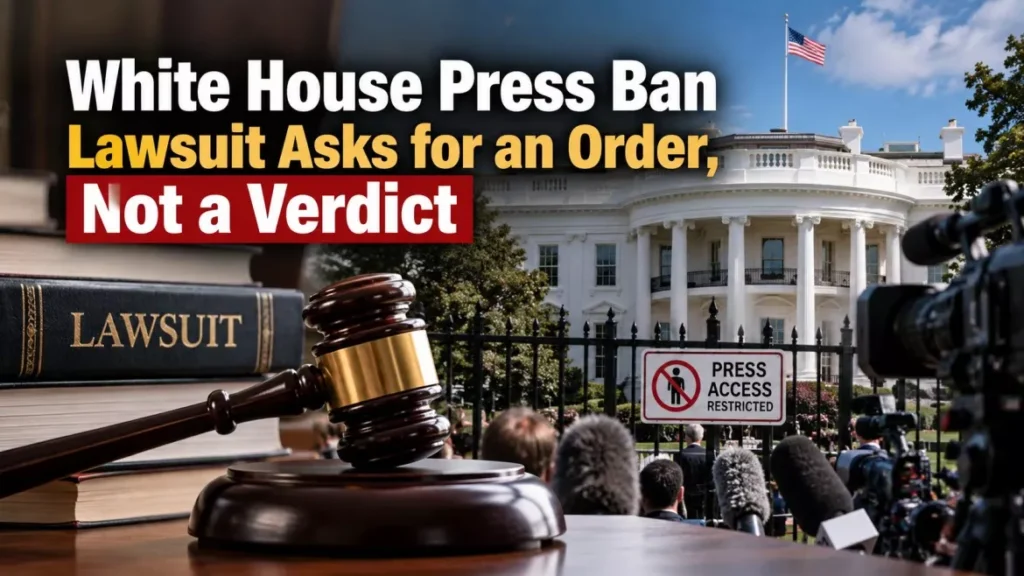

The White House press ban lawsuit filed by CNN, MS NOW and Politico asks a United States federal court to restore three reporters’ credentials. The outlets sued on 21 September 2026 in Washington, DC, after their badges were confiscated on 19 September. A judge hears their emergency request on 23 September.
Nothing has been decided. The hearing this week concerns a temporary restraining order, which is a holding measure, not a judgment on whether the ban was lawful. That distinction matters, and it is the part most coverage skips.
Who Is Suing and Who Is Being Sued
The case is Cable News Network, Inc. v. Trump, number 1:26-cv-03287, in the United States District Court for the District of Columbia. It was assigned to District Judge Timothy J. Kelly, who joined the federal bench in 2017 after being nominated by President Donald Trump.
Six plaintiffs are named: the three news organisations, Cable News Network Inc., Politico LLC and MS NOW Cable LLC, and three individual reporters, Betsy Klein of CNN, Akayla Gardner of MS NOW and Cheyenne Haslett of Politico. The reporters suing in their own names is a detail worth noting, because it is their individual credentials that were taken.
The defendants are President Trump and senior White House officials Susan Wiles and Steven Cheung. The complaint seeks declaratory and injunctive relief, meaning a court statement that the ban is unlawful and an order stopping it.
How the Ban Unfolded
- Friday 18 September 2026: Trump announced on Truth Social that he was barring CNN, MS NOW and Politico from the White House, citing what he called fake news.
- Saturday 19 September 2026: Reporters from the three outlets attempted to enter the White House and had their hard passes confiscated.
- Sunday 20 September 2026: ABC, CBS, CNN, Fox News and NBC News declined to replace CNN’s crew on the shared television pool.
- Monday 21 September 2026: The three outlets notified the government and filed suit, along with a motion for a temporary restraining order. The television pool suspended coverage of the president the same day.
- Tuesday 22 September 2026: Judge Kelly’s deadline for the Department of Justice to file its response to the restraining order motion.
- Wednesday 23 September 2026: Hearing on the restraining order motion, held by videoconference.
In their joint statement, the three outlets said they had notified the government they were suing “to protect our First Amendment rights and defend the principle that the government does not decide what the press reports or publishes”. They added that “without notice or process, the White House revoked our journalists’ credentials because it objected to our reporting”, and that left unchallenged this “threatens press freedom and the public’s right to independent journalism free from government interference”. The wording is set out in the plaintiffs’ own published statement.
Trump responded on Truth Social on the Monday afternoon, writing that “the White House is not instituting an assault on the Free Press, something which I cherish”, and that it was instead “instituting an assault on the FAKE NEWS, something that has grown like Cancer in our beloved United States of America”. When NBC News approached the White House press office for comment on the lawsuit, it was directed to that post.
What the Court Is Being Asked to Do This Week
A temporary restraining order is short-term emergency relief, not a decision on who is right. To obtain one in a United States federal court, a party must generally show it is likely to succeed eventually, that it will suffer irreparable harm without immediate relief, and that the balance of interests favours acting now.
If Judge Kelly grants it, the reporters get their passes back while the case continues. If he refuses, the ban stays in place while the case continues. Either way, the lawfulness of the ban itself remains for a later stage.
As of 22 September 2026, no court has ruled on the ban, no credentials have been restored, and the case is at its first procedural step in the District of Columbia.
Why the 2018 Acosta Ruling Settles Less Than It Seems
Judge Kelly is the same judge who in November 2018 ordered the first Trump White House to return the press pass of Jim Acosta, then CNN’s chief White House correspondent. Almost every account of this week’s case mentions that. Far fewer mention what that ruling actually held.
Kelly decided the Acosta case on the Fifth Amendment, which guarantees due process, finding that the White House had revoked the pass without adequate notice or an opportunity to respond. He did not rule that the First Amendment had been violated. He expressly declined to reach the question, telling the court he wanted “to emphasize the very limited nature of this ruling”.
That matters here because the central claim in the current complaint is a First Amendment one: that the government retaliated against the outlets for their coverage and discriminated against them by viewpoint. The 2018 precedent is a due-process precedent. On the constitutional question at the heart of this case, the judge has not previously said where he stands.
The 1977 Standard the Complaint Relies On
The complaint leans on Sherrill v. Knight, decided by the United States Court of Appeals for the District of Columbia Circuit on 15 December 1977 and reported at 569 F.2d 124. The case concerned a journalist refused a White House pass on the recommendation of the Secret Service.
The appeals court held that a bona fide journalist’s interest in a White House press pass is protected by the First Amendment, and that denial therefore carries procedural obligations. In the court’s published opinion, those obligations are “notice of the factual bases for denial, an opportunity for the applicant to respond to these, and a final written statement of the reasons for denial”.
The complaint’s argument is that none of those three steps happened before the badges were taken. The government has not yet filed its answer to that argument, and the Department of Justice may contest whether a presidential decision to exclude entire organisations is governed by the same standard as a Secret Service security screening of an individual.
What Happened to the Television Pool
The White House television pool is a rotation in which five networks take turns filming the president and share the footage with every other broadcaster, a system used since Franklin D. Roosevelt’s presidency to handle limited space at events and on Air Force One.
ABC, CBS, CNN, Fox News and NBC News suspended it. In a joint statement the five said that “no administration should restrict a news organization because it objects to its reporting” and that “the public has a vital interest in receiving accurate, independent information about its government”.
The practical effect is narrow but visible. CNN had been scheduled to supply the pool camera for the president’s trip to New York on 21 September 2026, and no television pool team travelled with him. Print, radio and wire service pools continued to operate, including for other officials. The White House Correspondents’ Association has called for the credentials to be restored.
What Has Not Been Decided
- The merits: no court has found the ban lawful or unlawful.
- The First Amendment question: whether excluding outlets for their coverage is viewpoint discrimination in a nonpublic government forum is unresolved in this case.
- The government’s position: the Department of Justice’s written response was due on 22 September 2026 and its legal arguments were not public at the time of writing.
- Any appeal: Trump has said publicly that he expects to appeal, though the judge has not yet ruled on anything to appeal from.
- Other outlets: Trump’s announcement suggested further bans; none has been confirmed.
Predictions that the outlets will win this week have been widely published, but they are commentary. Reporters and editors watching the case should treat the 23 September hearing as the first test of an emergency request, not as a verdict.
Frequently Asked Questions
What Is the White House Press Ban Lawsuit?
It is a case filed on 21 September 2026 by CNN, MS NOW, Politico and three of their reporters against President Trump and two senior White House officials, after their White House credentials were revoked. It is docketed as Cable News Network, Inc. v. Trump, 1:26-cv-03287, in the United States District Court for the District of Columbia.
When Is the Court Hearing?
Judge Timothy J. Kelly set a videoconference hearing for the afternoon of Wednesday 23 September 2026 on the plaintiffs’ motion for a temporary restraining order.
What Would a Temporary Restraining Order Do?
It would restore the reporters’ access temporarily while the case proceeds. It is emergency relief and does not decide whether the ban was lawful.
Did the Same Judge Rule Against Trump in 2018?
Judge Kelly ordered Jim Acosta’s press pass restored in November 2018, but he decided that case on Fifth Amendment due process grounds and expressly did not rule on the First Amendment. The current complaint’s main claim is a First Amendment one.
Which Reporters Lost Their Credentials?
Betsy Klein of CNN, Akayla Gardner of MS NOW and Cheyenne Haslett of Politico, who are named as individual plaintiffs alongside their employers.
Is the White House Press Pool Still Operating?
The five-network television pool suspended coverage of the president on 21 September 2026. Print, radio and wire service pools have continued.