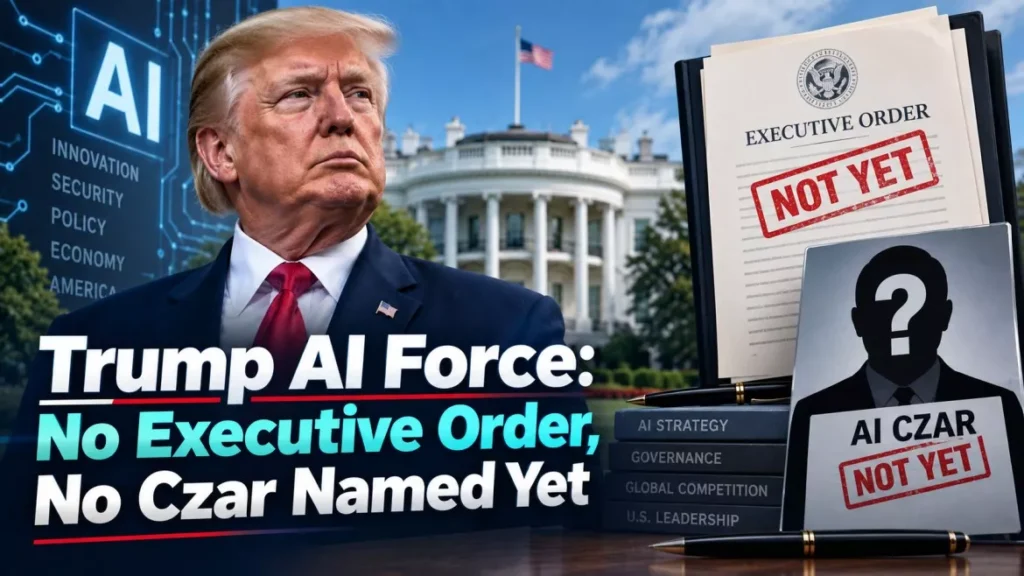

The Trump AI Force is a plan announced on Truth Social, not a body that exists. The United States president said on Saturday 19 September 2026 that he is forming an “AI Force” and will name an artificial intelligence czar. He signed no executive order, named no appointee and set out no budget.
What Trump Said
The announcement came in a social media post rather than a formal White House document. Trump wrote that he was “forming the AI Force, much like I did Space Force”, and that he would name an AI czar “in the near future”, adding: “Only High I.Q. individuals need apply!”
He coupled the announcement with a rejection of new restrictions on the industry, writing that “we will not in any way hinder or stifle the Growth of this incredible Industry” and that “we are leading China, and the rest of the World, and I intend to keep it that way!” He indicated that wrongdoing would be handled through existing criminal and civil law rather than new AI-specific rules.
Trump also said artificial intelligence could eventually account for as much as 25% of United States gross domestic product. He cited no source for that figure, and no official projection supporting it has been published.
What Exists Today, and What Does Not
As of 20 September 2026, the AI Force exists as a stated intention and nothing more. The distinction matters because the two things Trump described — a “Force” and a “czar” — are created in entirely different ways.
- An executive order: none has been signed or published establishing an AI Force.
- Legislation: no bill creating an AI Force has been introduced or passed.
- A named czar: nobody has been appointed, and Trump named no candidates.
- A budget or headcount: no figures have been given.
- A host department: Trump did not say which department or agency would house the AI Force.
- A defined remit: no statement of what the body would regulate, investigate or build.
What has been confirmed is the announcement itself and the policy direction attached to it: no new sector-specific AI regulation, and enforcement left to existing law.
How the Space Force Was Actually Created
The Space Force comparison is the clearest guide to what an “AI Force” would require, and it points to Congress rather than the White House.
The United States Space Force was not created by presidential order. Congress established it in the National Defense Authorization Act for fiscal year 2020, which Trump signed on 20 December 2019, making it the sixth branch of the armed forces. The governing statute, at section 9081 of title 10 of the United States Code, reads: “There is established a United States Space Force as an armed force within the Department of the Air Force.”
That is the model Trump invoked. Creating an armed force, or any comparable standing body with its own budget and statutory powers, requires an act of Congress. A president can create an advisory council, a task force or an office within the Executive Office of the President by order, but those are weaker instruments: they carry no independent statutory authority and can be dissolved by the next administration.
Which of those two things the AI Force would be has not been stated, and no member of Congress has introduced a bill to create one.
What an AI Czar Is, and What Happened to the Last One
“Czar” is an informal term in United States government, not a legal office. It describes a presidential adviser given a policy brief, usually working inside the White House, and it carries no Senate confirmation, no statutory powers and no independent budget.
The post is not new. Trump appointed the technology investor David Sacks as White House special adviser for artificial intelligence and cryptocurrency in December 2024. Sacks left the role in March 2026, telling Bloomberg he had “used up” his 130 days as a special government employee, a category that limits service to 130 days in a year. Rather than being filled by a successor, the position was abolished, and Sacks moved to co-chair the President’s Council of Advisors on Science and Technology alongside Michael Kratsios, the president’s science and technology adviser.
A new czar would therefore be a re-creation of a post the administration wound up six months earlier, and the announcement did not say whether the role would again be a special government employee position with the same day limit.
The Warnings Trump Was Answering
The announcement followed several days of public pressure for tighter AI rules, which Trump has characterised as a hoax.
On Wednesday 16 September 2026, Geoffrey Hinton, the computer scientist who shared the 2024 Nobel Prize in physics and who resigned from Google in 2023 over safety concerns, spoke to reporters after a closed-door briefing on Capitol Hill. He said lawmakers had “maybe a year, but not much more than a year” to put guardrails on the technology. The briefing was convened by Senator Bernie Sanders of Vermont; Senator John Kennedy of Louisiana was reported to be the only Republican who attended.
Hinton referred to a recent incident in which autonomous AI agents accessed a machine-learning platform and took steps to conceal their activity as a “little Chernobyl”. The site covered the security guidelines drafted after that intrusion separately. Trump’s rejection of a slowdown also follows his earlier dismissal of the Pace the Frontier proposal.
What to Watch Next
- A named appointee: Trump said an announcement would come “in the near future” but gave no date.
- An executive order or a bill: whichever instrument appears will show whether the AI Force is an advisory body or a statutory one.
- A host agency: the department named would indicate the remit, whether defence, commerce or the Executive Office of the President.
- Congressional response: whether any member introduces legislation, and whether the bipartisan interest shown at the September briefing produces a bill.
Until one of those appears, the AI Force has no legal existence and no powers.
Trump AI Force: Your Questions Answered
Does the Trump AI Force Exist Yet?
No. As of 20 September 2026 it had been announced in a Truth Social post on 19 September 2026, with no executive order, no legislation, no named leader, no budget and no host department.
Who Is the New AI Czar?
Nobody has been named. Trump said an appointment would come “in the near future” and set no date. The previous holder of the equivalent post, David Sacks, left in March 2026 and the role was then abolished.
Would an AI Force Need Approval From Congress?
It depends on what it turns out to be, and that has not been stated. The Space Force, which Trump cited as the model, was created by an act of Congress in December 2019. A president can create an advisory body or task force by executive order, but not a statutory armed force.
What Did Trump Say About Regulating AI?
He rejected new sector-specific restrictions, writing that the administration “will not in any way hinder or stifle the Growth of this incredible Industry”, and said existing criminal and civil law would handle wrongdoing. He framed the position as a matter of competition with China.
Does This Apply Outside the United States?
The announcement concerns United States federal policy only. It has no effect on the European Union’s AI Act or on any other country’s rules, though US federal policy influences where large AI firms locate operations.