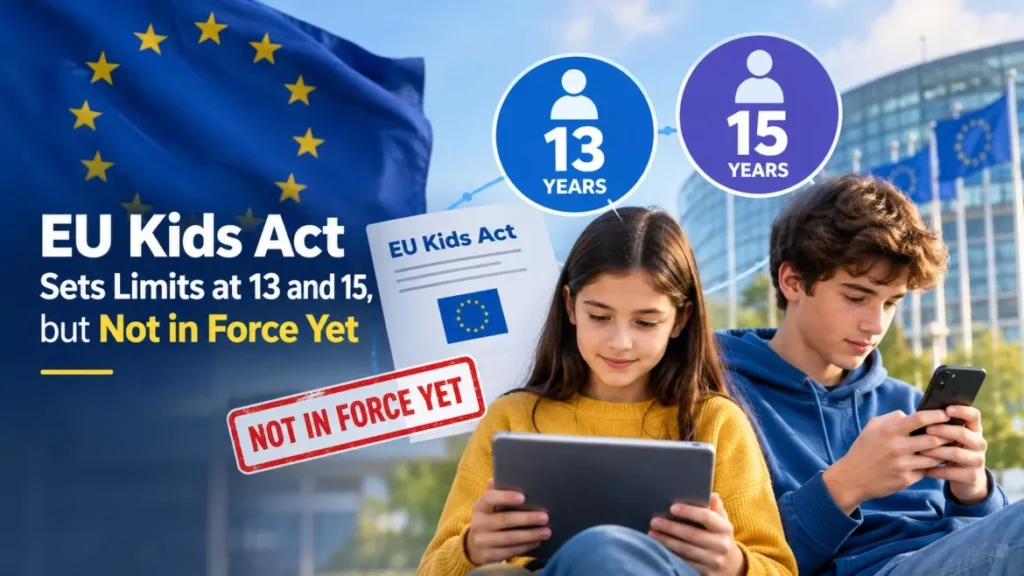

The European Commission has proposed the EU Kids Act, which would bar under-13s from social media and stop under-15s opening their own accounts. Ursula von der Leyen announced it in her State of the Union address on 16 September 2026. The draft also covers online games and AI chatbots, and is not yet law.
What the EU Kids Act Would Ban
The proposal sets a sliding scale of access rather than a single cut-off. Von der Leyen put the core rule in two sentences in her address to the European Parliament in Strasbourg: “No social media under the age of 13. No personal account under the age of 15.”
Between those two ages, the Commission president said children would get “only mini accounts set up and supervised by parents, with limited features and time restriction”. The draft regulation, as reported by the trade publication PPC Land, sets out four brackets.
| Age | What the draft would allow |
|---|---|
| Under 3 | No access to social media or other services the draft treats as risky |
| 3 to 12 | Parent-controlled accounts, and only on services built for children that meet safety standards |
| 13 to 14 | Supervised “introductory” accounts with limited features, a cap on contacts and a daily time limit |
| 15 to 17 | An account of the child’s own, without parental approval, on services that are safe by design |
The second strand of the proposal applies to every minor, not just the youngest. Platforms would have to strip out design features the Commission blames for compulsive use, and von der Leyen said the burden of proof would flip: “Platforms will have to prove that they are safe.”
Which Services the Rules Would Cover
The draft reaches well beyond Instagram and TikTok. It applies to a category PPC Land reports the text calls “Social Media+”, covering social media services, video-sharing platforms, online games, and AI chatbots and AI companions.
The news agency Agence Europe, reporting before the formal presentation, also described the scope as extending to “video-sharing platforms, online video games, as well as AI-based chatbots and companions”. PPC Land additionally lists app stores within scope, and reports that education services and platforms run by public authorities are excluded; those two details have not been confirmed elsewhere.
Including chatbots puts the EU alongside a wave of AI-specific child-safety rules. California passed its own measure this month, though its operative provisions do not bite until 2027, as covered in our report on the California chatbot law and its July 2027 start date.
How the Age Check Would Work
Age verification is the mechanism the whole proposal rests on, and it would not involve handing a passport to a social network. Providers would have to check age at account creation using the EU’s own age-verification tool or an equivalent public-authority system.
That tool uses zero-knowledge proofs, a cryptographic method that confirms a person is over a given age without revealing their identity or date of birth. The Commission urged member states in April 2026 to roll it out, either standalone or inside national digital identity wallets, by the end of 2026.
Existing accounts would not all be re-checked. PPC Land reports the draft requires “proportionate” checks on accounts that already exist rather than blanket re-verification, which matters for any family whose teenager already has an account.
Whether the check holds is a separate question. The Next Web reported that researchers defeated the proposed zero-knowledge-proof age check “in less than two minutes”; that finding comes from a single outlet and the Commission has not responded to it publicly.
What Changes for Families Today
Nothing. As of 17 September 2026, the EU Kids Act is a proposal from the European Commission, not a law, and no platform is obliged to change anything because of it.
Von der Leyen announced the Act in the State of the Union address on 16 September 2026, and the Commission was due to present the text formally on Thursday 17 September, alongside Executive Vice-President Henna Virkkunen, who holds the technology portfolio. Agence Europe reported that the proposal would be adopted internally by written procedure later in the same week.
No start date has been published for the rules themselves. Parents who want to change how their children use these services are still relying on the platforms’ own controls, and on general guidance of the kind in our piece on helping children use AI carefully.
Where EU Countries and Other Nations Stand
The age threshold was contested until the speech settled the Commission’s position. A Commission expert panel recommended 13 in July 2026, while France has argued for 15.
National positions still diverge sharply, which is why the number may move again in negotiation. The Next Web reported that Spain has pursued 16, that Estonia and Belgium have opposed age-based bans outright, and that Norway, France, Austria, Denmark and Slovenia have each pursued measures of their own.
Outside the bloc, the law firm Pinsent Masons notes that Australia banned under-16s from social media in 2025 and that the UK government has outlined plans to prohibit services to under-16s from spring 2027. The same firm reports that France’s Constitutional Council ruled a proposed national ban on under-15 access unconstitutional in August 2026 — a reminder that a ban can pass a parliament and still fail in court.
What Happens Next in Brussels
- Formal presentation: The Commission presents the text, with von der Leyen and Virkkunen leading, on 17 September 2026.
- European Parliament: MEPs must agree a negotiating position on the draft.
- Council of the EU: National ministers must reach a qualified majority; this is where the 13-versus-15 argument is most likely to reopen.
- Trilogue and final text: Parliament, Council and Commission negotiate the binding wording, after which any transition period would begin to run.
The Commission has not said how long it expects this to take, and EU files of comparable size have taken more than a year to clear.
What Is Still Unconfirmed
Three of the details readers most want are not settled. Fine levels are the clearest example: several news outlets have reported a ceiling of 6% of annual turnover, which is the maximum the existing Digital Services Act already allows, but PPC Land and Health Policy Watch both report that the draft regulation itself contains no penalty figures and instead refers to a supervisory fee to fund enforcement.
The daily time limit for 13- and 14-year-olds is also unfixed. Health Policy Watch reported a one-hour cap on school days; PPC Land reports that the draft restricts daily use without publishing a figure. Health Policy Watch further reports that the largest platforms would have to file compliance plans for approval 30 days before launching a new service, a requirement no other source we checked describes.
EU Kids Act FAQ
Is the EU Kids Act Law Now?
No. It is a Commission proposal announced on 16 September 2026 and presented formally on 17 September 2026. It must be negotiated and approved by the European Parliament and the Council of the EU before it binds anyone.
What Is the Minimum Age for Social Media Under the Proposal?
Thirteen for any access, and 15 for an account a child controls alone. Between 13 and 15, the draft allows only parent-supervised accounts with limited features and a daily time limit.
Does It Apply to Games and AI Chatbots?
Yes. The draft covers online games and AI chatbots and companions alongside social media and video-sharing platforms. PPC Land also reports app stores are in scope, which other sources have not confirmed.
Would My Teenager’s Existing Account Be Deleted?
The draft does not require blanket re-verification of accounts that already exist, according to PPC Land, only proportionate checks. What that means in practice will depend on the final text.
Which Countries Would the EU Kids Act Cover?
All 27 EU member states, as a single bloc-wide rulebook. The Commission’s stated aim is one standard of protection across the Union rather than 27 national regimes.