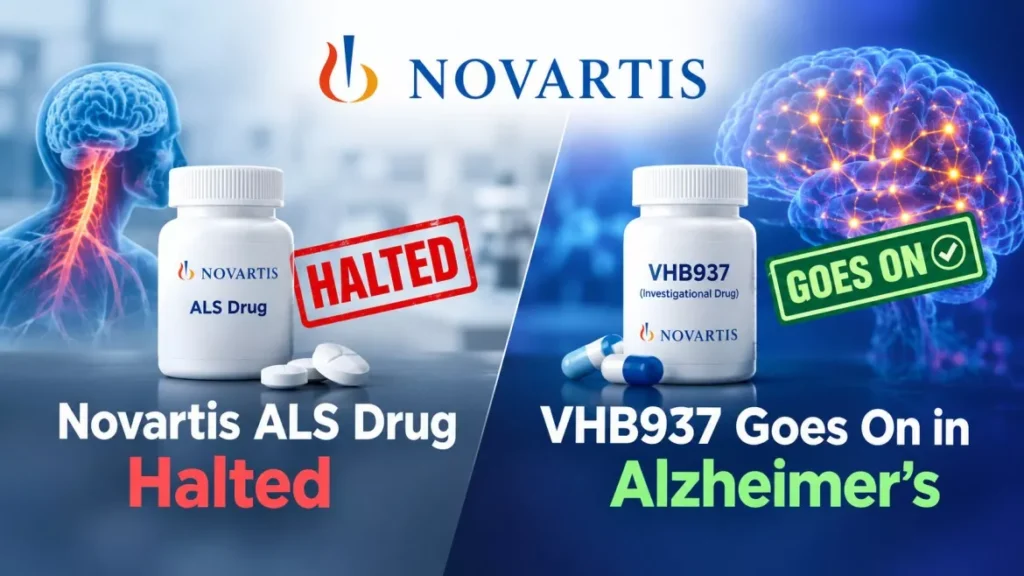

The Novartis ALS drug VHB937 has been discontinued after failing a mid-stage trial. The 251-patient ASTRALS study missed its primary and secondary endpoints, and Novartis confirmed the decision to Reuters on 16 September 2026. A separate trial of the same antibody in Alzheimer’s disease is still recruiting.
What Novartis Halted, and When It Told Whom
Novartis, the Swiss drugmaker headquartered in Basel, has stopped developing VHB937, also known as lifonebart, as a treatment for amyotrophic lateral sclerosis.
The sequence matters, because the failure is not as new as the headlines of 16 September 2026 suggest. BioSpace reported that Novartis set out the discontinuation in a letter dated 25 August 2026 to the European Organization for Professionals and People with ALS, a patient and clinician body, and confirmed it by email. Reuters obtained a company statement confirming the decision in mid-September.
- 17 October 2024: the ASTRALS trial begins, according to its registry record.
- 23 June 2026: the trial reaches its actual primary completion date.
- 25 August 2026: Novartis informs the European ALS organisation that the programme is being discontinued.
- 16 September 2026: the decision is reported widely after Novartis confirms it to Reuters.
- December 2026: detailed results are due to be presented at the 37th International Symposium on ALS/MND.
ALS, also called motor neurone disease or Lou Gehrig’s disease, progressively destroys the nerve cells that control voluntary muscle movement. There is no cure, and approved treatments slow progression only modestly, which is why mid-stage results in the field draw heavy attention.
What the ASTRALS Trial Tested and Missed
ASTRALS was a randomised, double-blind, placebo-controlled Phase 2 study in people with early-stage ALS, run over 40 weeks with an open-label extension.
| Item | Detail |
|---|---|
| Registry identifier | NCT06643481 |
| Sponsor | Novartis Pharmaceuticals |
| Phase | 2 |
| Actual enrolment | 251 participants |
| Study start | 17 October 2024 |
| Primary completion | 23 June 2026 |
| Status | Active, not recruiting |
The primary endpoint was a composite of survival free of permanent assisted ventilation and change in the ALS Functional Rating Scale-Revised, measured from baseline to week 40 and analysed using the Combined Assessment of Function and Survival method. Secondary measures included the functional rating scale total score, slow vital capacity as a measure of breathing, and serum neurofilament light, a protein released when nerve cells are damaged that is used as a marker of disease activity. These details come from the trial’s registry record on ClinicalTrials.gov.
VHB937 is a fully human monoclonal antibody designed to stabilise and activate TREM2, a receptor on microglia, the immune cells of the brain and nervous system. The idea was to modulate the inflammation that accompanies nerve cell loss. Endpoints Novartis had set for efficacy were not met against placebo.
Why VHB937 Is Not Finished
The antibody itself has not been abandoned. Only the ALS programme has.
A second Phase 2 trial of VHB937, in people with early Alzheimer’s disease, was listed as recruiting with a target enrolment of 407 participants at the time of writing, under registry identifier NCT07094516. That study tests two doses over a 72-week treatment period. Most coverage of the ALS halt did not mention it, which leaves the impression that the drug has been dropped outright.
TREM2 has been a difficult target across the industry. Alector discontinued its own TREM2 antibody, AL002, which bound a different part of the receptor. Whether the ALS result says anything about the Alzheimer’s programme will not be clear until that trial reports.
The Fourth Pipeline Setback in a Month
The ALS decision landed in the middle of the worst run of clinical results Novartis has had in years.
- Rapcabtagene autoleucel: Novartis paused eight of ten clinical trials of the experimental cell therapy, known as rap-cel, after three patient deaths.
- Pelacarsen: the lipoprotein(a)-targeting treatment failed to cut cardiovascular events in a late-stage trial, reported in early September 2026.
- Del-desiran: the Phase 3 HARBOR study in myotonic dystrophy type 1 missed its primary endpoint of video hand-opening time, a measure of muscle stiffness in the hand.
- VHB937: the ASTRALS Phase 2 ALS trial missed its primary and secondary endpoints.
Novartis shares fell sharply in the week of 7 September 2026. Reporting put the loss of market value at more than 24 billion Swiss francs by 8 September, described as the company’s largest single-day fall on record. Percentage figures differed between outlets and between the Swiss and United States listings, with CNBC reporting a drop of about 10% and TheStreet about 14%, so the exact daily move depends on which measure and which day is used.
What It Means for the $12 Billion Avidity Deal
Del-desiran, not the ALS drug, is the failure with the largest balance-sheet consequence.
It was the principal asset Novartis acquired in its purchase of Avidity Biosciences, a deal of roughly $12 billion completed in February 2026. Analysts at Barclays estimated that del-desiran and pelacarsen together represented around $5 billion in risk-adjusted peak sales, and treated del-desiran as the test of whether the Avidity acquisition would pay off.
Chief Executive Vas Narasimhan has been rebuilding the pipeline since Novartis spun off its generics and consumer businesses, while facing what he has described as the company’s steepest patent cliff in decades. The company reiterated full-year guidance and its target of 5% to 6% compound annual sales growth to 2030. Jefferies analyst Michael Leuchten wrote that worries over growth after 2030 would now likely re-emerge. Novartis has had commercial success in neuromuscular medicine before, including the gene therapy covered in our earlier report on Zolgensma and its price.
What Is Not Yet Known
The published record is still thin, and several things remain open.
- The full data: effect sizes, safety findings and subgroup results have not been released, and are due at the ALS/MND symposium in December 2026.
- The Alzheimer’s read-through: Novartis has not said whether the ASTRALS result changes its expectations for the Alzheimer’s study.
- The open-label extension: what happens to participants who continued into the extension phase has not been publicly detailed.
- Financial impact: Novartis has not quantified a write-down or charge attributable to the ALS programme specifically.
Frequently Asked Questions
What Is the Novartis ALS Drug That Failed?
VHB937, also called lifonebart, a monoclonal antibody that stabilises and activates the TREM2 receptor. Novartis discontinued it for amyotrophic lateral sclerosis after the Phase 2 ASTRALS trial.
How Many People Were in the ASTRALS Trial?
251 participants with early-stage ALS, according to the trial’s ClinicalTrials.gov record under identifier NCT06643481. The study ran from October 2024 and reached primary completion in June 2026.
Is Novartis Still Developing VHB937?
Yes, but not for ALS. A Phase 2 trial in early Alzheimer’s disease, with a target enrolment of 407 people, was listed as recruiting under identifier NCT07094516.
When Will the Full ASTRALS Results Be Published?
Detailed results are due to be presented at the 37th International Symposium on ALS/MND in December 2026. Novartis has not released effect sizes or safety data before then.
How Many Novartis Trials Have Failed Recently?
Four setbacks were reported within about a month: the rap-cel cell therapy pause after three patient deaths, the pelacarsen cardiovascular failure, the del-desiran Phase 3 miss, and the VHB937 ALS discontinuation.
Does This Affect the Avidity Biosciences Acquisition?
Not directly. The asset in question there is del-desiran, the main drug from the roughly $12 billion Avidity purchase completed in February 2026, which failed a separate Phase 3 trial.