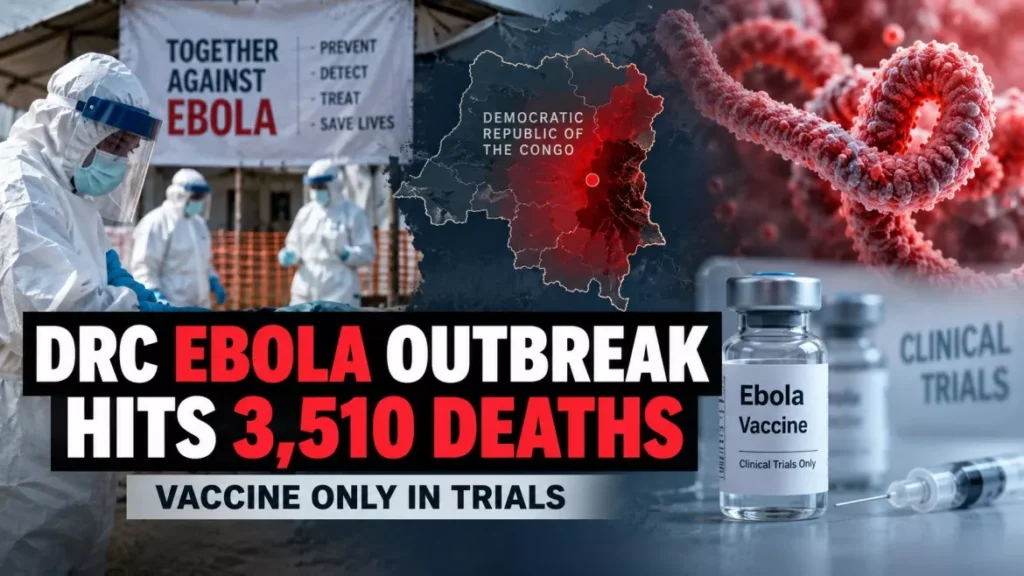

The DRC Ebola outbreak has reached 7,258 confirmed cases and 3,510 deaths. The figures cover reporting to 13 September 2026 and were compiled by the European Centre for Disease Prevention and Control from Congolese health data. The virus is Bundibugyo, a species for which no vaccine is licensed.
That last point is what separates this outbreak from the ones before it. Ervebo, the licensed Ebola vaccine, is approved against Zaire ebolavirus. Under emergency guidance the World Health Organization issued on 1 September 2026, it may be used against Bundibugyo virus only inside a research protocol.
As of 13 September 2026, 905 patients were in isolation in the Democratic Republic of the Congo and 1,726 people had recovered. The daily change reported on 14 September was 58 new confirmed cases and 35 further deaths. The case fatality ratio across the outbreak stands at about 48%.
Where the Cases Are
The outbreak is concentrated in the north-east of the country. Ituri province alone accounts for more than three-quarters of confirmed cases.
| Province | Confirmed cases | Deaths | Health zones affected |
|---|---|---|---|
| Ituri | 5,659 | 2,583 | 28 of 36 |
| North Kivu | 1,281 | 797 | 16 of 34 |
| Haut-Uélé | 281 | 115 | 6 of 13 |
| Tshopo | 28 | 10 | 7 of 23 |
| Bas-Uélé | 5 | 3 | 3 of 11 |
| South Kivu | 3 | 1 | 1 of 34 |
| Sud Ubangi | 1 | 1 | 1 of 16 |
The province-by-province breakdown is published by the European Centre for Disease Prevention and Control, the European Union agency that tracks communicable disease, in an update timed 15 September 2026. The 58 cases added on 14 September came from Ituri, which reported 44, North Kivu with 12 and Haut-Uélé with two.
The World Health Organization’s outbreak notice of 10 September listed six affected provinces. The single case in Sud Ubangi, in the north-west, appears in the European agency’s later table and takes the count to seven. Sud Ubangi does not border the other affected provinces.
Contact tracing is incomplete. The European agency records 78.6% of identified contacts under follow-up in the affected provinces. The World Health Organization’s earlier figure, for 7 September, was 21,359 of 24,719 contacts monitored, or 85.3%.
Why the Licensed Vaccine Does Not Apply Here
There are several species of Ebola virus, and a vaccine made against one is not automatically effective against another. Ervebo, made by Merck, is licensed against Zaire ebolavirus. It was the tool that ended several earlier Congolese outbreaks through ring vaccination, in which contacts of a confirmed case and their contacts are vaccinated to box the virus in.
This outbreak is caused by Bundibugyo virus, a distinct species. In August 2026 the Democratic Republic of the Congo received 70,000 doses of Ervebo, of which 20,000 were set aside for a Phase III clinical trial to test whether it protects against Bundibugyo virus at all.
The World Health Organization’s emergency guidance, published on 1 September 2026, is explicit about what is not yet known. Although some findings suggest possible cross-protection against Bundibugyo virus, the guidance states, “the available evidence remains insufficient to determine whether Ervebo® provides clinically meaningful protection”.
The guidance sets four conditions: vaccination only within ring randomised controlled trials, continued reliance on proven outbreak-control measures, clear communication to recipients that efficacy against Bundibugyo virus is unknown, and acceleration of work on a vaccine specific to the species.
How This Compares With the West Africa Epidemic
The outbreak is the second largest on record and, by early August 2026, the fastest growing. Only the West Africa epidemic of 2013 to 2016 has been larger.
- West Africa, 2013–2016: 28,652 cases and 11,325 deaths over about 28 months, caused by Zaire ebolavirus.
- Democratic Republic of the Congo, 2026: 7,258 confirmed cases and 3,510 deaths in about four months, caused by Bundibugyo virus.
- Case fatality ratio: about 48% in the current outbreak, against roughly 40% across the West Africa epidemic.
First cases were reported on 14 May 2026 in Ituri. The World Health Organization declared the outbreak a public health emergency of international concern on 16 May 2026. In July the organisation described it as the fastest-growing Ebola outbreak on record.
One caution belongs with every one of these numbers. They are confirmed cases reported through the Congolese surveillance system, in provinces where armed conflict has disrupted health services for years. Confirmed counts are a floor, not a measurement of the true total.
What Is Being Treated and Tested
No medicine is approved specifically for Bundibugyo virus disease, so treatment is supportive care alongside candidates being tested in trials.
- PARTNERS trial: a therapeutics trial deployed in July 2026, with more than 300 patients enrolled as of the World Health Organization’s 10 September notice.
- Remdesivir: an antiviral recommended for trial use. It was the drug given to the physician treated in France in June 2026, who recovered.
- Monoclonal antibodies: MBP-134 and maftivimab, both recommended for clinical trial evaluation rather than routine use.
- Vaccine candidates: the Phase III trial of Ervebo authorised on 31 July 2026, and a Phase I trial of a ChAdOx1-based candidate that began on 24 July 2026.
The rest of the response is the older toolkit: surveillance, laboratory testing, infection prevention and control in health facilities, safe and dignified burials, community engagement and cross-border coordination.
How Far It Has Travelled
Beyond the Democratic Republic of the Congo, spread has so far been limited and traceable. Uganda recorded 20 confirmed cases and two deaths between May and June 2026, and its outbreak has since been declared over after the required 42 days without a new case.
Three cases have been recorded outside Africa. France confirmed one on 24 June 2026 in an intensive care physician returning from the Democratic Republic of the Congo; he was treated with remdesivir, recovered, and five low-risk contacts were traced with no secondary cases. Germany treated two humanitarian workers evacuated for care.
The two agencies publishing risk assessments reach the same place by different routes. The World Health Organization rates the risk as very high inside the Democratic Republic of the Congo, high in bordering countries and low for the rest of Africa and globally. The European Centre for Disease Prevention and Control says the risk of importation into the European Union and European Economic Area remains very low, with sporadic cases possible but multiple independent importations unlikely.
Readers looking for figures that will have moved by the time they read this should go to the World Health Organization’s Disease Outbreak News page for the Democratic Republic of the Congo and the European agency’s epidemiological update, both of which are revised as new data arrives. Earlier coverage on this site explains how a separate outbreak in the same country was tracked and contained.
DRC Ebola Outbreak: Frequently Asked Questions
How Many People Have Died in the DRC Ebola Outbreak?
3,510 deaths from 7,258 confirmed cases in the Democratic Republic of the Congo, covering reporting to 13 September 2026, according to the European Centre for Disease Prevention and Control. A further two deaths were recorded in Uganda.
Why Is There No Vaccine for This Outbreak?
The outbreak is caused by Bundibugyo virus. The licensed Ebola vaccine, Ervebo, is approved against Zaire ebolavirus, a different species. World Health Organization guidance of 1 September 2026 permits its use against Bundibugyo virus only inside a research protocol.
Which Provinces Are Affected?
Seven: Ituri, North Kivu, Haut-Uélé, Tshopo, Bas-Uélé, South Kivu and Sud Ubangi. Ituri accounts for 5,659 of the 7,258 confirmed cases as of 13 September 2026.
Is This the Largest Ebola Outbreak Ever?
No. It is the second largest. The 2013 to 2016 West Africa epidemic recorded 28,652 cases and 11,325 deaths. The current outbreak was described by the World Health Organization as the fastest growing on record by early August 2026.
What Is the Risk to Countries Outside Africa?
The European Centre for Disease Prevention and Control assesses the risk of importation into the European Union and European Economic Area as very low. Three cases have been recorded outside Africa since May 2026, one in France and two evacuated to Germany, with no secondary transmission reported.