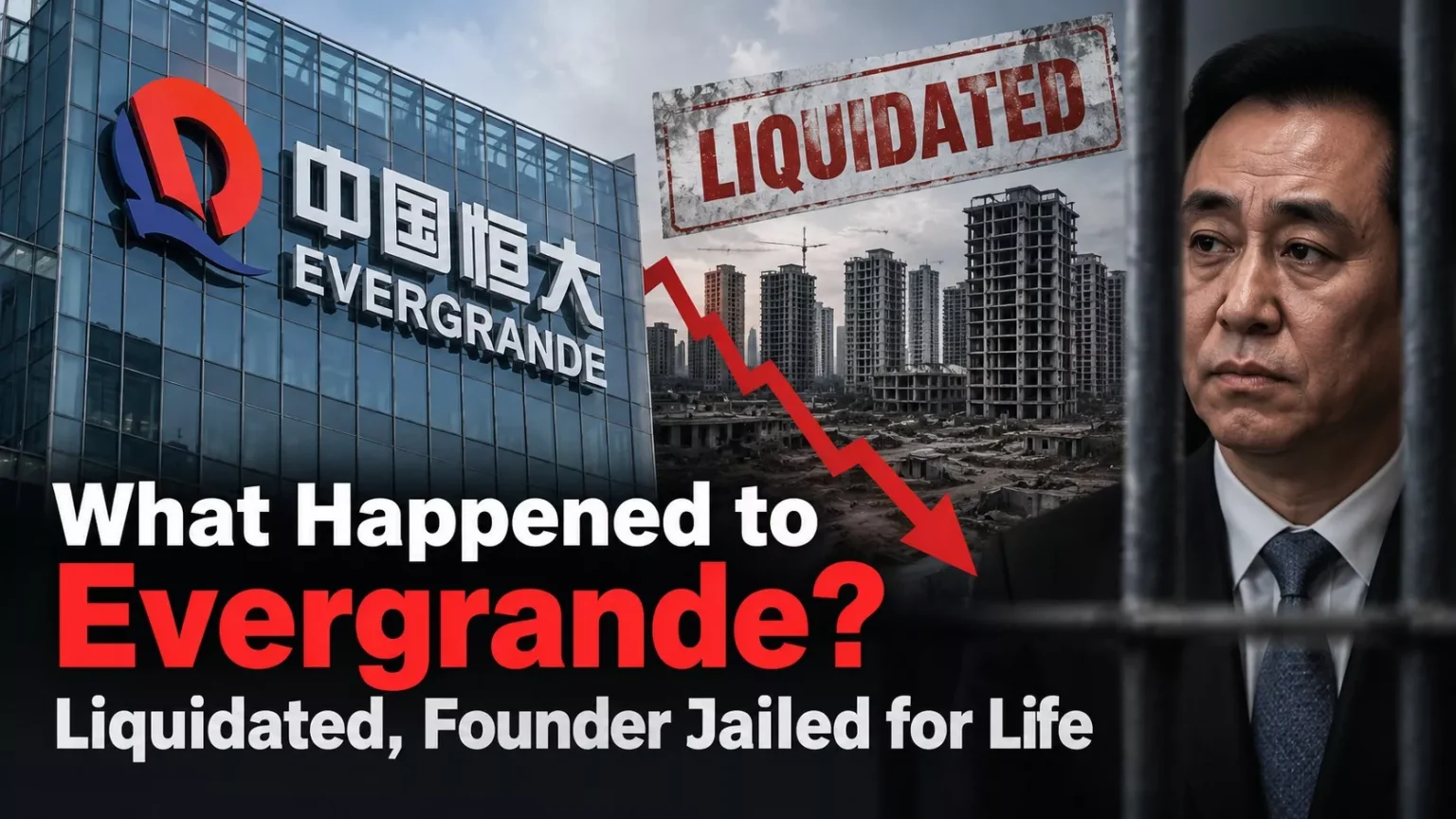

Evergrande has been broken up and liquidated, and its founder is in prison for life. The Chinese developer collapsed in 2021 owing more than $300 billion, was ordered into liquidation by a Hong Kong court in January 2024, and was delisted in August 2025. Hui Ka Yan was sentenced on 20 August 2026.
Is Evergrande Still a Company?
Not as a functioning business. China Evergrande Group survives only as a legal shell being wound up by court-appointed liquidators, and its main property arm is now in bankruptcy proceedings of its own.
The company stopped trading on 29 January 2024, the day the Hong Kong High Court ordered it wound up, and its shares were formally cancelled from the Hong Kong Stock Exchange on 25 August 2025 after an 18-month deadline to resume trading passed. Evergrande did not appeal.
As of 9 September 2026, there is no Evergrande share to buy, no listed parent company raising money, and no realistic path back. What remains is an asset-recovery exercise run by liquidators and, since August 2026, a separate mainland bankruptcy case against the unit that actually built the apartments.
Why Evergrande Collapsed
Evergrande ran out of cash because its business model depended on borrowing faster than it built. Founded in 1996 and listed in Hong Kong in 2009, it grew into China’s biggest developer by selling apartments before they were finished and using the deposits, plus heavy debt, to buy the next tranche of land.
That worked while prices rose and credit was cheap. In 2020 Beijing capped how much developers could borrow relative to their assets and cash, and the funding that the model required disappeared almost overnight.
Construction stalled, buyers stopped paying, and in 2021 Evergrande defaulted with more than $300 billion in liabilities — the largest corporate collapse in Chinese history, and the trigger for a property downturn that has outlasted the company itself.
What Happened to Hui Ka Yan, Evergrande’s Founder?
Hui Ka Yan was sentenced to life in prison on 20 August 2026 by the Shenzhen Intermediate People’s Court. He was 67 at the time of sentencing.
Hui, who is also known by the Mandarin form of his name, Xu Jiayin, was convicted of financial crimes including large-scale fraud and bribery. The court also stripped him of his political rights for life and ordered his personal assets confiscated. Prosecutors said the offences ran from 2016 to 2021 and involved inflating Evergrande’s assets while concealing what it owed.
Two corporate fines were imposed alongside the sentence: 8.82 billion yuan on Evergrande and 7 billion yuan on Hengda Real Estate, its onshore development unit — about 15.8 billion yuan, or roughly $2.4 billion, in total. Other senior Evergrande executives were sentenced at the same time, with terms running up to 18 years.
A life term is heavier than the outcome in most comparable corporate collapses elsewhere, including the fraud case against Terraform Labs co-founder Do Kwon. Hui was once ranked China’s richest person; liquidators have been pursuing roughly $7.7 billion of assets they say he holds worldwide.
What Regulators Found in Evergrande’s Books
The core finding was that Evergrande’s sales figures were fabricated on an enormous scale. In March 2024 the China Securities Regulatory Commission concluded that Hengda Real Estate had inflated its revenue by 564 billion yuan, about $78 billion, across 2019 and 2020.
The method was straightforward: booking revenue from apartments before they had been completed and handed over to buyers. The regulator said 213.99 billion yuan of the total was inflated in 2019 and 350 billion yuan in 2020, and that Hengda then issued bonds on the strength of those false accounts.
The CSRC fined Hengda about 4.2 billion yuan, roughly $580 million, fined Hui 47 million yuan personally, and barred him from China’s securities markets for life. That regulatory case, two and a half years before the criminal verdict, is what established the fraud that the Shenzhen court later sentenced him for.
The Two Liquidations, and Why They Are Not the Same
Evergrande is being unwound in two separate jurisdictions, under two different legal processes, and confusing them is the single easiest mistake to make with this story.
Hong Kong, January 2024: The Holding Company
The Hong Kong High Court ordered China Evergrande Group — the listed parent — into liquidation on 29 January 2024, after the company failed to produce a workable restructuring plan for its offshore creditors. Edward Middleton and Tiffany Wong of Alvarez & Marsal were appointed joint liquidators.
Their problem is jurisdictional. The liquidators have said that around 90 percent of Evergrande’s assets sit in mainland China, and that most of those had already been sold, pledged to domestic creditors or frozen before they arrived. A Hong Kong winding-up order does not automatically reach them.
Guangzhou, August 2026: The Business That Built the Flats
On 21 August 2026 — the day after Hui was sentenced — the Guangzhou Intermediate People’s Court accepted a bankruptcy liquidation case against Hengda Real Estate Group, the mainland subsidiary that carried out Evergrande’s actual development work.
The application came from Guangzhou Rural Commercial Bank, on the grounds that Hengda could not repay its debts and that its assets were insufficient to cover its liabilities. This is the step that begins winding up the onshore business, and it is where the assets that matter to most creditors and homebuyers actually sit.
What Creditors and Homebuyers Get Back
Very little, and slowly. Evergrande’s liquidators have put the offshore debt they are working through at about $45 billion, against total group liabilities of more than $300 billion.
Deloitte estimated at the outset of the liquidation that holders of Evergrande’s dollar bonds would recover about 3.4 percent, compared with 22.5 percent had a restructuring succeeded. Restructuring specialists quoted after the August 2026 sentencing expect recoveries in the single digits as a percentage of liabilities. Evergrande’s offshore bonds were indicated below two cents on the dollar after the Guangzhou ruling, which is the market’s own estimate of what is left.
Homebuyers are a separate and less transparent problem. Hundreds of thousands of Chinese households paid in advance for apartments in Evergrande projects that stalled, and completion has been handled piecemeal by local governments and state-linked builders rather than by the company. Four years after the default, buyers were still describing unfinished blocks and flats delivered without working utilities. No consolidated official count of undelivered Evergrande homes has been published, and the bankruptcy of Hengda does not by itself create one.
Timeline: Evergrande From Default to Life Sentence
| Date | Event |
|---|---|
| 1996 | Hui Ka Yan founds Evergrande in China. |
| 2009 | Evergrande lists on the Hong Kong Stock Exchange. |
| 2020 | Beijing caps developer borrowing, cutting off Evergrande’s funding model. |
| 2021 | Evergrande defaults with more than $300 billion in liabilities. |
| 29 January 2024 | Hong Kong High Court orders liquidation; shares suspended. |
| March 2024 | CSRC finds Hengda inflated revenue by 564 billion yuan and bans Hui for life. |
| 25 August 2025 | Evergrande is delisted from the Hong Kong Stock Exchange. |
| 20 August 2026 | Hui Ka Yan sentenced to life in prison in Shenzhen. |
| 21 August 2026 | Guangzhou court accepts bankruptcy liquidation of Hengda Real Estate. |
Frequently Asked Questions
Is Evergrande Bankrupt?
In practical terms yes, though through two processes rather than one. The Hong Kong parent has been in court-ordered liquidation since January 2024, and a Guangzhou court accepted a bankruptcy liquidation case against its mainland development unit, Hengda Real Estate, on 21 August 2026.
How Much Money Did Evergrande Owe?
More than $300 billion in total liabilities at the time of its 2021 default, which made it the world’s most indebted property developer. Liquidators have put the offshore portion they are pursuing at roughly $45 billion.
Can You Still Buy Evergrande Shares?
No. The Hong Kong Stock Exchange cancelled the listing on 25 August 2025 after the company failed to meet the conditions to resume trading within 18 months. Existing share certificates remain valid documents but cannot be traded on the exchange.
Will Evergrande Homebuyers Get Their Apartments?
Some have, many have not, and there is no company-wide guarantee. Completion of stalled Evergrande projects has fallen to local authorities and state-linked developers, and buyers have reported flats handed over in unfinished or substandard condition.
Did Evergrande Cause China’s Property Crisis?
It was the largest and most visible casualty rather than the sole cause. The 2020 borrowing limits exposed leverage across the sector, and the downturn in Chinese home prices has continued well beyond Evergrande’s own collapse.