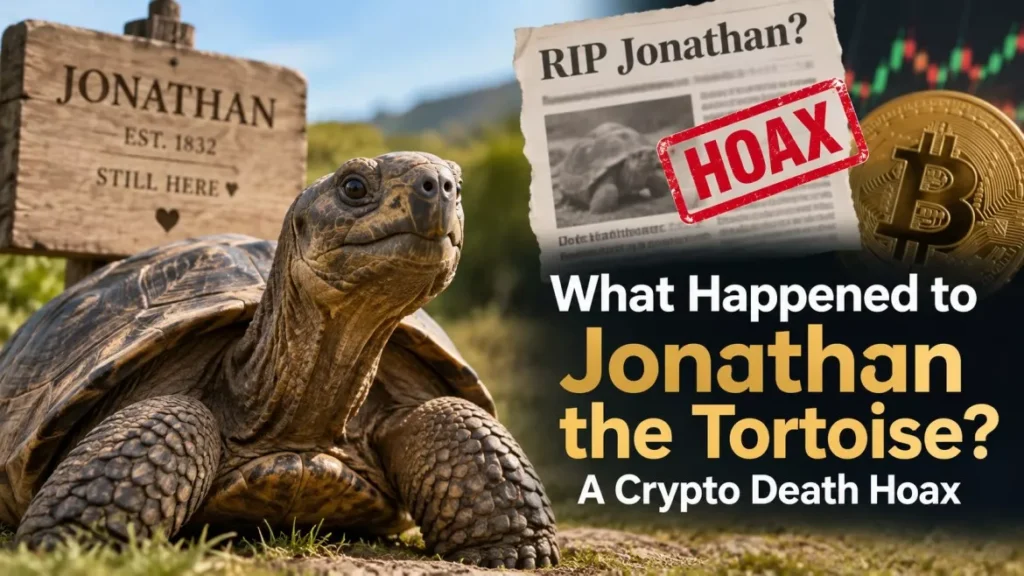

Jonathan the tortoise is alive. A fake X account impersonating his veterinarian announced his death on 1 April 2026, and the claim reached two million views before it was debunked. The St Helena Government confirmed the following day that he had been seen at Plantation House.
Jonathan Is Alive, and the Governor Checked in Person
The St Helena Government issued a formal statement on 2 April 2026 addressing the claims directly. It said that “stories circulated on social media falsely claiming that Jonathan had passed away” and that “these claims are entirely untrue and appear to be part of an online hoax.”
The statement went further than a denial. It confirmed that “Jonathan was seen this morning at his home in the grounds of Plantation House, where he continues to enjoy his routine with the care and attention of the Plantation House staff and the St Helena Veterinary Service.”
There was also a less formal verification. As the false reports spread, the Governor of St Helena, Nigel Phillips, went out into the grounds late at night to check on the tortoise himself and confirmed he was alive and well.
What the Fake Death Announcement Actually Said
The claim originated in a post on X from an account presenting itself as Joe Hollins, the veterinarian who has cared for Jonathan for years. The post stated that Jonathan had died overnight on 1 April 2026 at the age of 193.
Two details made it convincing. The account used the identity of a named, real person with genuine professional authority over the subject. And the date was plausible, because Jonathan is genuinely old enough that the news would surprise nobody.
The real Joe Hollins had nothing to do with it. He does not use X at all, which is part of why the impersonation went unchallenged from the source for as long as it did. Investigators later traced the account to Brazil rather than St Helena.
The Crypto Token Behind the Hoax
This was not a prank for its own sake. The impostor account was soliciting cryptocurrency donations while the false reports circulated.
There was a Jonathan-themed token in existence, and the fabricated death moved it. Its market capitalisation rose 376 per cent during the period the false posts were spreading, climbing from about $25,000 to roughly $119,000.
Those are small numbers by cryptocurrency standards, which is precisely what makes the episode instructive. A token with a market cap in the tens of thousands can be moved substantially by a single well-timed piece of fake news, and the cost of manufacturing that news was one impersonated account.
The pattern is a familiar one to fraud investigators. The FBI has reported that crypto scams account for around half of all fraud losses, with impersonation among the most common entry points.
Why Major News Outlets Published It
The hoax did not merely trend. It was picked up and reported as fact by established newsrooms, including the BBC, the Daily Mail and USA Today, all of which published pieces treating Jonathan’s death as confirmed.
The failure was a sourcing one. The account carried the name of the correct veterinarian, and for a subject as remote as St Helena, a message from the animal’s own vet reads like a primary source. Nobody appears to have contacted Hollins directly, or the Governor’s office, before publishing.
Remoteness was the vulnerability. St Helena is a small South Atlantic island roughly 1,900 kilometres from the nearest continental landmass, and there is no large press corps on the ground to make a routine confirmation call.
The timing helped it along as well. The post landed on 1 April, a date on which readers are primed to doubt unusual news, which meant the earliest sceptical replies were dismissed as people assuming a prank. By the time the correction arrived, the obituaries were already published and circulating on their own.
Death hoaxes of this kind follow a well-worn route through social platforms before reaching mainstream coverage. The same mechanism has repeatedly been used against living celebrities, where a single fabricated post is amplified faster than anyone can correct it.
Who Jonathan Is
Jonathan is a giant tortoise living in the grounds of Plantation House, the official residence of the Governor of St Helena, a British Overseas Territory in the South Atlantic.
He is generally identified as a Seychelles giant tortoise, a form of Aldabrachelys gigantea. He was brought to St Helena in 1882 from the Seychelles, then administered under the British Crown colony of Mauritius, and presented as a gift. He has lived on the island ever since, and shares the gardens with three other tortoises.
He is the oldest known living land animal, and since 2022 he has also held the Guinness World Records title for the oldest chelonian in recorded history, a category covering all turtles and tortoises. He took that record from Tu’i Malila, a radiated tortoise in Tonga that lived to roughly 188.
One popular claim about him is wrong, and it is worth correcting because it circulates alongside the genuine ones. Jonathan is often linked to Napoleon Bonaparte, who was exiled to St Helena and died there. The dates rule it out. Napoleon died on the island in May 1821, roughly eleven years before Jonathan is thought to have hatched and more than sixty years before the tortoise arrived. They never shared the island.
What Jonathan has genuinely lived through is still substantial. A tortoise hatched around 1832 was already fifty years old when he arrived on St Helena, and he has since occupied the same garden through two world wars and the entire history of powered flight.
How Anyone Knows He Is 194
No birth certificate exists, and this is the part most coverage skips. Jonathan’s age is an inference, not a measurement, and the reasoning behind it is worth understanding.
The anchor is his arrival. When Jonathan reached St Helena in 1882 he was described as fully mature. For a giant tortoise, full maturity means an age of at least 50 years. Working backwards from 1882 therefore places his hatching no later than about 1832, which makes him roughly 194 in 2026.
The important consequence is that 1832 is a floor, not an estimate of his actual birth year. He was at least 50 on arrival, and possibly older. In all likelihood Jonathan is older than the figure that gets reported, not younger.
This also explains the small inconsistencies readers notice between sources. The fake post said 193 while most coverage in 2026 says 194, because a conservative estimate anchored to a season rather than a date will drift by a year depending on who is counting.
What Condition He Is In
Jonathan is in good health for his age, but he has lost two of his senses.
Cataracts have left him effectively blind, and he has lost his sense of smell almost entirely, which means he cannot locate food on his own. His hearing, by contrast, remains excellent, and he responds to familiar voices.
Because he cannot find food unaided, he is hand-fed a specially prepared diet of fruit and vegetables by the veterinary team, a regime introduced in 2016 that is widely credited with the improvement in his condition since. Veterinary assessments continue to describe him as being in good order with a healthy appetite. He still basks in the sun and still mates.
That 2016 intervention is the detail most worth noting. Before it, an animal that could neither see nor smell his food was dependent on grazing he could no longer do efficiently. Hand-feeding a calorie-dense diet reversed a decline that had looked terminal, which is a reminder that his continued survival is actively managed rather than passive.
His DNA is currently being analysed, with researchers interested in whether his exceptional longevity holds anything of broader biological value.
Guinness Named Him an ICON in 2026
In June 2026, two months after the hoax, Guinness World Records inducted Jonathan as a Guinness World Records ICON, a designation reserved for a small number of record holders of unusual public significance.
Hollins, his veterinarian, summarised the appeal of the record plainly: “It is extraordinary to think that this gentle giant has outlived every other living creature on land, including of course the whole human race.”
The claim holds up literally. A tortoise hatched around 1832 predates the invention of the telephone, the first photograph of a person, and every human being currently alive.
How to Check the Next Claim That He Has Died
Jonathan is old enough that the real announcement will come eventually, and the 2026 hoax showed that major outlets are not a reliable filter. Three checks settle it quickly.
- Go to the St Helena Government website. The territory’s government publishes statements about Jonathan directly, as it did on 2 April 2026. It is the closest thing to a primary source.
- Ignore anything attributed to Joe Hollins on social media. His veterinarian does not use X. Any post carrying his name on that platform is not from him.
- Check whether a token or a donation link is attached. The 2026 hoax existed to move a cryptocurrency. A death announcement that arrives with a wallet address is selling something.
Where Things Stand
As of September 2026, Jonathan is alive at Plantation House, blind, unable to smell, hand-fed daily, and holding two Guinness World Records along with an ICON designation awarded three months ago.
The hoax that briefly killed him off says more about the information environment than about the tortoise. He has outlasted the telegraph, the fax machine and, for now, a fraudulent X account.
Frequently Asked Questions
Is Jonathan the Tortoise Still Alive?
Yes. The St Helena Government confirmed on 2 April 2026 that reports of his death were an online hoax, and he remains alive at Plantation House on St Helena as of September 2026.
How Old Is Jonathan the Tortoise?
About 194 as of 2026. He is estimated to have hatched around 1832, based on his being fully mature, and therefore at least 50 years old, when he arrived on St Helena in 1882. That figure is a minimum, so he may be older.
Who Started the Jonathan Death Hoax?
A fake X account impersonating his veterinarian Joe Hollins posted that Jonathan had died on 1 April 2026. The account was traced to Brazil, and the real Joe Hollins does not use X.
Was the Jonathan Hoax a Crypto Scam?
Yes. The impostor account solicited cryptocurrency donations, and the market capitalisation of a Jonathan-themed token rose 376 per cent, from about $25,000 to roughly $119,000, while the false reports circulated.
What Kind of Tortoise Is Jonathan?
He is a giant tortoise usually identified as a Seychelles giant tortoise, a form of Aldabrachelys gigantea. He was brought from the Seychelles to St Helena in 1882.
Where Does Jonathan the Tortoise Live?
In the grounds of Plantation House, the official residence of the Governor of St Helena in the South Atlantic, where he lives with three other tortoises.