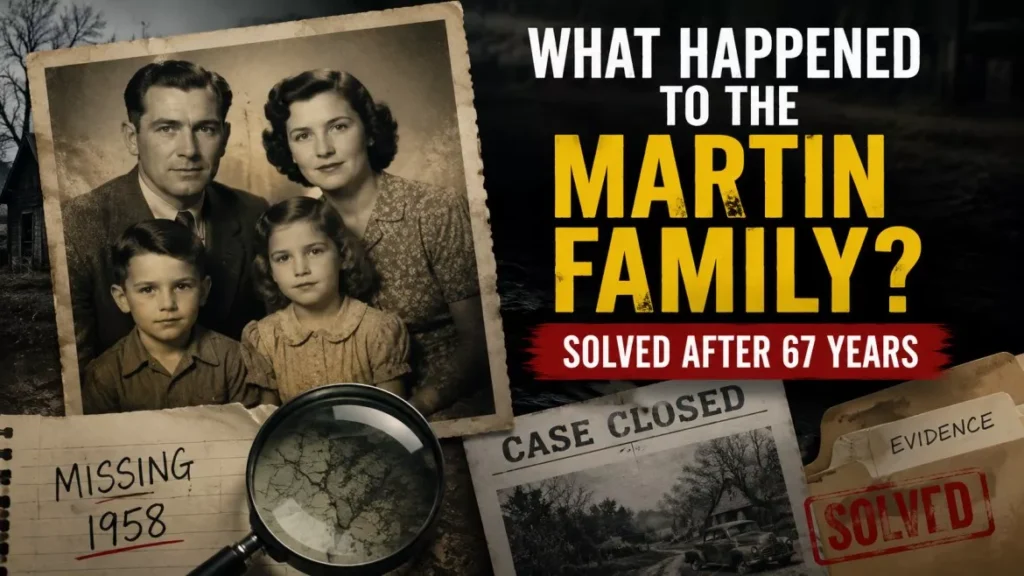

The Martin family died in the Columbia River in December 1958, when their station wagon went into the water near Cascade Locks. A diver located the car in late 2024, and the Oregon State Medical Examiner’s Office identified Kenneth, Barbara and Barbie Martin on 16 April 2026. Investigators found no evidence of a crime.
Who Were the Martin Family?
The Martins were a Portland, Oregon, family of five who vanished together on a Sunday outing in December 1958. They were Kenneth Martin, 54; his wife Barbara, 48; and their three daughters, Barbara “Barbie”, 14, Virginia, 13, and Susan, 11.
A sixth member of the household was not in the car. Donald Martin, the couple’s eldest son, was 28 and serving in the United States Navy, stationed in New York, when his parents and sisters disappeared.
The family travelled in a 1954 Ford Country Squire station wagon. That vehicle became the single most important object in the case, because for 66 years nobody could find it.
What Happened on 7 December 1958?
The family left their Portland home on 7 December 1958 to gather greenery in the Columbia River Gorge for Christmas decorations, and none of the five was seen alive again.
The Gorge is a canyon carved by the Columbia River along the border between Oregon and Washington, roughly 40 miles east of Portland. Cutting evergreen boughs there was an ordinary seasonal errand for Portland families at the time.
The last confirmed sighting placed the Martins around dusk on the north bank of the Columbia, on the Washington side. After that, there was no trace of the family, the car, or any belongings.
Why Did the Largest Search in Oregon History Find Nothing?
The 1958 search failed because investigators had the right location but not the technology to search it properly.
The effort that followed was described at the time as the largest manhunt the state had ever attempted. Deputies from the Hood River County Sheriff’s Office found tire tracks in a parking area at Cascade Locks and formed an early theory that the station wagon had backed into the river.
Divers went into the water at the locks and found nothing. Without sonar coverage of the deeper channels or the equipment to move river sediment, a submerged car sitting in a scoured basin was effectively invisible to them.
Two of the daughters did surface. In the spring of 1959, the bodies of Susan and Virginia Martin were recovered from the shores of the Columbia, roughly 30 miles apart from one another. Both were identified using dental records, and both deaths were ruled drownings.
Those recoveries confirmed that the river had taken the family, but they pointed downstream rather than to any single spot. The case then went quiet for more than six decades.
Why the Martin Case Stayed Famous for Six Decades
The case endured because it paired a total disappearance with an entirely ordinary errand, and because it was never formally abandoned.
Five people, one car and an afternoon of cutting Christmas greenery went missing on a stretch of river thousands of Oregonians visited every winter. There was no ransom demand, no named suspect, no wreck at the roadside and, for decades, no vehicle. Two of the children were recovered within months, and the other three people were simply gone.
Law enforcement kept the file open rather than shelving it. The Multnomah County Sheriff’s Office continued to list the Martin family among its cold cases, and Oregon coverage returned to the disappearance repeatedly as one of the most baffling in the state’s history.
That sustained attention is why private researchers and divers kept going back to the Gorge long after the official search ended, and it is ultimately the reason the car was found at all.
How Was the Family’s Car Found After 66 Years?
An independent diver named Archer Mayo located the station wagon in late 2024 by modelling where the river would have carried and buried it.
Mayo was not working for a police agency. He had spent years studying the stretch of river and had completed hundreds of dives before the search narrowed. “Through predictive modeling that I’ve been doing and my knowledge of the river, I was able to start digging, with Army Corps of Engineer permission and all the agencies involved,” he told NBC News in March 2025.
He used a suction dredge to clear sediment, and within days of striking metal the vehicle was assessed as almost certainly the Martin car. It lay about 50 feet below the surface in a catch basin near the old locks, an area divers call “the pit”. The car was upside down and buried beneath sediment and rock.
That position explains the failure of every earlier search. The wagon was not sitting on the riverbed waiting to be seen; it was underneath the riverbed.
The Hood River County Sheriff’s Office confirmed the find publicly on 7 March 2025, describing an active investigation, and crews began lifting the frame and components from the river that month. During dives in the summer of 2025, human remains and personal artifacts were recovered from the wreck, including a camera case carrying Ken Martin’s name.
How Were the Remains Identified in 2026?
The remains were identified through forensic DNA sequencing carried out by Othram, a private laboratory in Texas, with the results announced by the Oregon State Medical Examiner’s Office on 16 April 2026.
Othram used what it calls Forensic-Grade Genome Sequencing to build a detailed genetic profile from skeletal material, then compared that profile against a DNA sample from a living relative of the family. The advanced testing was funded by the National Institute of Justice through the NamUs missing persons programme.
One detail matters more than the headlines suggested, and it is worth stating plainly: the three identifications were not three identical DNA matches.
Kenneth Martin was the one completely sequenced. According to Dr Hailey Collord-Stalder of the state medical examiner’s division, the two remaining sets of remains were genetically female, and anthropological assessment indicated that one set came from a juvenile and one from an adult woman. Combined with the circumstances of the recovery, that was the basis for identifying Barbara and Barbie Martin.
This is a conclusion built from three converging lines of evidence rather than a single laboratory result. It is a normal outcome for badly degraded remains, and it is the sort of layered identification that has reopened other long-dormant cases, including the DNA questions that still surround the JonBenét Ramsey investigation.
What the Case Solved, and What It Did Not
The 2026 identification answered where the Martins ended up, but it did not establish exactly how the car entered the water.
The Hood River County Sheriff’s Office concluded its investigation and stated that it found no evidence of a crime. That is a specific finding, and it is not the same as a demonstrated sequence of events.
| Question | Status |
|---|---|
| Where did the family go? | Answered. Into the Columbia River at Cascade Locks. |
| Were all five accounted for? | Answered. Two recovered in 1959, three recovered in 2025 and identified in 2026. |
| Was there a crime? | Investigators found no evidence of one and closed the case. |
| How did the car enter the river? | Not established. The leading explanation remains a theory. |
| Why were two daughters found far downstream? | Not addressed in the published accounts of the case. |
The working explanation for the car reaching the water is the one Mayo has described: that the wagon reversed into the river from an unprotected parking area after becoming stuck against a curb. It is consistent with the tire tracks deputies noted in 1958, but it has not been proven, and no agency has presented it as an established fact.
The second open question is stranger. Susan and Virginia were recovered from the riverbank in 1959, one near Camas and one closer to the Bonneville Dam, while their father, mother and eldest sister stayed with the car. The published accounts of the case do not explain that difference.
Where the Martin Family Case Stands as of September 2026
As of 3 September 2026, the case is closed and all five members of the Martin family are accounted for.
The most recent verified development is the identification announcement of 16 April 2026. Nothing further has been announced by the medical examiner’s office or the Hood River County Sheriff’s Office in the months since.
For a disappearance that ran for 67 years, that is an unusually complete ending. Most cases of this age never reach it; families more often live with the pattern seen in long-running searches such as the one for Teekah Lewis, where new activity produces attention but not an answer.
What made the difference here was not a confession or a reopened police file. It was one diver with a sediment dredge and a model of how a river moves things, followed by a laboratory able to read DNA from bone that had spent 66 years underwater.
Timeline of the Martin Family Case
| Date | Event |
|---|---|
| 7 December 1958 | Kenneth, Barbara, Barbie, Virginia and Susan Martin leave Portland for the Columbia River Gorge and disappear. |
| December 1958 | The state launches what is described as its largest manhunt to date; divers search Cascade Locks without success. |
| Spring 1959 | Susan and Virginia Martin are recovered from the banks of the Columbia, about 30 miles apart. Both deaths are ruled drownings. |
| Late 2024 | Diver Archer Mayo locates a submerged 1954 station wagon about 50 feet down near Cascade Locks. |
| 7 March 2025 | The Hood River County Sheriff’s Office publicly confirms the discovery; recovery of the vehicle begins. |
| Summer 2025 | Human remains and artifacts, including a camera case bearing Ken Martin’s name, are recovered from the wreck. |
| 16 April 2026 | The Oregon State Medical Examiner’s Office identifies Kenneth, Barbara and Barbie Martin. The sheriff’s office closes the case, citing no evidence of a crime. |
Frequently Asked Questions
Was the Martin Family Murdered?
No. The Hood River County Sheriff’s Office concluded its investigation in April 2026 and stated that it found no evidence of a crime.
How Many Martin Family Members Were Found?
All five. Susan and Virginia Martin were recovered in the spring of 1959, and the remains of Kenneth, Barbara and Barbie Martin were recovered from the submerged car in 2025 and identified in 2026.
Who Found the Martin Family Car?
Archer Mayo, an independent diver working with permission from the Army Corps of Engineers and other agencies, located the station wagon in late 2024 after hundreds of dives and predictive modelling of the river.
Why Did It Take 67 Years to Find the Car?
The wagon was roughly 50 feet underwater in a catch basin near the old locks, upside down and buried under sediment and rock. Divers in 1958 searched the same area but had no way to see or excavate a vehicle beneath the riverbed.
How Were the Remains Identified?
The Texas laboratory Othram sequenced DNA from the skeletal remains and compared it with a living relative. Kenneth Martin was fully sequenced; Barbara and Barbie Martin were identified using genetic sex, anthropological assessment and the circumstances of the recovery.
Is the Martin Family Case Closed?
Yes. The investigation was concluded in April 2026, although the exact way the car entered the river has never been established.