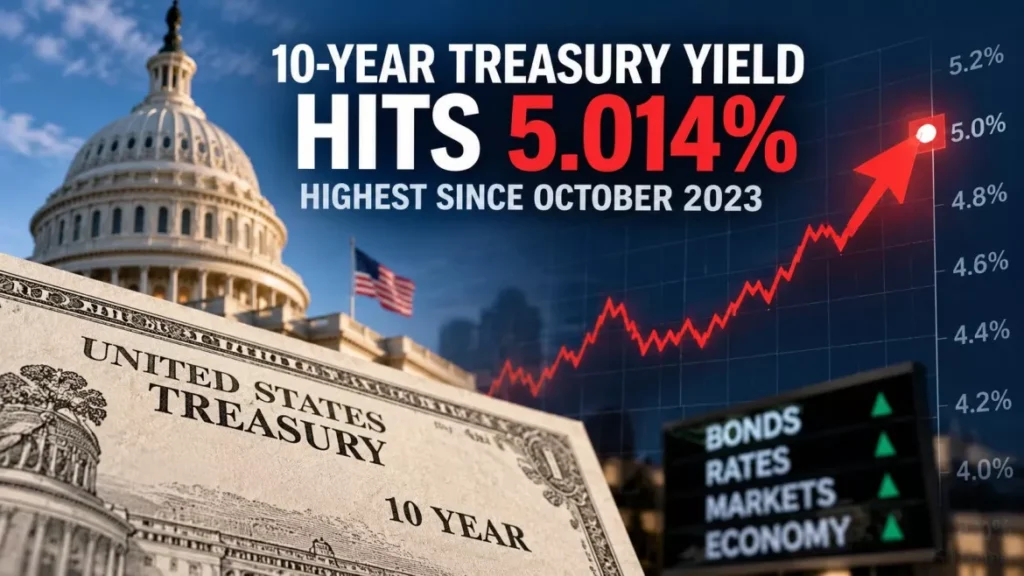

The 10-year Treasury yield touched 5.014% on 14 September 2026, its highest level since October 2023, before easing back to 4.947%. The move came two days before the US Federal Reserve decides on interest rates. Traders put the chance of a quarter-point rise at 90%, according to the CME Group’s FedWatch tool.
Where US Government Bond Yields Stood on Monday
All three benchmark maturities finished the session lower than their intraday peaks, even as the 10-year briefly cleared the 5% mark. A basis point is one hundredth of a percentage point.
| Security | Level on 14 September 2026 | Move on the day |
|---|---|---|
| 10-year Treasury note | 4.947%, after an intraday high of 5.014% | Down more than 2 basis points |
| 30-year Treasury bond | 5.321% | Down more than 3 basis points |
| 2-year Treasury note | 4.615% | Down more than 2 basis points |
The readings above are intraday quotes reported by CNBC on 14 September 2026. Yields move continuously while markets are open, so any single figure is a snapshot rather than a settled level.
Why “Since 2007” Is the Wrong Comparison
Several outlets headlined Monday’s move as the first 5% yield since 2007. That skips a crossing three years ago.
The 10-year yield last reached 5% in October 2023, and before that in July 2007. Monday was therefore the first time since October 2023, and the second occasion since 2007, not the first.
The climb has been steady rather than sudden. The Federal Reserve’s own daily series for the 10-year constant maturity yield shows 4.95% on 10 September 2026, up from 4.78% on 4 September.
What Is Pushing Yields Higher
A bond yield rises when the price of the bond falls, which happens when investors sell or demand more compensation to lend. Several pressures have been reported at once.
- Energy costs: Brent crude climbed to about $108 a barrel, reviving inflation concerns, according to Yahoo Finance’s market report.
- Rate expectations: David Mericle, chief economist at Goldman Sachs, said the latest US inflation report “had little impact on our inflation view but pushed market pricing of a hike to nearly 90%”.
- Debt supply: heavier government and corporate borrowing, including issuance tied to artificial intelligence infrastructure, adds to the volume of bonds the market must absorb.
- Carry trade unwinding: investors who borrowed cheaply in Japanese yen to buy higher-yielding assets have been closing those positions, a move known as unwinding the yen carry trade.
These are the drivers market participants have cited. No single cause has been established, and the relative weight of each is a matter of opinion rather than record.
What Moves With the 10-Year Treasury Yield
The 10-year yield is the return investors require to lend to the US government for a decade, and it serves as the reference point that many other long-dated borrowing costs are priced against. It is a United States market, quoted in US dollars, but it is widely used as a global benchmark.
In the United States, 30-year fixed mortgage rates tend to track the 10-year yield rather than the Fed’s policy rate. This site reported US mortgage rates at 7.12% on daily surveys and 6.76% in Freddie Mac’s weekly reading. Corporate borrowing and long-term government debt in other countries are also commonly priced at a spread over Treasuries.
Credit card rates are a different case. They move with short-term rates tied to the Fed’s policy setting, not with the 10-year yield, so the two do not shift in step.
For savers, a higher yield means new purchases of Treasuries pay more than they did a month ago. The other side is that existing bonds lose market value when yields rise, because bond prices and yields move in opposite directions. Individual outcomes depend on what someone holds, when they bought it and whether they hold to maturity.
The Federal Reserve Decides on Wednesday
The Federal Open Market Committee, the Federal Reserve body that sets US interest rates, meets on 15 and 16 September 2026, with the decision due on Wednesday. Market-implied odds of a quarter-point increase stood at 90% on the CME Group’s FedWatch tool on 14 September 2026.
Other gauges have differed. Prediction market Polymarket showed about 80% on the same day, and Goldman Sachs changed its published forecast from no change to expecting a rise. The Federal Reserve itself has not pre-committed to any outcome.
Europe has already moved. The European Central Bank raised its three policy rates by 25 basis points on 10 September 2026, with the change taking effect on 16 September at a 2.50% deposit rate. The two decisions land in the same week but apply to different economies.
As of 15 September 2026, the Federal Reserve had not announced a decision, and the 10-year Treasury yield was below 5% after Monday’s brief crossing.
Frequently Asked Questions
What Is the 10-Year Treasury Yield?
It is the annual return investors receive for lending money to the United States government for ten years, expressed as a percentage. It is quoted in US dollars and is treated internationally as a benchmark for long-term borrowing costs.
How High Did the 10-Year Treasury Yield Go?
It reached an intraday high of 5.014% on 14 September 2026 and was last quoted at 4.947%, down more than two basis points on the day, according to CNBC.
When Was the 10-Year Treasury Yield Last at 5%?
October 2023. Before that, the last time was July 2007. Reports describing Monday as the first 5% reading since 2007 omit the 2023 crossing.
Does a Higher Treasury Yield Mean Higher Mortgage Rates?
In the United States, 30-year fixed mortgage rates generally track the 10-year Treasury yield, though the two are not identical and the gap between them varies. Rates for any individual borrower also depend on credit profile, deposit and lender.
Is the Federal Reserve Expected to Raise Rates?
The CME Group’s FedWatch tool put the probability of a quarter-point increase at 90% on 14 September 2026, ahead of the decision due on 16 September. The Federal Reserve has not pre-committed to an outcome.
Why Do Bond Prices Fall When Yields Rise?
A bond pays a fixed amount. If investors demand a higher return, the only way an already-issued bond can deliver it is for its market price to fall, so price and yield move in opposite directions.