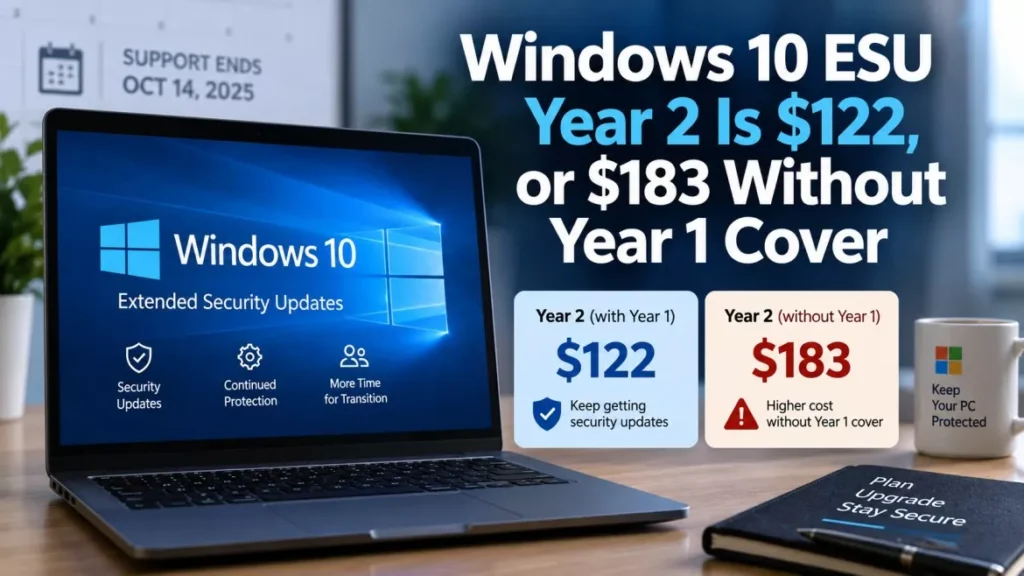

Windows 10 ESU Year 2 costs $122 a device for organisations, double the Year 1 price of $61. Year 1 cover ends on 13 October 2026, and because the programme is cumulative, a device enrolled late must be paid for across both years, $183 in all. Microsoft publishes the pricing rule in its own Extended Security Updates documentation.
Two other Microsoft cost changes land in the same fortnight: a set of Microsoft 365 and Copilot promotional discounts lapses on 30 September 2026, and a 5% uplift begins on 1 October 2026 for annual-term software subscriptions in the Cloud Solution Provider channel that are billed monthly.
As of 15 September 2026, none of the three had taken effect. Prices below are the list figures Microsoft quotes in United States dollars through Volume Licensing, with euro figures from the Cloud Solution Provider price list; local currency amounts vary by market and by the agreement an organisation buys under.
The Three Dates in the Next Four Weeks
| Date | What changes |
|---|---|
| 30 September 2026 | A block of Microsoft 365 and Copilot promotional discounts expires |
| 1 October 2026 | 5% uplift applies to annual-term CSP software subscriptions billed monthly, at renewal on or after this date |
| 13 October 2026 | Windows 10 ESU Year 1 coverage ends, as does Windows 10 Enterprise LTSB 2016 ESU Year 1 |
| 14 October 2026 | Year 2 ESU coverage begins at the doubled price |
The three are unrelated programmes that happen to converge. What they share is that each is triggered by a date rather than by an action, so an organisation that does nothing still ends up on the new terms.
What Windows 10 ESU Year 2 Costs
Extended Security Updates are paid security patches for a Windows version past its end of support. Windows 10 reached end of support on 14 October 2025, and the commercial programme runs for a maximum of three years after that.
| Coverage year | Period | Per device (USD) | Per device (EUR, standard) | Per device (EUR, cloud-managed) |
|---|---|---|---|---|
| Year 1 | November 2025 to 13 October 2026 | $61 | €48.51 | €35.91 |
| Year 2 | October 2026 to October 2027 | $122 | €97.01 | €71.82 |
| Year 3 | October 2027 to October 2028 | $244 | €194.03 | €143.64 |
| Three-year total | — | $427 | €339.55 | €251.37 |
The dollar figures come from Microsoft. Its documentation states that Extended Security Updates for organisations can be bought through Volume Licensing “at $61 USD per device for Year One” and that “the price doubles every consecutive year, for a maximum of three years”. The euro figures are the Cloud Solution Provider price-list amounts reported by the licensing advisory firm LicenseQ, which also lists a lower cloud-managed rate for devices enrolled through Intune or Windows Autopatch.
Two conditions apply to every device. It must be running Windows 10 version 22H2. The minimum purchase is one licence, so there is no volume floor.
Why Skipping Year One Does Not Reduce the Bill
The programme is cumulative, which is the detail most price comparisons leave out. Microsoft’s documentation puts it plainly: “If you decide to purchase the program in Year Two, you have to pay for Year One too, as ESUs are cumulative.”
In practice that means a device that has never been enrolled cannot start at the Year 2 price of $122. It costs $61 plus $122, or $183, to bring that device into coverage from 14 October 2026. Coverage also cannot be bought for part of a year; Microsoft says the programme must be purchased by the year, so six months is not an option.
What ESU does not include is also defined: no new features, no non-security updates requested by customers, no design change requests, and no general technical support beyond problems with the ESU licence itself. Organisations that want support for anything else need a separate support plan.
Where Windows 10 ESU Costs Nothing Extra
Windows 10 virtual machines running in several Microsoft cloud services receive Extended Security Updates at no additional cost, according to Microsoft’s documentation. This is the part of the programme that rarely appears in cost comparisons.
- Windows 365: Cloud PCs, and Windows 10 endpoints connecting to them, entitled for up to three years with an active subscription licence.
- Azure Virtual Desktop: included.
- Azure virtual machines and Azure Dedicated Host: included.
- Azure VMware Solution: included, covering Citrix and Omnissa Horizon deployments on it.
- Nutanix Cloud Clusters on Azure: included.
- Azure Local, Azure Stack Hub and Azure Stack Edge: included.
The entitlement applies to the virtual machine, not to physical desktops running alongside it. Organisations still running mixed estates of physical and virtual Windows machines, of the sort affected by the recent Remote Desktop Services fault across 14 Windows versions, will be paying per device for the physical half.
The 5% Uplift on Monthly-Billed CSP Software
From 1 October 2026, Microsoft applies a 5% premium to annual-term software subscriptions bought through the Cloud Solution Provider channel and billed monthly. The Cloud Solution Provider programme is the route through which most partners and resellers sell Microsoft licences.
The products named are SQL Server, Windows Server, Client Access Licences and System Center. The uplift is not retroactive: it is applied to an existing subscription at its next renewal on or after 1 October 2026.
Two billing arrangements are unaffected. Annual-term subscriptions billed annually keep their price. Month-to-month subscriptions, which already carry a premium, are unchanged. On a €200,000 annual spend on SQL Server and Windows Server under annual terms with monthly billing, the uplift adds €10,000 at renewal.
Microsoft issued a correction to an earlier partner communication that carried the wrong effective date for this change. The date now stated is 1 October 2026.
Which Promotions Lapse on 30 September
A group of promotional discounts reaches its end date on 30 September 2026. Licensing advisers put the number at about a dozen offers. The ones corroborated across more than one source are:
- Microsoft 365 E5: the three-year subscription discount available through the Cloud Solution Provider channel.
- Microsoft 365 Copilot, one-year offers: 15% off on 300 or more new annual seats and 30% off on 1,000 or more.
- Microsoft 365 E3: the three-year discount.
- Defender Suite and Purview Suite: a 10% discount.
- Windows 365 Enterprise: a 20% offer.
Sources disagree on one item. LicenseQ lists all three Microsoft 365 E7 offers among those ending on 30 September 2026, while partner guidance elsewhere states that E7 and Copilot Business offers run to 31 December 2026. An organisation holding a specific offer should check its own quote or the Microsoft partner price list rather than a summary, because promotion end dates differ by offer and by channel.
Separately, Microsoft renamed Windows 365 Frontline to Windows 365 Flex on 3 September 2026, a naming change rather than a pricing one.
Windows 10 ESU Year 2: Frequently Asked Questions
How Much Is Windows 10 ESU Year 2 for a Business?
$122 per device in United States dollars for the year running from October 2026 to October 2027, double the $61 Year 1 price, according to Microsoft’s pricing rule. The Cloud Solution Provider euro price is €97.01 per device, or €71.82 for cloud-managed devices.
What Happens on 13 October 2026?
Windows 10 ESU Year 1 coverage ends, along with Year 1 coverage for Windows 10 Enterprise LTSB 2016. Year 2 coverage runs from the following day at the doubled price.
Can a Device Start at Year 2 Without Paying for Year 1?
No. Microsoft states that Extended Security Updates are cumulative, so a device enrolled in Year 2 must also be paid for in Year 1. The combined figure is $183 per device.
Who Is Affected by the 5% CSP Uplift?
Organisations with annual-term CSP subscriptions to SQL Server, Windows Server, Client Access Licences or System Center that are billed monthly. It applies at renewal on or after 1 October 2026. Annually billed and month-to-month subscriptions are not affected.
Do Azure or Windows 365 Machines Need a Paid ESU Licence?
No. Microsoft’s documentation lists Windows 365, Azure Virtual Desktop, Azure virtual machines, Azure Dedicated Host, Azure VMware Solution, Nutanix Cloud Clusters on Azure, Azure Local, Azure Stack Hub and Azure Stack Edge as carrying Windows 10 ESU at no additional cost.