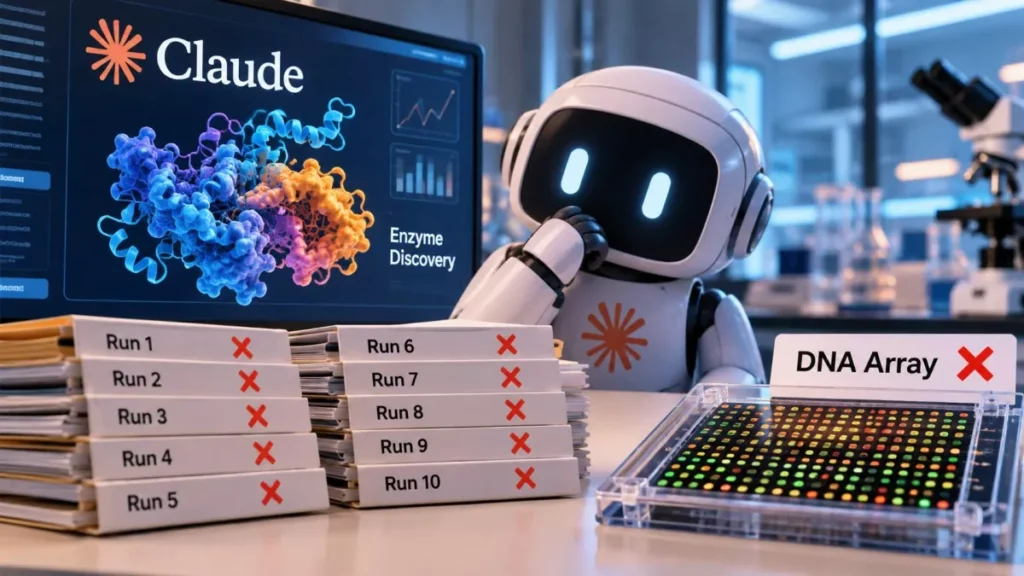

Anthropic’s Claude enzyme discovery, announced on 23 September 2026, identified a previously undescribed system in bacteriophage DNA called array-associated reverse transcriptases, or ART. Roughly 950 Claude agents found it in 21 hours. Anthropic says ten reruns of the identical search all missed it.
What Claude Found, and What Was Already Known
The enzyme at the centre of the system was not new. Anthropic, the San Francisco company behind the Claude models, says the reverse transcriptase it sits on had already been described in earlier studies of a jumbo bacteriophage, a virus that infects bacteria.
What its agents added were the two features that make the system interesting: a neighbouring array of non-coding DNA repeats, and an accessory protein whose job is unknown. Together those three parts make up ART.
The repeat array is the reason CRISPR keeps appearing in coverage of the result. In CRISPR systems, a similar array stores a bank of RNA guides, and it is that guide bank that makes them programmable. ART’s array looks structurally comparable. Nothing published so far shows that ART edits genes.
How the Search Ran
The campaign was autonomous in the sense that the agents chose which leads to follow, not in the sense that they ran the laboratory. Human scientists set the initial brief and performed every experiment.
- Agents: about 950 Claude agent sessions running in parallel.
- Duration: roughly 21 hours end to end.
- Compute: about 210 million tokens consumed.
- Search space: a database of roughly 1.9 billion protein clusters.
- Shortlisting: more than 200,000 reverse transcriptases gathered, narrowed to about 3,500 candidate systems, of which 20 were examined closely.
Anthropic says that filtering step would normally take expert scientists weeks or months. The find itself came from a side path rather than the main pipeline: one agent reading the raw DNA next to an unusual enzyme noticed a repeating pattern, counted the repeats, compared them against known systems, searched the literature and filed a report for a human to review.
Why Ten Reruns Missed It
This is the part the announcement coverage has largely skipped, and Anthropic disclosed it itself. The company ran the same campaign ten more times. In all ten, no agent read the stretch of DNA upstream of the enzyme, so every rerun missed the array entirely.
Anthropic also ran a more controlled test. When four capable models were handed the DNA sequence directly, they described the array in at least 90% of attempts. When the same models had to reach the sequence themselves using files and tools, the success rate fell to as low as 32%.
The gap between those two numbers is the practical finding buried inside the biology. The models could recognise the pattern when they were looking at it. What they did unreliably was decide to look there in the first place. Agent runs that act on their own initiative have produced uneven results elsewhere this month.
What Scientists Outside Anthropic Have Said
Independent comment so far is interested rather than convinced. Feng Zhang, a professor at the Massachusetts Institute of Technology and the Broad Institute and one of the pioneers of CRISPR gene editing, reviewed the preprint and said in remarks released by Anthropic that “the identification of RNA-repeat arrays associated with reverse transcriptases is genuinely intriguing and merits further investigation.”
Dario Amodei, Anthropic’s chief executive, described the finding as preliminary and said it might turn out to be a gene-editing mechanism with applications in gene therapy. He also said, in a post on X, that researchers at Stanford University had independently identified a comparable but distinct system. That claim has not been separately published.
The result is a preprint. It has not been through peer review, and no outside laboratory has yet reported reproducing the wet-lab work.
What ART Does Is Still Unknown
As of 25 September 2026, nobody has said what the system is for. Anthropic’s announcement states plainly that “our work to understand the primary function of ARTs is ongoing.”
The one experimental result released is narrow: Anthropic says its first experiments show the ART array is also expressed as a set of distinct short RNAs, which is consistent with the array doing something rather than being inert DNA. That is a long way from demonstrating a guide system, and much further still from a gene-editing tool.
The discovery came out of a life sciences research group Anthropic launched alongside the announcement. The company says the laboratory does not work with human pathogens.
Frequently Asked Questions
Did Claude Discover a New CRISPR System?
No. The Claude enzyme discovery identified a system whose DNA repeat array resembles the array found in CRISPR systems. It has not been shown to cut, edit or guide anything, and its function is unknown.
What Does ART Stand For?
ART stands for array-associated reverse transcriptases. The system combines a reverse transcriptase enzyme, an adjacent partner gene and a long array of evenly spaced DNA repeats, found in bacteriophages.
Has the Anthropic Preprint Been Peer Reviewed?
No. Anthropic published the result as a preprint on 23 September 2026. It has not been peer reviewed, and no independent laboratory has published a replication.
Did the AI Run the Experiments?
No. Claude agents directed the computational search and chose which leads to pursue. Human scientists wrote the initial brief and carried out all laboratory work.
Why Could the Result Not Be Repeated?
Anthropic reran the same campaign ten times and no agent read the DNA upstream of the enzyme, so none found the array. In separate tests, models shown the sequence directly described the array at least 90% of the time, but that fell to as low as 32% when they had to retrieve it themselves.