
The Bank of America fine announced by the United States Treasury totals more than $1.21 billion across three agencies. The bank admitted it willfully violated the Bank Secrecy Act and failed to report over $5 billion in suspicious transactions on time between January 2018 and July 2025. Treasury announced the actions on 13 October 2026.
How the $1.21 Billion Breaks Down
The three figures published on 13 October 2026 do not add up the way the coverage suggests, because one of them is credited against another rather than paid on top of it.
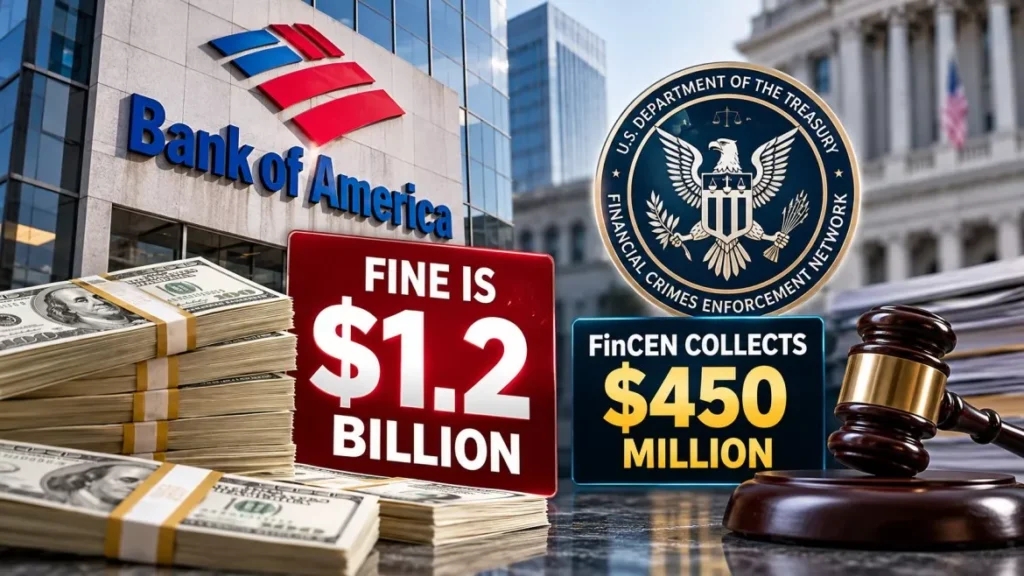
The Financial Crimes Enforcement Network, the Treasury bureau known as FinCEN that administers United States anti-money-laundering law, imposed a civil money penalty of $1.2 billion. The Office of the Comptroller of the Currency, the federal regulator that supervises national banks, separately assessed $750 million. FinCEN then agreed to credit the OCC payment against its own penalty.
| Agency | Amount | How it is paid |
|---|---|---|
| FinCEN civil money penalty | $1,200,000,000 | Reduced by the OCC credit |
| Credited to the OCC | $750,000,000 | Paid to the US Treasury |
| Balance due under the FinCEN order | $450,000,000 | Paid to the Treasury within ten days |
| OFAC sanctions settlement | $11,600,000 | Separate settlement |
The consent order states plainly that, after the credit, “Bank of America shall make payment of $450,000,000 to the Department of the Treasury”. FinCEN’s consent order sets a deadline of ten days from the effective date and warns that interest, penalties and administrative costs accrue on late payment. The order also bars the bank from claiming any tax deduction, tax credit or other tax benefit for the penalty.
Adding $1.2 billion to the $11.6 million settlement with the Office of Foreign Assets Control, the Treasury office that administers sanctions, produces the “more than $1.21 billion” that Treasury cited. Adding all three published figures separately would double-count the $750 million. One small inconsistency remains in the record: the OFAC amount appears as $11.6 million in Treasury’s release, covering 475 apparent violations, while the FinCEN consent order refers to an $11,000,000 penalty in its discussion of parallel actions.
What Bank of America Admitted
The admissions are narrower than the word “willfully” suggests to a general reader, and the order spells out the limit.
Under the FinCEN resolution, the bank admits it willfully violated the Bank Secrecy Act, the 1970 United States law requiring banks to help the government detect money laundering. Specifically, it admits it failed to implement and maintain an anti-money-laundering programme meeting the Act’s minimum requirements, failed to conduct required due diligence on correspondent accounts held for foreign financial institutions, and failed to file Suspicious Activity Reports.
A Suspicious Activity Report, or SAR, is a confidential filing a bank must send to FinCEN when it spots a transaction with signs of possible criminality. The order notes that Bank of America admits to “willfulness” only as the term is used in civil enforcement of the Bank Secrecy Act, where the government need show only reckless disregard or willful blindness rather than a bad motive. This is a civil consent order, not a criminal conviction, and no criminal charge against the bank was announced.
The Failures Regulators Described
The conduct covered what the order calls the Relevant Time Period: from at least 1 January 2018 through 1 July 2025.
- Unreported suspicious activity: The bank failed to file timely and accurate reports on suspicious transactions totalling over $5 billion, with over $1 billion of that activity implicating national security and other priority risks.
- Trade-based money laundering: The order cites over $600 million of transactions carrying signs of potential trade-based money laundering, a technique that moves value by misdescribing goods on invoices.
- A lookback that found more: A limited-scope review identified nearly $4 billion in suspicious activity that would not otherwise have been reported.
- Monitoring gaps: The OCC said the bank’s transaction monitoring system failed to properly monitor trillions of dollars in transactions, and that for multiple years more than one-third of cases were created by a single automatic promotion feature rather than by risk-based alerts.
- Staffing and audit: The OCC found the Bank Secrecy Act officer and staff lacked adequate skills, key personnel were not properly trained, and the audit function missed long-standing concerns that examiners later found.
Treasury named two priority risk categories in particular: Chinese money laundering networks and illicit finance along the southwest border of the United States. The OFAC settlement concerned apparent violations of several sanctions programmes, including those covering Iran, Russia, narcotics and global terrorism.
Why the 2024 Order Was Not Enough
This is the second enforcement action against the same compliance programme in under two years, and the first one carried no fine.
The OCC issued a cease-and-desist order against Bank of America on 23 December 2024 over Bank Secrecy Act deficiencies. That order required the bank to hire an independent consultant, run look-back reviews of past suspicious activity reporting and fix governance, internal controls, independent testing and training. It imposed no monetary penalty and placed no restriction on the bank’s growth.
The OCC’s 2026 release says the bank did not complete the steps needed for an effective programme. After the earlier order, according to the regulator, the bank still did not escalate potentially suspicious activity to investigators, and it processed potential trade-based money laundering because of a systemic gap in its monitoring. Comptroller of the Currency Jonathan V. Gould said the bank’s “poor response to its BSA deficiencies is unacceptable”. The 2024 order remains in effect alongside the new penalty.
What the Bank Must Do Now
The consent order attaches obligations that run for years and are independent of any undertakings in the parallel OCC action.
- Hire a SAR lookback consultant: The bank must engage a qualified independent consultant, at its own expense, within 30 days, to find and report suspicious transactions that went unreported, including activity involving credit cards.
- Hire a suspicious activity monitoring consultant: Also within 30 days, to review the monitoring controls, with staged reporting deadlines running to 240 days from the start of the review.
- Hire a due diligence consultant: A separate consultant reviews customer due diligence and foreign correspondent account due diligence, with reports due within 90 days of retention.
- Hire a data governance consultant: Within 30 days, to review the data feeding the anti-money-laundering programme.
- Submit to focused reviews: Treasury said the independent reviews will focus on the southwest border, cartels and narcotics trafficking, on Iran and on Russia.
Treasury Secretary Scott Bessent said in the department’s announcement that “today’s actions send a clear message that even the biggest financial institutions are not above the law”. Bank of America said that “financial crime compliance is serious, and we are responsible for getting it right”, and that it had worked with regulators on resolutions tied to the 2024 OCC consent order and FinCEN’s investigation.
What It Did to Third-Quarter Earnings
The penalty landed in results the bank published the following morning, on 14 October 2026.
Bank of America recorded the $1.2 billion as a non-tax-deductible noninterest expense in the third quarter of 2026. Net income fell to $6.93 billion from $8.33 billion in the same quarter of 2025, a decline of about 17%. Diluted earnings per share were $0.91 against $1.04 a year earlier; the bank said the charge reduced earnings per share by $0.17, and that adjusted earnings per share were $1.08. Revenue, net of interest expense, rose 3% to $30.0 billion from $29.0 billion.
Because the penalty is not deductible, the full amount reduces after-tax profit rather than part of it. Shares fell on 14 October 2026, with reports of declines ranging from about 4% in premarket trading to between 6% and 8% during the session; share prices move continuously and any figure is a reading at a moment. The bank’s most recent annual disclosure, cited in the consent order, reported net income of approximately $30.5 billion, so the charge is roughly 4% of a typical year’s profit. A separate legal matter involving the bank is covered in our earlier report on the UBS lawsuit against Bank of America.
Where It Ranks and What Is Still Open
Treasury described the action as the third-largest penalty in the department’s history. The two larger ones are the Binance settlement in 2023, which FinCEN put at $3.4 billion, and the TD Bank action in 2024, where FinCEN’s penalty was $1.3 billion and the total resolution across agencies reached roughly $3 billion.
Those comparisons should be read carefully, because published rankings mix FinCEN-only penalties with combined multi-agency totals. On a FinCEN-penalty basis, Bank of America’s $1.2 billion sits below both.
Several things are not resolved. The lookback has not been completed, so the eventual volume of newly reported suspicious activity is unknown. The bank’s quarterly filing says it continues to respond to requests for information from other regulators about its Bank Secrecy Act, anti-money-laundering and sanctions compliance programmes, which means further actions are possible but none has been announced. No criminal charge has been brought against the bank, and no individual has been charged in connection with these orders.
Frequently Asked Questions
How Much Is the Bank of America Fine?
The Bank of America fine totals more than $1.21 billion, announced by the United States Treasury on 13 October 2026. It comprises a $1.2 billion FinCEN civil money penalty, against which a $750 million payment to the Office of the Comptroller of the Currency is credited, plus an $11.6 million sanctions settlement with OFAC.
How Much Does Bank of America Pay FinCEN Directly?
$450 million. The consent order credits the $750 million OCC payment against the $1.2 billion penalty, leaving a balance of $450,000,000 due to the United States Department of the Treasury within ten days of the order’s effective date.
What Period Do the Violations Cover?
The FinCEN consent order defines the relevant time period as at least 1 January 2018 through 1 July 2025. The December 2024 OCC cease-and-desist order falls inside that window, and regulators said the failures continued after it.
Did Bank of America Admit Wrongdoing?
Yes, in civil terms. The bank admits it willfully violated the Bank Secrecy Act and failed to maintain a compliant anti-money-laundering programme, to conduct correspondent account due diligence and to file Suspicious Activity Reports. The order records that “willfulness” here is the civil enforcement standard, which requires reckless disregard or willful blindness rather than bad motive. These are civil consent orders, not criminal convictions.
Is This the Largest Bank Secrecy Act Penalty Ever?
No. Treasury called it the third-largest penalty in its history, behind the 2023 Binance settlement and the 2024 TD Bank action. Published rankings vary because some count FinCEN penalties alone and others count combined totals across agencies.
How Did the Penalty Affect Bank of America’s Results?
The bank recorded the $1.2 billion as a non-tax-deductible expense in the third quarter of 2026. Net income fell to $6.93 billion from $8.33 billion a year earlier, and diluted earnings per share came in at $0.91 against $1.04, with the charge accounting for $0.17 of the fall.