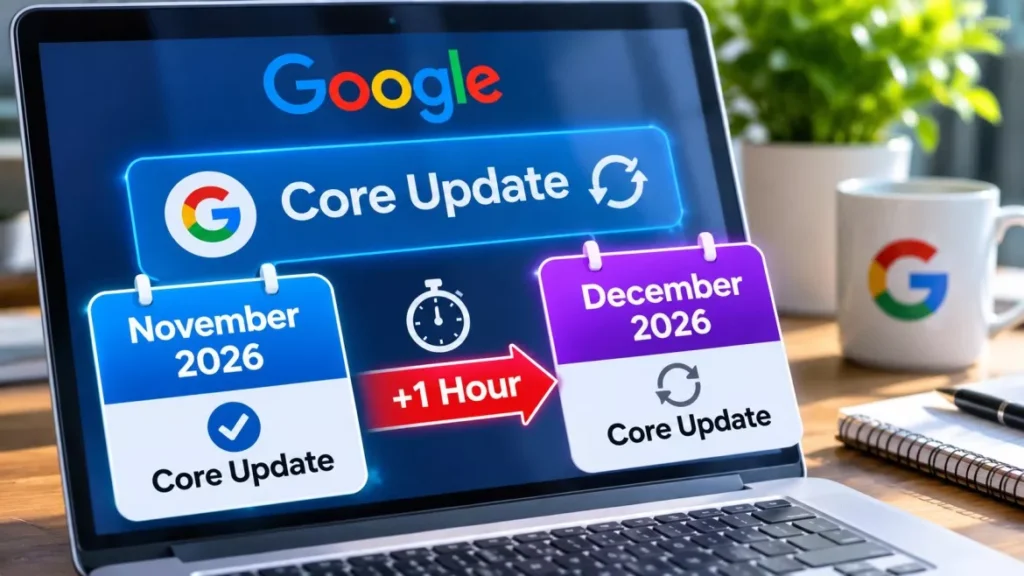

Google has announced a December 2026 core update before it starts rolling out. The notice appeared on the Search Status Dashboard at 7:03 a.m. Pacific on 24 November 2026, one hour after Google marked the November core update complete. Google has not given a start date.
Two core updates in consecutive calendar months is unusual on its own. The tighter problem for anyone who runs a website is that the second was announced before there was time to measure the first.
What Google Said About the December 2026 Core Update
Google named two targets: complex questions and personalised results. The dashboard entry is the only description the company has published, and it reads in full:
“Preannounced the December 2026 core update, which focuses on multiple improvements to how our systems understand and rank relevant content (including for longer and more complex questions), as well as improving personalized results for people who have personalization turned on. This core update applies to all locations and languages where Google Search is available, and our guidance about general core updates applies. This update is scheduled to be released in December 2026.”
That is more detail than Google usually gives in advance. The equivalent notices for the March, May and November updates this year gave a rollout window but did not say what the update was trying to improve.
The entry carries no start date and no expected duration. Search Engine Roundtable reported a Google spokesperson saying: “We don’t have a date yet — we will announce it as usual the day it starts rolling out.” The same report noted that the dashboard was displaying the December update as an active incident although the rollout had not begun.
An Hour Apart: The Timeline on Google’s Dashboard
All three entries sit on the same dashboard, and the times are Google’s own, in US Pacific time.
- 10 November 2026, 10:07 Pacific: Google releases the November 2026 core update, “which applies globally and to all languages”, and says the rollout may take up to two weeks.
- 24 November 2026, 06:03 Pacific: Google records that “the rollout was complete as of November 24, 2026”. The dashboard puts the total at 13 days and 20 hours.
- 24 November 2026, 07:03 Pacific: Google preannounces the December 2026 core update, scheduled for December with no date attached.
Why Google Is Giving Notice After Saying It Would Not
The early warning is a regulatory obligation, not a change of editorial habit. Google’s own Search Central documentation says that for changes where United Kingdom users may experience a significant ranking shift, it provides advance notice to site owners in accordance with the CMA’s fair ranking conduct requirements for Google.
The CMA is the Competition and Markets Authority, the United Kingdom’s competition regulator. It designated Google as having strategic market status in general search earlier in 2026 and then imposed a set of conduct requirements on the company, among them a fair ranking requirement obliging Google to rank organic results on objective and non-discriminatory criteria and to warn site owners before significant ranking changes. Reporting on the requirement puts the date it was imposed at 17 June 2026, with a six-month compliance window running to 17 December 2026.
Google’s documentation lists two kinds of change that trigger a notice: actionable policy changes, such as revisions to content policies or technical guidelines that oblige site owners to alter their sites, and significant ranking changes, with broad algorithmic updates given as the example. It does not state how much notice any of them receives.
Two details make this worth watching beyond the United Kingdom. The requirement is British, but the December notice says the update “applies to all locations and languages”, so every market gets the warning. And Barry Schwartz of Search Engine Roundtable, who has covered Google’s algorithm announcements for two decades, pointed out that Google has said repeatedly that it does not preannounce core updates — and once promised to, then said it was not practical. Readers who followed Google’s earlier regulator-driven changes to Search in Europe will recognise the pattern.
The Measurement Problem for Site Owners
The scheduling leaves no clean week in which to read November’s effects. Google’s standard guidance is to wait until a rollout has finished and then compare a settled period against a period before it started, which means the earliest honest read on November begins around 1 December.
December is also the earliest the next update could start. If it begins in the first week of the month, the measurement window for November closes before it opens.
The calendar makes it worse. The November rollout ended on 24 November 2026, three days before Black Friday on 27 November and six days before Cyber Monday on 30 November. For retailers and publishers, traffic in that stretch moves for reasons that have nothing to do with ranking, so the week immediately after the rollout is the least reliable week of the quarter to draw conclusions from.
The practical response is narrow but real: compare against a pre-update baseline rather than the days around it. The dashboard timestamps give 3 to 9 November 2026 as the last full week before the November rollout began, which is the cleanest comparison period available until the December update’s dates are known.
How November Compared With 2026’s Other Core Updates
November’s was the longest core update rollout of the year, and the third of three. Google’s dashboard records the durations.
| Core update | Start date | Rollout length |
|---|---|---|
| March 2026 core update | 27 March 2026 | 12 days, 4 hours |
| May 2026 core update | 21 May 2026 | 11 days, 21 hours |
| November 2026 core update | 10 November 2026 | 13 days, 20 hours |
| December 2026 core update | Not announced | Not announced |
The five-month gap between May and November was the longest stretch of 2026 without a core update. A December rollout would close the year with two inside six weeks. For comparison, the site covered a similar completion notice for the March 2024 core update.
As of 25 November 2026, the December 2026 core update has been announced but is not running. Google has published no start date and no expected duration, and the November core update remains the most recent one to have rolled out.
What Google Has Not Said
The preannouncement is unusually specific about intent and unusually vague about everything operational.
- The start date: only “December 2026”, with the spokesperson saying the date will be announced on the day.
- The rollout length: no estimate, where the November notice said up to two weeks.
- The notice period: Google’s documentation commits to advance notice but names no number of days.
- Whether this becomes routine: Google has not said whether spam updates, or core updates in 2027, will get the same treatment once the December compliance date passes.
Frequently Asked Questions
When Does the December 2026 Core Update Start?
Google has not said. The dashboard says only that it is scheduled for December 2026, and a Google spokesperson told Search Engine Roundtable that the date would be announced on the day the rollout begins.
What Does the December 2026 Core Update Change?
Google says it improves how its systems understand and rank relevant content, particularly for longer and more complex questions, and improves personalised results for people who have personalisation switched on. It applies in every location and language where Google Search is available.
Why Did Google Announce This One in Advance?
Google’s documentation ties advance notice to the Competition and Markets Authority’s fair ranking conduct requirements in the United Kingdom. Although the obligation is British, Google is applying the notice to all markets.
Did the November 2026 Core Update Finish?
Yes. Google marked it complete on 24 November 2026, after a rollout of 13 days and 20 hours that began on 10 November.
Should I Change My Site Before December?
Google’s long-standing position on core updates is that there is no single fix and that a ranking drop does not necessarily mean a page is faulty. Because the November rollout ended three days before Black Friday, data from that week is an unreliable basis for changes.