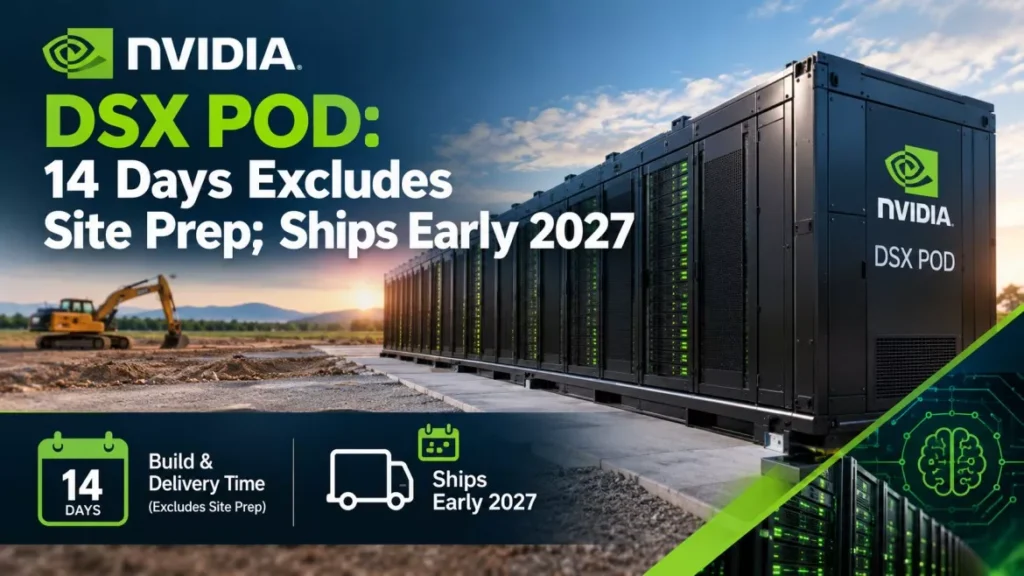

Nvidia DSX POD is a container-sized AI data centre that Nvidia introduced at GTC Berlin on 21 October 2026. Partners will build each pod around Vera Rubin systems, integrating and validating it before delivery. Nvidia says that cuts on-site deployment from six months to as little as 14 days.
What Nvidia Announced at GTC Berlin
Nvidia, the Santa Clara company that designs the GPUs behind most AI training and inference, published the DSX POD reference design on 21 October 2026, the day of Jensen Huang’s keynote at its Berlin developer conference.
A DSX POD is a modular container holding a complete AI compute cluster. Compute, networking, cabling, rack-level power distribution and liquid cooling are assembled inside it at a factory. Partners finish the rack-to-rack cabling, wiring, piping and functional validation before the container ships, so the unit arrives tested rather than as parts to be assembled.
Huang framed the point of it in Nvidia’s release: “An AI factory creates value when it starts producing tokens — not when construction is complete.”
DSX POD extends the DSX AI factory platform that Nvidia first set out at GTC in San Jose in March 2026.
What One DSX POD Contains
Nvidia’s own release describes the pod’s contents by category rather than by component count. The rack figure comes from reporting rather than from Nvidia.
| Item | Detail | Source |
|---|---|---|
| Racks per pod | Seven Vera Rubin NVL72 racks | CNBC and ServeTheHome, not stated by Nvidia |
| Per NVL72 rack | 72 Rubin GPUs and 36 Vera CPUs, linked by NVLink 6 | Nvidia, March 2026 |
| Integrated at the factory | Compute, networking, cabling, rack-level power, liquid cooling | Nvidia |
| Container type | Intermodal shipping container, moved by truck | ServeTheHome; exact size not confirmed by Nvidia |
| Weight | About 28,000 kilograms, per one report | Single outlet |
If the seven-rack figure holds, the arithmetic puts roughly 504 Rubin GPUs and 252 Vera CPUs in a single container. That is a calculation from Nvidia’s published NVL72 specification of 72 Rubin GPUs and 36 Vera CPUs per rack, not a number Nvidia has stated for the pod.
What the 14-Day Figure Covers, and What It Does Not
The 14-day claim applies only after a site is ready. It is not the time to build an AI data centre from nothing.
Nvidia’s wording is that the units arrive ready to connect to a prepared site’s power, cooling, networking and other supporting infrastructure. Everything in that phrase — the substation capacity, the water or chilled-liquid supply, the fibre, the pad the container sits on, the permits — happens before the 14 days starts. ServeTheHome’s account is consistent: a pod is not fully self-contained, and still needs power, networking and a larger cooling system to run.
That distinction matters because site readiness, not equipment installation, is what has actually been holding projects up. Microsoft’s Nscale data centre stalled on electricity transmission upgrades rather than on hardware delivery. A pod that installs in a fortnight does not shorten a grid connection queue.
What the figure does compare is like against like at the installation stage: a factory-built, pre-validated container versus racks delivered loose and cabled, plumbed and tested on site. On that narrower comparison, six months to 14 days is the claim Nvidia is making, and no independent deployment data exists yet to test it.
Nvidia Is Not Building or Selling the Pods
DSX POD is a reference design. Nvidia publishes the blueprint; partners manufacture, sell and deliver the containers. Headlines describing Nvidia as having “announced racks you can ship on a truck” compress that into something Nvidia is not doing.
Seventeen partners are named in the release: Anduril, Armada, Bull, Crusoe, DayOne, Dell Technologies, Delta, Eaton, Foxconn’s Ingrasys unit, GIGABYTE, HPE, Lenovo, Pegatron, Quanta Cloud Technology, Schneider Electric, Vertiv and Wistron.
The list is worth reading closely, because it is not only server makers. Eaton, Schneider Electric, Vertiv and Delta are power and cooling specialists, which tells you where the integration work in a container like this sits. Nvidia has not said how pricing will differ between partners, or whether the design permits configurations other than the reported seven racks.
When You Can Get One
As of 22 October 2026, no DSX POD has shipped. Nvidia says its partners plan to deliver the pods worldwide in early 2027, and the company has given no more precise date than that.
The Vera Rubin hardware inside them is further along. Nvidia said in March 2026 that Vera Rubin products would reach partners from the second half of 2026. At GTC Berlin, Nvidia and Google Cloud said the first A5X instances built on Vera Rubin NVL72 were running with an initial customer, with general availability planned for November 2026 — a detail reported by coverage of the announcement rather than stated in the DSX POD release.
So the sequence for a prospective buyer is: Vera Rubin racks available now through partners and, shortly, rentable by the hour on Google Cloud; the container that packages seven of them, not until early 2027.
What Nvidia Did Not Disclose
- Price: No figure was given, for the pod or per rack, and Nvidia does not set partner pricing.
- Container dimensions: Nvidia has not confirmed the container size. ServeTheHome’s writer suspects a 40-foot unit.
- Power draw: No figure for what a single pod requires, which is the number a site operator needs first.
- Efficiency claims: Water and power efficiency percentages attributed to the Vera Rubin reference architecture in some coverage do not appear in the DSX POD release itself.
- What the 14 days assumes: Nvidia has not specified what counts as a prepared site, so the figure cannot be checked against a defined baseline.
The Other GTC Berlin Announcements
DSX POD led the keynote but was not the only item. Nvidia also set out three-year supply chain capacity targets, including a 2.5-fold increase in substrate supply from IBIDEN, Samsung Electro-Mechanics and Unimicron, a fourfold increase in interposer wafers from Amkor by the end of 2028, a doubling of test capacity at KYEC by 2027, and a fifteenfold rise in optical engine capacity rising to thirtyfold by the end of 2028.
It also published an OpenShell reference architecture for agentic AI safety, which pairs Vera Rubin for model reasoning with Vera CPUs for agent execution and BlueField-4 DPUs for security enforcement. It is a design document rather than a product, and builds on the OpenShell secure runtime Nvidia released as free software in September 2026. A separate update lets the Sync Cluster Assistant manage DGX Spark clusters of up to eight units.
As with any vendor launch, the specifications are firmer than the performance claims. Nvidia’s competitors have faced the same scrutiny, as when Microsoft’s Maia 300 arrived with confirmed specifications and an unverified 40% efficiency figure.
Frequently Asked Questions
What Is the Nvidia DSX POD?
It is a reference design for a complete AI compute cluster built inside a modular shipping container, announced on 21 October 2026. Compute, networking, power distribution and liquid cooling are integrated and tested at a factory before the container is delivered.
Does a DSX POD Really Deploy in 14 Days?
That is Nvidia’s claim for installation at an already-prepared site, down from about six months for an on-site build. It excludes power, cooling and network provisioning, and no independent deployment has been measured yet.
When Can You Buy a DSX POD?
Nvidia’s partners plan worldwide delivery in early 2027. No pod had shipped as of 22 October 2026, and no price has been announced.
How Many GPUs Are in a DSX POD?
Nvidia has not published a figure. Reporting puts seven Vera Rubin NVL72 racks in a pod, and Nvidia specifies 72 Rubin GPUs per rack, which would be about 504 GPUs.
Does Nvidia Sell the DSX POD Itself?
No. Nvidia supplies the reference design, and seventeen named partners including Dell, HPE, Lenovo, Schneider Electric and Vertiv build and deliver the containers.