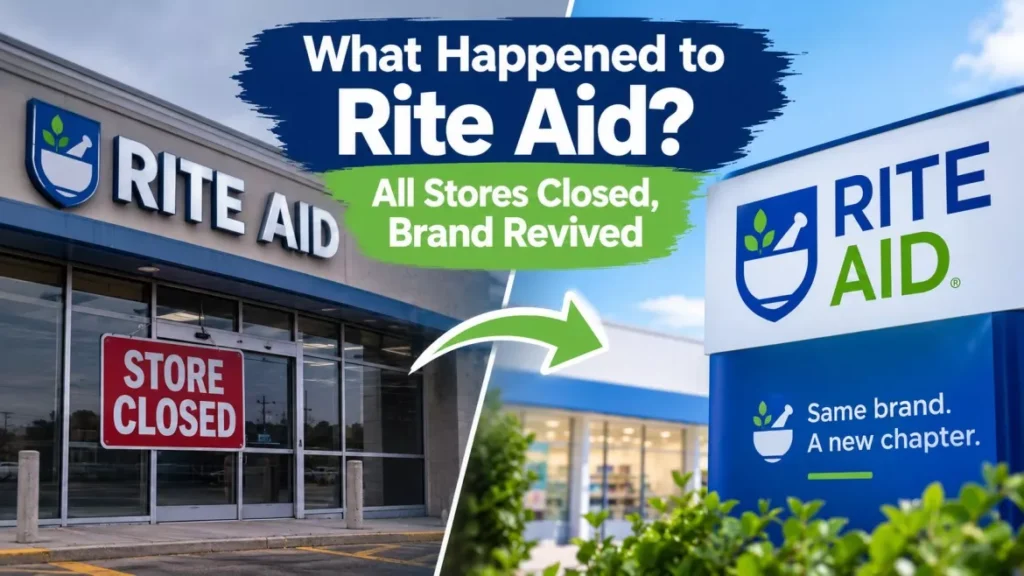

Rite Aid closed every one of its stores in early October 2025, 63 years after it opened in Scranton, Pennsylvania. A second Chapter 11 filing on 5 May 2025 ended in full liquidation, and prescription files went to CVS, Walgreens, Albertsons and Kroger. The brand name was then sold separately.
When Did the Last Rite Aid Stores Close?
The final stores shut in the first week of October 2025, and the company said so on its own website.
Its notice read: “All Rite Aid stores have now closed. We thank our loyal customers for their many years of support.” The chain had opened in 1962 as a single discount store called Thrift D Discount Center, founded by Alex Grass.
Customers were not left without a route to their records. The website stayed online purely so former patients could request prescription and immunisation histories or find another pharmacy, and files from more than 600 locations were transferred to CVS, the largest buyer.
Who Owns the Rite Aid Name Now?
A separate, otherwise unrelated company called Rite Aid LLC holds the trademark.
The sale was handled as a bankruptcy asset. Hilco Global was retained to market the chain’s consumer intellectual property, with bids due by 31 October 2025, and a December 2025 court filing proposed selling the intangible assets for $7.8 million to an entity listed as Rite Aid LLC, also known as PMDLabs Inc. The package covered trademarks, domain names, mobile apps, rights to certain social media accounts and some loyalty data. Prescription files were never part of it.
Two similarly named entities now cause confusion. Rite Aid LLC, which runs the website, is not New Rite Aid LLC, the vehicle the former owners created during the bankruptcy process.
What Does Rite Aid Sell in 2026?
Blood tests, not medicines.
The website returned in 2026 as a direct-to-consumer lab testing service. According to an Erie Times-News report published on 1 April 2026, the offer is two blood screenings a year for $349, health insurance does not cover it, and a company spokesman described the service as monitoring health markers over time rather than diagnosing illness after symptoms appear. That report named Quest and Private MD Labs as the companies handling the draws and the testing.
As of 16 October 2026, riteaid.com sells individual lab panels covering hormones, vitamin D and inflammation markers, alongside a membership that advertises screening for more than 1,200 health conditions up to twice a year. The site describes Private MD Labs as the laboratory partner that powers Rite Aid’s blood testing service. Nothing on it dispenses medication.
The pattern is familiar enough in retail collapses. A dead chain’s name is often worth more than its shops, as happened when Francesca’s stores closed and its name was sold on.
Will Rite Aid Pharmacies Reopen?
There is no announced plan for physical pharmacies, and no date for online prescriptions.
The company said in April 2026 that it had no plans to open physical pharmacies and was not offering online prescription services for the time being, adding only that prescription services were coming and that it would announce when they were ready. More than six months later the site still lists pharmacy services as coming soon, with no timetable attached.
Anyone waiting for a Rite Aid counter to reopen should treat that as indefinite. The stores, leases and pharmacy licences were liquidated in 2025 and sold to competitors.
Why Did Rite Aid Collapse?
Debt it took on to grow, followed by opioid litigation it could not settle cheaply.
The chain peaked in 2008 with 5,059 stores and about 112,800 employees, swollen by the 2007 purchase of 1,854 Brooks and Eckerd drugstores from the Jean Coutu Group, a deal it struggled to integrate. A 2015 agreement to sell itself to Walgreens was blocked by regulators, and Rite Aid ended up selling roughly 2,000 stores to Walgreens instead to pay down borrowings.
Litigation finished the job. The company faced more than 1,000 opioid-related lawsuits, including a US Justice Department complaint accusing it of filling unlawful prescriptions for drugs such as oxycodone and fentanyl, while executives also blamed rising theft and competition from larger rivals and online sellers.
It filed for Chapter 11 in October 2023 with roughly $4 billion of debt, emerged as a privately held company in September 2024, then filed again on 5 May 2025 with more than $2.5 billion in liabilities. The second filing was a wind-down from the start.
What Else Was Sold Off?
The most valuable leftovers were the pharmacy files and the ice cream.
- Prescription files: bought by CVS, Walgreens, Albertsons, Kroger and Giant Eagle, with CVS taking files from more than 600 locations.
- Thrifty Ice Cream: sold to Hilrod Holdings, controlled by Monster Beverage’s Hilton Schlosberg and Rodney Sacks, for $19.2 million, approved by the New Jersey bankruptcy court on 1 July 2025.
- Consumer brands and the domain: private label names and riteaid.com went with the intellectual property package in the December 2025 sale.
Thrifty, a Southern California soda-fountain brand Rite Aid had owned for decades, therefore outlived the pharmacy that sold it. The name, the recipes and the scoop shops changed hands intact, in much the way the Tupperware brand survived its own bankruptcy and reappeared under new owners.
Frequently Asked Questions
Are Any Rite Aid Stores Still Open?
No. Every location closed by early October 2025, and the retail business was liquidated rather than restructured.
Is Rite Aid Still a Pharmacy?
No. The business operating under the name sells laboratory blood tests and dispenses no medication.
How Do I Get My Old Rite Aid Prescription Records?
Through the pharmacy that bought them, most often CVS, Walgreens, Albertsons, Kroger or Giant Eagle depending on the state.
Did Anyone Buy Rite Aid as a Company?
No buyer took on the chain itself. Its assets were split up, with the trademark and domain going to an unrelated company that kept the name.
What Happened to Thrifty Ice Cream?
It was sold for $19.2 million to Hilrod Holdings in a sale approved on 1 July 2025 and was not wound down with the stores.