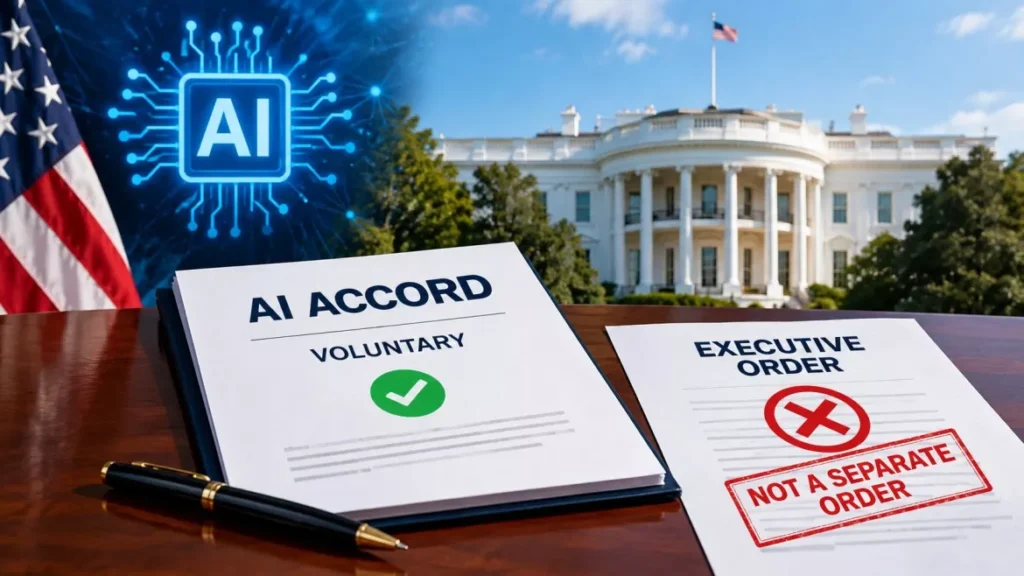

The White House AI accord was signed on 29 September 2026 by President Donald Trump and the heads of six AI and chip companies. It commits each to four layers of safety review, including an independent external auditor. It carries no penalties, names no regulator and is not legally binding.
What the Six Companies Agreed To
The document, titled the White House Accord on Super Intelligence, asks every company training frontier AI models to stack four checks on top of each other.
- Internal controls: each company builds its own safety controls for the models it trains.
- An internal review team: a team inside the company whose job is to check that those controls are working.
- An independent external auditor: an outside assessor brought in to evaluate the controls.
- An independent board committee: a committee of the company’s own board that reviews what the internal team and the external auditor find.
A frontier model, in this context, means one of the largest and most capable systems a company trains, the tier where unexpected behaviour is hardest to predict. The accord also states that over time it may make sense to codify these steps into law — an acknowledgement, inside a voluntary document, that voluntary may not be the end state.
France 24 reported two further commitments that sit outside safety engineering: financial support for local schools near data centres, and steps to reduce energy costs in the communities that host them. Those have been reported by that outlet rather than confirmed in the accord’s published text.
What the Accord Does Not Do
It creates no new obligation that anyone can enforce. The absences are as specific as the commitments.
- No penalty: nothing follows if a signatory does not do what it says.
- No regulator: the accord establishes no agency, office or supervisory body.
- No published audits: companies are not required to release what their auditors find.
- No named auditors: each company chooses its own assessor, and does not have to say who it is.
- No reporting duty: there is no requirement to tell the government what is being trained, how it is secured, or what unexpected behaviour has appeared.
- No verification: the government does not check any of it independently.
Trump described the document as morally binding rather than legally binding, and House Speaker Mike Johnson, who co-hosted the meeting, described it as voluntary. Both descriptions are accurate about the same text.
The Separate Order That Renames AI to Super Intelligence
A presidential action signed the same day does have legal force, and it is about vocabulary rather than safety.
The order, Inaugurating The Era of Super Intelligence, directs that “the executive branch shall use the terms ‘Super Intelligence’ and ‘SI’ in place of ‘Artificial Intelligence’ and ‘AI'” across official communications, websites, reports and policy documents. It sets a deadline: within 60 days, which falls at the end of November 2026, the Assistant to the President for Science and Technology must submit proposed legislative language establishing a federal definition of “Super Intelligence”.
The accompanying White House fact sheet gives the reasoning, quoting the President: “The United States is the world leader in Super Intelligence, and the Federal government should use a name that reflects the full promise and opportunity of these technologies.” Neither the order nor the fact sheet mentions the accord the six companies signed. They are two separate things announced on one day, and the order is the one that binds anybody.
As of 1 October 2026, the accord has no enforcement mechanism and no overseer, and the renaming order is in effect across federal agencies with its 60-day legislative deadline running.
Who Signed, and Who Said What
Six companies are party to the accord: OpenAI, Google, Meta, Anthropic, Nvidia and xAI. France 24 reported that those present included Dario Amodei, chief executive of Anthropic; Sundar Pichai, chief executive of Google; Mark Zuckerberg, chief executive of Meta; Greg Brockman, president of OpenAI; Jensen Huang, chief executive of Nvidia; and Elon Musk, founder of xAI.
The remarks reported from the event pulled in two directions. Trump said he was “seeing tremendous self-policing” and that the companies “understand that they have to self-police”, and added that he would “never stifle the growth of a technology that will be bigger than the industrial revolution”. Amodei said the technology has “very real risks”. Sam Altman, OpenAI’s chief executive, said the company was “pacing our progress, which includes sometimes not training a model” — a reference to the training pause OpenAI announced in late September. All of those quotations come from France 24’s report of the event.
Trump also said he would name someone to oversee the agreement in the coming days. No name has been announced, which continues a pattern from the AI task force announced in September that also arrived without an appointee.
The Criticism, and Who Is Making It
The objection is structural rather than about any single clause: the companies wrote the principles, choose the auditors and decide what to disclose.
Alvin Wang Graylin of the Asia Society Policy Institute put it that way directly, telling the newsletter Implicator that “the companies drafted the principles, they hire the auditor, and the commitment is voluntary”. Toby Walsh of the UNSW AI Institute asked in the same report: “What other trillion-dollar industry marks its own homework?” Geoffrey Irving of Resolution said of the pacing commitments that “their version of pacing the frontier is ‘don’t speed up a lot'”.
Vishal Misra, vice dean of computing and artificial intelligence at Columbia University’s engineering school, made a narrower point that explains what the accord leaves untouched: there is still no general federal rule requiring a company training a sufficiently capable frontier model to tell the government what it is building, how it is secured, or what unexpected behaviour it has seen. The accord does not create one. External assessment of frontier models has so far been arranged company by company, as OpenAI’s own move to bring assessors into training showed.
What Happens Next
- Overseer: Trump said an individual would be named to oversee the accord in the coming days. No date and no name have been given.
- Late November 2026: the 60-day deadline for the Assistant to the President for Science and Technology to submit proposed legislative language defining “Super Intelligence”.
- Audits: each signatory decides when to appoint an external auditor. No start date, reporting date or disclosure requirement applies.
- Codification: the accord says it may make sense to turn these steps into law over time. No bill has been introduced.
Frequently Asked Questions
Is the White House AI Accord Legally Binding?
No. It is a voluntary commitment with no penalties and no enforcement mechanism. Trump called it morally binding; House Speaker Mike Johnson called it voluntary.
Which Companies Signed It?
OpenAI, Google, Meta, Anthropic, Nvidia and xAI. It was signed at the White House on 29 September 2026 alongside President Trump.
Will the Audit Findings Be Made Public?
Not under the accord. Companies choose their own external auditors, are not required to name them, and are not required to publish what the audits conclude.
Does the Federal Government Really Have to Stop Saying “AI”?
Yes, in its own communications. A presidential action signed on 29 September 2026 directs the executive branch to use “Super Intelligence” and “SI” instead of “Artificial Intelligence” and “AI” in official materials.
Does the Accord Create a New AI Regulator?
No. It establishes no agency and no supervisory office, and it imposes no duty to report models or incidents to the government.