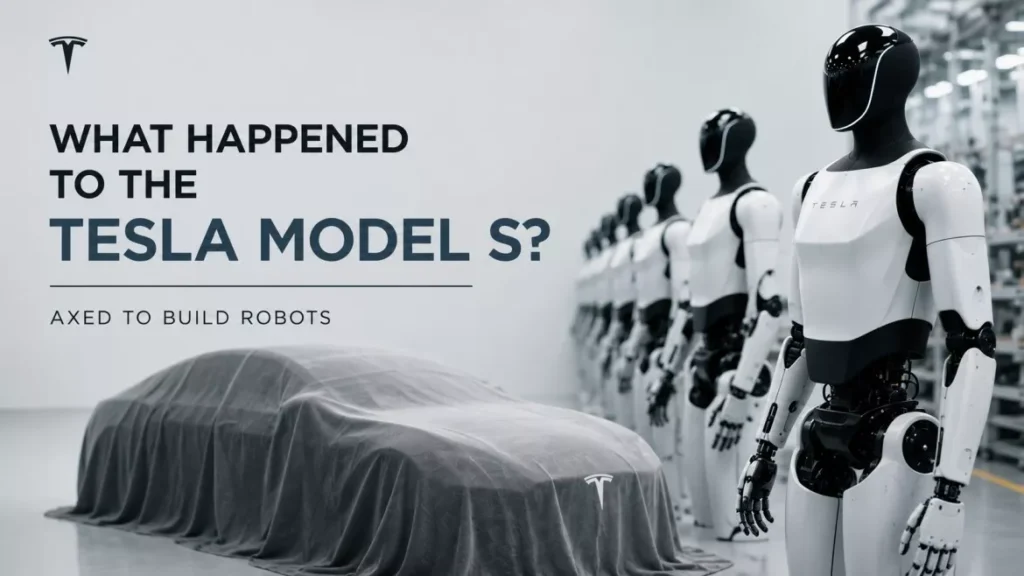

The Tesla Model S and Model X are discontinued. Elon Musk announced the decision on 28 January 2026, custom orders closed on 1 April, and the last cars were built at Fremont in early May after production runs of 14 and 11 years. Their factory lines now build Optimus robots.
Can You Still Buy a New Tesla Model S or Model X?
No. Tesla stopped taking custom orders for both cars on 1 April 2026, and the factory has not built one since May.
When orders closed, Tesla had roughly 600 finished cars left worldwide: about 295 Model S and 301 Model X units, nearly all of them sitting in United States inventory. Those were sold as remaining stock, not built to order. Anything advertised as a new Model S or Model X after that point is either leftover inventory or a used car.
The practical answer for a shopper in September 2026 is that the Model S and Model X are now used-car purchases.
Why Did Tesla Discontinue the Model S and Model X?
Three reasons converged: the underlying engineering was too old to keep certifying, Tesla needed the factory for robots, and the cars had stopped selling in meaningful numbers.
Tesla’s own executives explained the first two in unusual detail. Lars Moravy, the company’s vice president of engineering, and chief designer Franz von Holzhausen discussed the decision on the Ride the Lightning podcast in an episode reported in late May 2026.
A Car Designed in 2008 Ran Out of Road
The Model S architecture was drawn up in 2008 and launched in 2012. Crash-safety standards from bodies such as Euro NCAP and the Insurance Institute for Highway Safety have tightened steadily since.
Moravy said keeping the ageing platform at a five-star safety rating had become increasingly difficult. Bringing it fully in line with future protocols would have required what he described as a hundreds-of-millions-of-dollars overhaul of a car already selling in small numbers.
Optimus Needed a Factory, and Fremont Was Free
While engineers were costing that redesign, Tesla was hunting for manufacturing space to start building its Optimus humanoid robot. The Model S and Model X lines at Fremont were a large, underused footprint.
Moravy called the timing serendipitous and said the two things went hand in hand. Rather than spend heavily to modernise a low-volume car line, Tesla handed the space to Optimus, a programme Musk has said he eventually wants running at a million units a year.
The Sales Case Had Already Collapsed
By their final years the two cars were a rounding error in Tesla’s business, accounting for a low single-digit share of the company’s deliveries while the Model Y and Model 3 carried the volume.
Electrek estimated that around 30,000 Model S and Model X units sold in 2025 against a Fremont line capable of roughly 100,000 a year. A factory running at under a third of capacity is an expensive thing to defend.
How the Shutdown Unfolded, Step by Step
The wind-down took about four months from announcement to final car.
| Date | Event |
|---|---|
| June 2012 | Model S deliveries begin |
| September 2015 | Model X deliveries begin |
| 28 January 2026 | Musk announces the end of both programmes on the Q4 2025 earnings call |
| 1 April 2026 | Custom orders close; about 600 cars remain in global inventory |
| Early May 2026 | The final Model S and Model X are built at Fremont |
| 12 May 2026 | The Signature Edition delivery event is postponed |
| Mid-2026 onward | Fremont lines are repurposed for Optimus production |
What the Model S and Model X Meant
The Model S is the car that made Tesla a real carmaker rather than a niche experiment. Launched in 2012 as the company’s first ground-up design, it proved a long-range electric saloon could compete with established luxury brands and generated the scale Tesla needed to attempt the mass-market Model 3.
Several conventions that EV owners now take for granted arrived with it: over-the-air software updates that improve a car after purchase, the Supercharger network, and the front boot that the company nicknamed the frunk. In its Plaid form the Model S also became one of the fastest production saloons ever sold, with more than 1,000 horsepower.
The Model X mattered for a different reason. Arriving in 2015 as a three-row crossover sharing a substantial share of its components with the Model S, it was the first widely available electric SUV, in the body style that now dominates the global EV market. Its falcon-wing rear doors were the most talked-about feature and the most criticised, a recurring source of complaints about reliability and cost.
Lifetime sales figures are reported inconsistently, with published accounts putting the combined total somewhere between about 610,000 and 750,000 cars across both models. Either way, these were high-volume vehicles by luxury standards, which is part of why their discontinuation is a business decision rather than a collector’s event.
What Changes for People Who Already Own One?
Very little in the near term. Musk said Tesla will continue to support the Model S and Model X programmes for as long as people own the vehicles, covering service, parts and software updates.
Warranty terms are unaffected by the discontinuation. The basic vehicle warranty remains four years or 50,000 miles, whichever comes first, and the battery and drive unit warranty remains eight years or 150,000 miles.
Software and charging are the two areas owners ask about most. Tesla has a long record of continuing to ship over-the-air updates to older cars years after a model changes, and Supercharger access is unaffected by the decision, since the network serves existing vehicles regardless of whether their model is still in production.
The honest caveat is that support for a discontinued, low-volume model tends to get harder as the years pass. Parts for a car built in the hundreds of thousands are easier to source than parts for one Tesla no longer makes. Owners should expect normal service now and more friction a decade out.
The Signature Edition: 350 Farewell Cars
Tesla marked the end with a limited Signature Edition: 250 Model S and 100 Model X units, 350 cars in total, finished in garnet red with gold accents and priced at $159,420 each.
The send-off did not go entirely to plan. A delivery event scheduled at Fremont for 12 May 2026 was postponed, with buyers told only that it had been put back. The genuine last car off the line, a black Model S, was signed by the production staff who built it.
What Should a Model S or Model X Shopper Buy Instead?
Within Tesla’s own range, there is no direct replacement. The lineup as of September 2026 is the Model 3, the Model Y and the Cybertruck.
- Model 3 is the closest thing to the Model S in shape: a saloon, though a smaller and cheaper one.
- Model Y is the practical substitute for the Model X. A three-row Model Y L variant arrived in July 2026 and partly covers the seven-seat use case, without the falcon-wing doors.
- Cybertruck was restructured in February 2026 into three trims: a base all-wheel-drive model, a Premium all-wheel-drive model, and the tri-motor Cyberbeast.
Buyers who specifically want a large electric saloon or a full-size electric SUV now have to look outside Tesla. Nothing in the current range replaces the Model S on size or the Model X on interior space.
The remaining route to either car is the used market, which is now the only place a Model S or Model X can be bought at all. Supply there is substantial, given how many were built across the two runs, so buyers are not facing scarcity so much as a fixed and slowly ageing pool.
Will Used Model S and Model X Prices Go Up?
Probably not by much. Discontinuation rarely turns an ordinary production car into an appreciating asset, and the Model S and Model X were built in large numbers over long runs.
An analysis by the used-EV marketplace Find My Electric, updated in July 2026, concluded that a dramatic and sustained price jump is unlikely for most examples, while noting that clean, well-optioned late cars may hold value better than expected. Final-year 2025 and 2026 builds were reported to be commanding some premium.
The 350 Signature Edition cars are the plausible exception. Low production numbers, a distinctive finish and a clear end-of-line story are the conditions collectors usually respond to. That is a reasonable expectation rather than a documented outcome, and no verified resale data for those cars exists yet.
Is Tesla Building a Replacement Flagship?
Tesla has announced no replacement for either car. As of 2 September 2026, no successor sedan or full-size SUV has been confirmed, and the company’s stated priorities are autonomy, the robotaxi programme and Optimus rather than a new luxury model.
Musk framed the shutdown as a deliberate change of business rather than a gap to be filled, describing Tesla as moving into a future based on autonomy. Moravy’s team made the related point that the Model S and Model X, as the oldest designs in the range, were the least suited to a driverless world.
The scale of the pivot is visible in Tesla’s spending. The company committed to about $20 billion of capital expenditure in 2026, directed at autonomy and robotics rather than at new passenger models.
Speculation about a future flagship or a larger Cybertruck-derived SUV circulates among Tesla watchers, but nothing has been confirmed by the company.
Frequently Asked Questions
Is the Tesla Model S Discontinued?
Yes. Tesla ended Model S production at its Fremont factory in early May 2026 after a 14-year run. Custom orders had already closed on 1 April 2026.
Why Did Tesla Stop Making the Model S and Model X?
The 2008-era platform had become expensive to keep certified against tightening crash-safety standards, sales had fallen to a low single-digit share of Tesla deliveries, and the company wanted the Fremont floor space to manufacture its Optimus humanoid robot.
What Is Being Built at the Old Model S Factory Lines?
Optimus, Tesla’s humanoid robot. Musk announced the conversion on the Q4 2025 earnings call on 28 January 2026 and has spoken of an eventual output target of a million units a year.
Will Tesla Still Service My Model S or Model X?
Yes. Musk said Tesla will support both models for as long as owners keep the cars, including parts, service and software updates. Existing warranties are unchanged at four years or 50,000 miles for the vehicle and eight years or 150,000 miles for the battery and drive unit.
How Many Model S and Model X Cars Were Left When Orders Closed?
About 600 worldwide on 1 April 2026, made up of roughly 295 Model S and 301 Model X units, almost all in the United States.
Is Tesla Releasing a New Flagship Car?
No replacement has been announced. As of 2 September 2026, Tesla’s lineup is the Model 3, Model Y and Cybertruck, and the company has pointed to autonomy and robotics rather than a new luxury vehicle.